Will a Trump-Kim Summit Redefine the Peninsula’s Geopolitics?

⏱️ 6 Mins Read
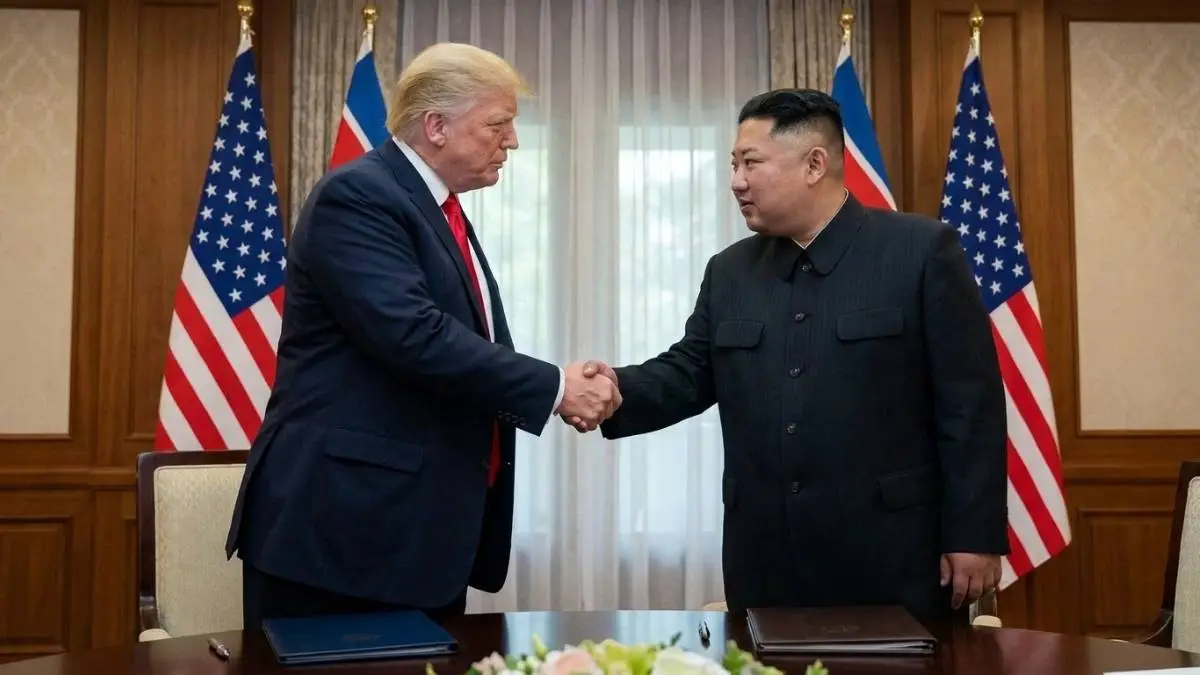
An anticipated meeting between US President Donald Trump and North Korean leader Kim Jong Un, potentially scheduled on the sidelines of the upcoming APEC summit (November 18–19), could spark significant anxiety and shift dynamics in South and North Korea relations.
Trump recently said that he ‘may’ meet Kim during his upcoming trip to Asia for the APEC summit in Shenzhen, China. However, North Korea is not an APEC member, and Pyongyang has not announced any formal summit preparations or confirmations, leaving the meeting uncertain.
The official schedule for Trump November 2026 trip shows that he will visit Southeast Asia first, concluding his regional tour with the APEC summit in China. Rumors in diplomatic circles are that if a one-on-one meeting actually materializes, it would likely happen right after the APEC summit, potentially involving a quick flight to Pyongyang.
📌 Executive Brief
- Military Escalation: North Korea has conducted over 180 tests in five years, focusing on AI-guided torpedoes and hypersonic missiles to neutralize US strategic assets.
- Diplomatic Uncertainty: President Trump’s potential meeting with Kim Jong remains conditional amid recent border friction and mutual accusations regarding hypersonic test failures.
- Strategic Stakes: With 28,500 US troops stationed in the region, any diplomatic breakthrough must address the immediate threat posed by new super-speed weaponry.
- Technological Arms Race: Integrating artificial intelligence into North Korean weapons systems marks a new phase in the peninsula’s security dilemma.
The prospect of Kim Jong Trump summit is said to be important for regional stability; while diplomatic channels remain open, the gap between political rhetoric and kinetic capability continues to widen.
While a one-on-one dialogue might temporarily de-escalate military posturing, it threatens to alter the Korean Peninsula’s fundamental security architecture. As Washington explores transactional diplomacy, Seoul must navigate the precarious balance of maintaining its US alliance while guarding against strategic marginalization.
The Impact on the Korean Peninsula
The prospect of a renewed summit creates a complex web of risks and opportunities for both nations, fundamentally shifting South Korea North Korea relations.
South Korea’s Strategic Anxiety: For Seoul, the immediate concern is preserving the US-South Korea alliance. Trump’s past willingness to unilaterally scale back joint military exercises, labeling them as costly and ‘hostile’ to Pyongyang, has raised deep concerns regarding military readiness.
South Korean leaders fear that direct, bilateral deals between Washington and Pyongyang could bypass Seoul’s sovereign interests. If Trump accepts North Korea’s nuclear status or trades reduced pressure for minor concessions, the balance of power between South Korea North Korea will be permanently destabilized. Furthermore, recent US approvals for South Korea to pursue nuclear-powered submarines have already drawn sharp warnings from Pyongyang, setting a volatile backdrop for any summit.
North Korea’s Diplomatic Leverage: Conversely, this Kim-Trump meeting (if it happens) will offer Pyongyang profound diplomatic leverage. Engaging directly with the US President validates its nuclear posture and weakens unified Western pressure. However, North Korean officials have responded to summit speculation with conditional engagement. Kim Jong Un and his inner circle demand the end of joint drills and concrete security guarantees before committing.
Meanwhile, Pyongyang balances potential US outreach by deepening its strategic ties with Moscow and Beijing, using the prospect of US North Korea relationships as leverage rather than a signal that it is abandoning its hardened military stance.
What Are the Stakes for Washington and Pyongyang?
An anticipated summit will offer highly distinct strategic incentives for both leaders, reshaping North Korea and American relations.
Strategic Benefits for Kim Jong Un
• De Facto Nuclear Validation: A meeting where complete denuclearization is no longer the non-negotiable priority serves to legitimize North Korea as a permanent nuclear weapons state.
• Sanctions Relief: Securing a partial or full lifting of economic sanctions would allow North Korea to revitalize its economy without dismantling its core defense programs.
• Geopolitical Maneuvering: By renewing high-profile contact regarding Kim Jong Un and US diplomacy, Pyongyang ensures it does not become overly dependent on Beijing or Moscow.
Strategic Benefits for Donald Trump
• High-Profile Foreign Policy Legacy: A successful summit would validate Trump’s art of the deal approach to transactional diplomacy.
• US Homeland Security: Trump could secure a “quasi-arms control” freeze, capping North Korea’s intercontinental ballistic missile (ICBM) development and removing the direct nuclear threat to the U.S. mainland.
• Disruption of Rival Blocs: A breakthrough with Pyongyang could serve as a tactical move to disrupt China’s regional dominance and chip away at the growing military alignment between North Korea and Russia.
Ultimately, while Trump gains immediate political currency and homeland security wins through a Kim Jong Trump meeting, Kim secures the ultimate survival package: international legitimacy, economic breathing room, and a permanent nuclear deterrent.
| Event | Detail | Strategic Implication |
| U.S. Troop Presence | 28,500 troops stationed on the Korean Peninsula | Serves as the primary deterrent but also a primary target for North Korean missile development. |
| Test Frequency | 180+ rounds of tests over the past five years | Indicates a sustained, high-intensity pace of weapons development rather than sporadic displays. |
| Missile Speed | >5x the speed of sound (Hypersonic) | Renders traditional air defense systems less effective, necessitating new countermeasures. |
| Weapon System | Zam-2.0 torpedo & AI-guided systems | Demonstrates a shift toward autonomous, precision-guided underwater threats to naval assets. |
| Diplomatic Status | 4th potential U.S.-North Korea summit | Suggests a history of engagement, but current friction threatens the viability of this next meeting. |
The Threat of Korea Passing and Alliance Friction
If a bilateral deal occurs, South Korea stands to lose significantly. A primary fear is losing the US security umbrella. If Trump permanently suspends military drills or draws down the 28,500 US troops stationed on the peninsula, South Korea’s combat readiness would degrade immediately.
Moreover, if Washington shifts its goal from denuclearization to merely freezing ICBMs that threaten the US, Seoul would be left permanently exposed to North Korea’s shorter-range tactical nuclear arsenal.
Taiwan’s parallel vulnerability, where US security guarantees are equally subject to transactional bargaining, compounds regional security uncertainty into a single interconnected risk.
This could shatter confidence in US extended deterrence, forcing South Korea to consider building its own independent nuclear weapons. Finally, Seoul faces severe geopolitical sidelining, often termed Korea Passing, if decisions dictating its sovereign future are made without its input.
China’s Strategic Calculation
China may view these developments with a mix of opportunism and caution, intending to maintain its role as the primary gatekeeper of East Asian geopolitics, which directly influences the trajectory of South Korea-China relations.
Reasserting Dominance: If the summit occurs, China will center itself as the ultimate power broker. Beijing’s move follows the same playbook it deployed when Wang Yi visited Seoul in 2026, using American unpredictability to position China as the stable regional alternative.
Facilitating the talks elevates President Xi Jinping as a global peacemaker and reminds the West that any permanent solution must pass through Beijing.
Approval of Regional De-escalation: China generally welcomes dialogue because it serves Beijing’s strategic goals. Trump’s willingness to reduce US military drills pushes American assets further from the Chinese mainland. Furthermore, a deal that freezes North Korea’s weapons program without causing a regime collapse aligns perfectly with the current China and South Korea relationship dynamic, keeping a communist buffer state intact.
Fear of Being Sidelined: Despite supporting dialogue, Beijing harbors anxiety about China Passing. A nightmare scenario for China involves North Korea pivoting its allegiance toward Washington for massive economic windfalls, leaving China strategically isolated.
To prevent this, China continues to tighten its economic grip on Pyongyang, ensuring no major concessions are made without consultation. However, a recent shift is that Russia’s parallel backing of North Korea, providing military technology and cash in exchange for munitions, has given Kim Jong Un new leverage to avoid Beijing’s absolute control.
The Economic Counterbalance: The Korea Eximbank-IFC Agreement
While diplomatic tensions command headlines, South Korea is actively maneuvering to protect its long-term sovereignty. The recent agreement between the Korea Eximbank and the International Finance Corporation (IFC) serves as an indirect but critical geopolitical leverage point.
While the agreement contains no military mandates and does not directly ease defense frictions with Washington, it alters South Korea’s geopolitical positioning. By partnering with the IFC to secure critical mineral supply chains, South Korea reduces its heavy reliance on adversarial markets for materials vital to semiconductors, EV batteries, and AI.
This effectively shields South Korea’s relations with China from Beijing’s economic coercion.
In the grand theater of superpowers, securing global supply chains ensures that South Korea remains an irreplaceable economic titan. It sends a clear message to Washington: South Korea is not just a dependent security partner, but a global economic powerhouse co-managing the supply chains of the future, making the nation too valuable an ally to bypass.
Can Diplomatic Engagement Outpace the Hypersonic Arms Race?
The technical verification of North Korea’s latest capabilities is becoming a significant hurdle for any potential kim jong trump dialogue. Pyongyang’s state media has claimed that its new intermediate-range hypersonic missile can change its flight orbit at low altitude, leaving defenders with no way to avoid it. This assertion directly challenges the efficacy of current US defense architectures, which are designed to intercept ballistic trajectories rather than maneuverable, low-altitude hypersonic threats.
This technological leap is not occurring in a vacuum. It follows weeks of friction with Seoul, including a landmine explosion along the border, and is compounded by mutual denials regarding the success of recent hypersonic tests. North Korea cast doubt on Seoul’s hypersonic test, claiming it may have failed to achieve hypersonic flight, while South Korea rejected the claim.
These conflicting narratives suggest that before a Kim Jong Trump summit can yield tangible security guarantees, both sides must navigate a complex landscape of technical verification and strategic signaling. The stakes are high: with 28,500 US troops stationed on the Korean Peninsula, the US presence serves as both a primary deterrent and a primary target for North Korean missile development.
The High-Stakes Calculus of Engagement
The prospect of a fourth US-North Korea summit represents a high-risk, high-reward diplomatic maneuver. While President Trump has stated he “may” meet with Kim during his Asia tour, the window for de-escalation is narrowing as North Korea’s weapons systems evolve from ballistic threats to maneuverable, AI-guided hypersonic and underwater assets.
The AI integration into target detection, as confirmed by KCNA, suggests that future conflicts may involve autonomous decision-making in military hardware, a development that traditional arms control frameworks are ill-equipped to handle.
Ultimately, the success of this potential Kim Jong Trump summit will depend on whether both sides can bridge the gap between political ambition and technical verification. With 28,500 US troops on the peninsula and over 180 rounds of tests conducted in the last five years, the status quo is no longer sustainable.
If the summit fails to address the immediate threat posed by super-speed weaponry and the underlying economic fractures, the region risks entering a new phase of instability where diplomatic channels are rendered obsolete by the sheer velocity of technological escalation. The coming weeks will determine whether this Trump tour serves as a bridge to peace or a final warning before a more volatile security environment takes hold.
This peninsula calculus is one front in the broader great-power economic competition, where the US, China, and Russia are simultaneously using military positioning, economic architecture, and diplomatic maneuvering to reshape the regional order.
Read more analysis in our Great Power Economics section.