The Taiwan US Trade Deal: Why Taipei’s $500B Investment is a Trap

⏱️ 4 Mins Read
Taiwan, which controls 90% of advanced chip manufacturing, produces the silicon required for every iPhone, NVIDIA GPU, data center, and modern automobile. Yet, despite holding the ultimate geopolitical trump card, Taipei has trapped itself. By attempting to buy security through massive capital outflows in the recent Taiwan US trade deal, the island’s security guarantee has been reduced to a mere negotiating chip with Beijing.
This is not a geopolitical abstraction; it is a live supply-chain risk event with a verified price tag of $10.6 trillion in first-year global economic losses. Taiwan is the single point of failure for the global technology economy. By complying with Washington’s ultimatums, Taipei has walked into a tightening trap that every serious investor and risk manager must understand before the market fully prices it in. This is the highest-stakes front in the great-power economic competition between the US and China, where the prize is not territory but control of the technology that runs the global economy.
This is a live supply chain risk event carrying a verified price tag of $10.6 trillion in first-year global economic losses. Taiwan is the single point of failure for the global technology economy. By complying with Washington’s ultimatums, Taipei has walked into a tightening trap that every serious investor and risk manager must understand before the market fully prices it in.
Executive Summary: The Data Behind the Trap
Before analyzing the geopolitical miscalculation, the raw macroeconomic data defines the scale of Taiwan’s vulnerability:
- 92% Global Share: Taiwan’s TSMC produces 92% of the world’s most advanced semiconductors (7nm and below).
- $500 Billion US Investment: Under the January 2026 agreement, Taiwan committed $250 billion in direct capital investment and $250 billion in government credit guarantees to the US.
- $165 Billion Arizona Fabs: TSMC’s committed investment for six fabs, two packaging facilities, and an R&D center in Arizona represents the largest foreign direct investment in US history.
- $14 Billion Frozen Arms Package: A critical US arms package for Taiwan remains on hold following the May 2026 Trump-Xi summit.
The role of Taiwan in the global AI chip supply chain
The January 2026 agreement fundamentally altered the island’s economic trajectory. When US Commerce Secretary Howard Lutnick publicly threatened a 100% tariff on Taiwanese chip companies lacking a US presence, it was not an invitation; it was an ultimatum to relocate strategically valuable assets away from Taipei.
Taiwan has committed a staggering $500 billion investment. To understand the severity of this capital extraction, consider how Taiwan’s financial exposure compares to other US allies in the region:
| Country | Investment Impact on GDP | Impact on FX Reserves | Coercion Level |
| Taiwan | 55% | 83% | Severe (Ultimatum) |
| South Korea | 19% | N/A | Moderate |
| Japan | 13% | N/A | Low |
The Business Consequence: Taiwan’s capital is bleeding at an unsustainable pace, as $250 billion in direct investment over a decade implies annual outflows of $25 billion. Nearly double Taiwan’s peak outward direct investment to the US in 2024. This structural reallocation of capital will compress domestic investment capacity, trigger depreciation of the New Taiwan dollar, and harm demand-driven industries.
The semiconductor dependency: These numbers reveal that this is not new. Still, the Trump-Xi summit made it impossible to ignore, making Taiwan’s chip dominance from a business advantage into a negotiating liability.
The Dismantling of the ‘Silicon Shield’
Taiwan’s ‘Silicon Shield’, the premise that invading the island would destroy the very semiconductor supply chains the aggressor relies upon, has been its ultimate deterrent. However, the US strategy to onshore 40% of Taiwan’s supply chain actively dismantles this shield while offering a false sense of security.
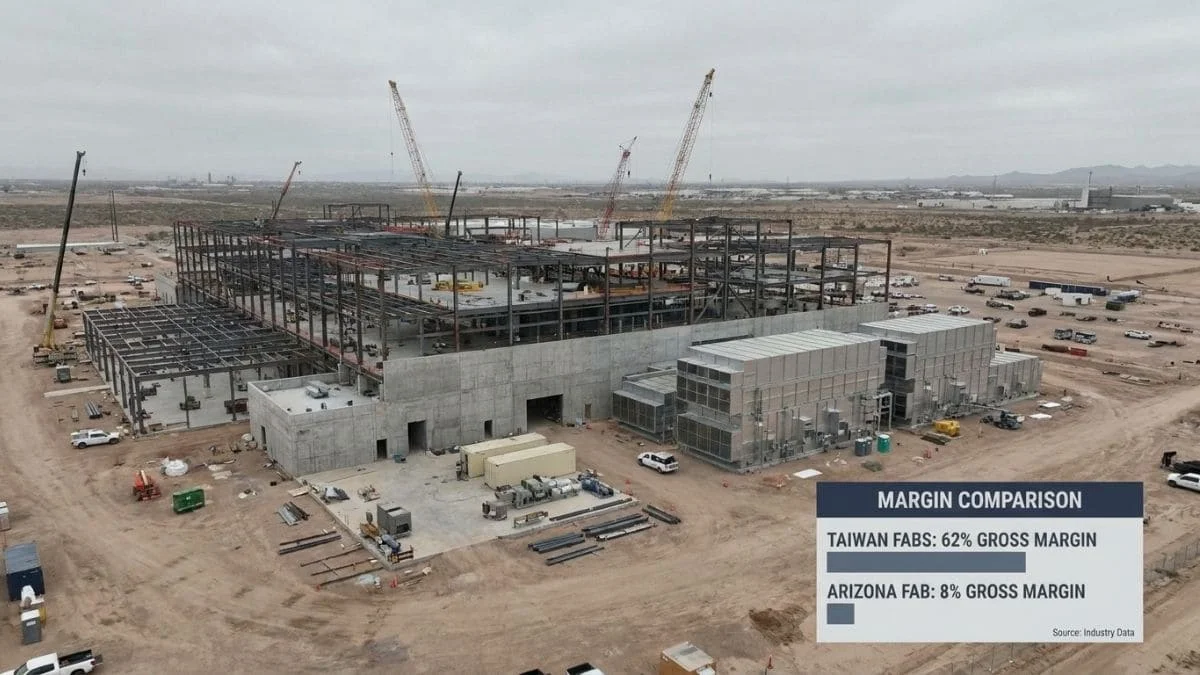
For institutional risk managers actively mapping a semiconductor supply chain Taiwan contingency 2026, the reality of US-based production is grim. According to recent supply chain data from Semianalysis, the much-touted Arizona fab cannot globally compete.
The TSMC Arizona facility faces production costs that are 2.4 times higher than those in Taiwan, resulting in a mere 8% gross margin per wafer, compared to the massive 62% margin at TSMC’s domestic fabs.
This financial discrepancy confirms that evaluating the TSMC Arizona overseas fab conflict risk in 2026 is not just about geopolitics but also about hard economics.
The Arizona facility does not significantly de-risk the concentration in Taiwan; it merely leases the technology while the absolute cutting edge remains an ocean away. If Taipei’s fabs go offline today, it would create at least a five-year gap in global AI chip supply, triggering a catastrophic Taiwan shortage across all technology sectors that no American fab can immediately replace.
However, every unprofitable TSMC fab that opens in Arizona makes Taiwan slightly less irreplaceable in Washington’s eyes, while also failing to secure the global supply chain. The less indispensable Taiwan becomes, the weaker the economic deterrent against Chinese aggression.
The Taiwan US trade deal as the Ultimate Bargaining Chip
The structural danger of this investment peaked following the May 14-16, 2026 summit in Beijing. By describing Taiwan’s $14 billion arms package as “a very good negotiating chip,” President Trump effectively granted Beijing a functional veto over American defense commitments.
Taiwan made a fatal strategic error: it separated its economic concessions from its security demands. The $500 billion US investment commitment contains no binding security reciprocals, no milestone-linked arms approvals, and no conditionality. Taipei gave Washington its strongest economic leverage and got nothing in return on hard security.
Escalation Scenarios for Investors
The market incorrectly treats Taiwan as a binary risk (invasion vs. peace). In reality, investors face a spectrum of escalations fueled by Taiwan’s weakened leverage:
- Sustained Political Uncertainty: The current trajectory. Frozen arms deals and sustained use of Taiwan as leverage elevate risk premiums, driving capital outflow and currency pressure.
- Quarantine or Blockade (Near-Term Risk): A Chinese customs inspection regime could partially sever the Taiwan Strait, a corridor handling over $3 trillion in annual global trade, triggering immediate shortages in AI, auto, and PC supply chains without a single shot fired.
- Full Military Conflict: This scenario would paralyze every sector dependent on advanced manufacturing, triggering an estimated $10.6 trillion in global losses and destroying the very supply chains both superpowers rely on.
Does Taiwan Have a Way Out?
This is not an argument that conflict is inevitable. It argues that the risk of Taiwan’s self-inflicted trap is being systematically underpriced.
Taiwan still retains one critical trump card: legal restrictions ensure the most advanced sub-2nm process nodes remain exclusively on the island. Even with massive capacity moving to Arizona, the absolute cutting edge stays in Taiwan, keeping the global AI sector fundamentally dependent on its stability.
To survive the trap it built for itself, Taiwan must convert this remaining leverage into an explicit, conditional security architecture. Both economic investments and security deals can no longer be treated as separate conversations. Taipei must make every future foreign investment milestone directly contingent on security deliverables.
Seoul also faces a similar diplomatic situation, where America’s unpredictable approach toward North Korea pushes South Korea to take unconventional measures in the face of adversity.
Read more analysis in our Great Power Economics section.