Pakistan Economy: Why Macroeconomic Growth Hasn’t Fixed Daily Life

⏱️ 3 Mins Read
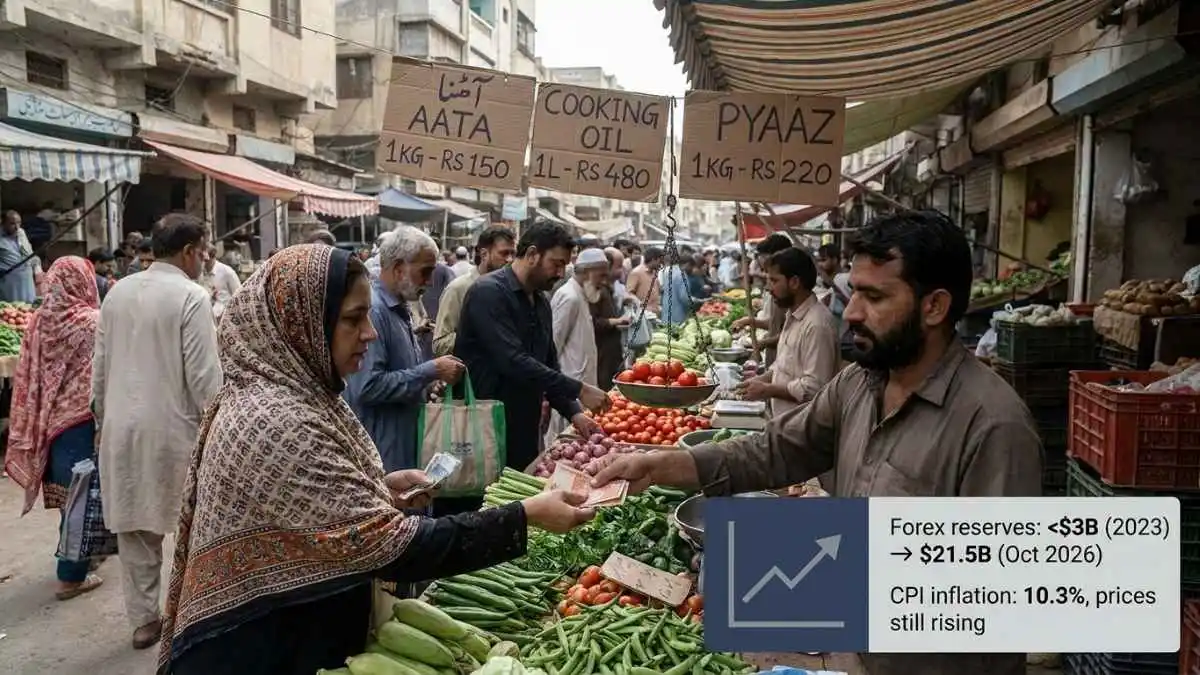
While Pakistan economy, according to the SBP Governor, has achieved historic stability with forex reserves surging to $21.5 billion, the average citizen faces a disconnect between macroeconomic headlines and daily purchasing power. In this article, we analyze why structural reforms have not yet translated into concrete improvements in living standards.
📌 Executive Brief
- The Illusion of Borrowed Reserves: Foreign reserves of $21.5 billion technically remove default risk, but they largely consist of IMF tranches and bilateral rollovers rather than export-earned capital, which cannot strengthen the structural base. However, the SBP Governor attributed this specific 2026 foreign reserves growth to the bank’s own foreign exchange market purchases and regulatory changes rather than massive new debt. Even so, Pakistan’s ability to fulfill financial obligations remains fragile.
- The Growth Gap: Real GDP growth of 3.7% in FY26 is a recovery from contraction, but it is still a demographic failure. For a population of over 257 million, growth below 4% cannot create enough jobs to prevent increasing unemployment and poverty.
- Inflation vs. Energy Tariffs: Consumer Price Index (CPI) inflation fell from 11.1% in August to 10.3% year-on-year (YoY) in September 2026, but the cost of living remains unbearable for middle- and low-income segments because of high indirect taxation and energy tariffs that needed to plug circular debt.
- The Austerity Cycle: Without deep tax-base expansion targeting untaxed elite sectors like real estate and retail sectors, Pakistan remains locked in a cycle of sovereign crises, IMF austerity, temporary stabilization, and eventual relapse.
Structured Data: Macro Indicators vs. Household Realities
| Metric | Historical Baseline (2023 Crisis) | Current Status (FY26/Oct 2026) | Projected FY27 |
| Forex Reserves | < $3.0 Billion | $21.5 Billion (Debt-driven) | Continued accumulation expected |
| GDP Growth | Contraction (FY23) | 3.7% (FY26) | 3.5% – 4.5% (SBP) / 3.7% (ADB) |
| Inflation (CPI) | > 30% (Crisis Peak) | 10.3% (FY26) | 8.3% (ADB) / 7.0% (Govt Target) |
| Current Account | High Deficit | Contained | 0 – 1% of GDP |
| Poverty Rate | Rising sharply | 39% – 43.5% | Dependent on BISP targeted relief |
Why Does a $21.5 Billion Forex Buffer Not Translate to Cheaper Groceries?
The headline numbers for the Pakistan economy look dramatically different from the panic of early 2023. Official foreign exchange reserves have recovered from less than US$3 billion to US$21.5 billion as of October 9, 2026. This massive buffer has mathematically eliminated the risk of immediate sovereign default, a fear that held the nation just three years ago. SBP Governor Jameel Ahmad recently told investors that sustained, prudent macroeconomic policies and structural reforms have strengthened Pakistan’s economic resilience.
However, for the average shopper, the math doesn’t add up, even though CPI inflation has dropped to 10.3%. Many citizens view this drop in inflation as a “gimmick” because absolute prices have not fallen; they are simply rising more slowly. Although the stabilization is real, portraying it as prosperity or an economic triumph is a political gimmick that ignores the fact that real wages for the middle class are still eroding.
Macro data also overlooks a demographic headwind, and for a developing country like Pakistan, whose population is expanding and crossing 257 million, growth below 4% is not enough to create livelihood opportunities for youth and lift millions out of poverty, which currently hovers between 39% and 43.5%.
How Do Structural Reforms Fail to Reach the Average Household?
The government argues that the current setup is a necessary holding pattern to fix decades of mismanagement. Parliament has prepared 174 distinct amendments to privatize loss-making State-Owned Enterprises (SOEs), liberalize protected sectors, and reform energy sector governance. Currently, SOEs like Pakistan Steel Mills drain billions from the national budget each year, diverting funds from social safety nets and infrastructure and leaving the household micro-economy starved.
However, the failure to collect direct taxes from industrialists and the elite has further widened the disconnect, forcing reliance on aggressive indirect taxes. The same structural failure that drives Pakistan’s tax dependency drives its remittance dependency. Both are symptoms of a state that has optimized for crisis management rather than structural transformation.
Even with targeted relief schemes, such as the Prime Minister’s Fuel Relief Scheme providing a Rs100 per liter discount for small vehicle or bike owners, the overall cost of living makes this relief null and void. The fuel relief scheme addresses the symptom, while the structural energy-pricing problem- “how Pakistan can sustainably reduce fuel costs within IMF parameters- remains unresolved.
The IMF Cycle: Stability or Stagnation?
Pakistan’s economic cycle shows a recurring long-term pattern of approaching the International Monetary Fund (IMF), and the current stabilization phase is only a partial return to where things used to be. Without deep structural reform, this IMF program will not be the last.
Pakistan’s recurring IMF dependency is the clearest example of the middle power trap, where a state organizes its institutions around managing dependency rather than eliminating the structural weakness that created it.
The IMF has publicly urged Pakistan to phase out the fuel relief scheme due to its cost. At the same time, the government defends it as a temporary, non-inflationary buffer funded by internal austerity, such as a 50% cut in fuel quotas for government officials.
Countries like South Korea and Vietnam turned rapid GDP growth into massive middle-class expansion through strategic investment in education and industrial policy. In the post-COVID period, Spain combined solid economic growth of around 3.5% with falling unemployment and tangible gains for lower-income workers through structural policy choices like minimum wage increases. In contrast, Pakistan’s 3.7% growth in FY26, while an improvement from 3.2% in FY25, has not yet been translated into similar tangible gains for the wider population.
The Road Ahead: Projections and Persistent Risks
The outlook for FY27 shows continued stabilization but persistent challenges. The SBP projects economic growth of 3.5 to 4.5 percent in FY27. However, the Asian Development Bank (ADB) projects average inflation to rise to 8.3 percent in FY27, above the SBP’s medium-term target range of 5 percent-7 percent.
Read more analysis in our Middle Power Trap section.