The Storage Schism: US, China, and the Zinc Bromine Battery

⏱️ 3 Mins Read
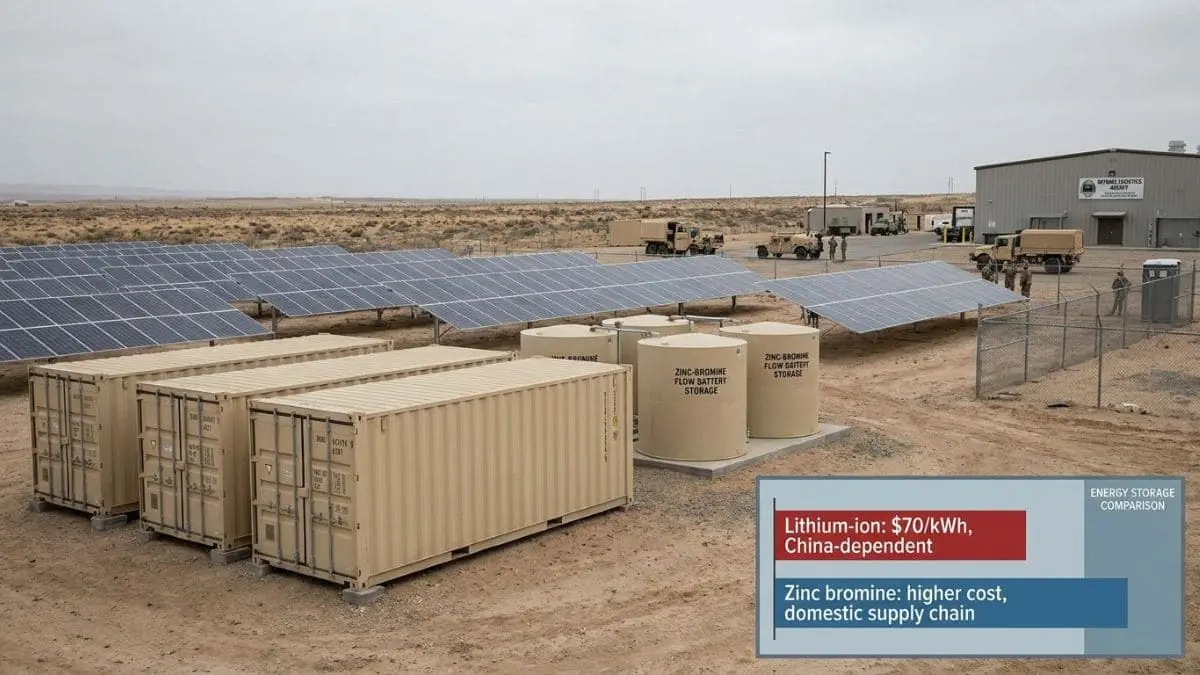
Despite lithium’s low-price availability and 95% round-trip efficiency, the US military and grid operators are preferably choosing an alternative technology, ‘the zinc bromine battery’ that is up to 25% less energy-efficient.
In 2025, lithium-ion battery prices fell by 45% to a record floor of just $70 per kilowatt-hour due to Chinese manufacturing overcapacity, creating a cutthroat mechanism that is eradicating alternative energy storage technologies.
But why are they accepting a system in which a quarter of stored electricity is lost as heat? The lithium-ion installations are thermal-runaway firebombs inextricably tethered to Chinese supply chains.
Furthermore, China controls the vast majority of processing capacity for lithium, cobalt, and graphite, making the global lithium-ion supply chain vulnerable for the West in a trade-war-like event or maritime blockade after any regional conflict.
The same Chinese infrastructure-control strategy that dominates battery supply chains is also embedded in Western solar grids through remotely accessible inverter technology.
Conversely, a zinc bromine flow battery is not only fireproof, but it also uses a water-based electrolyte and comes from geological reserves. The global market is no longer a free-market meritocracy; it is a proxy war between Chinese state-backed scale and US protectionist defense spending aimed at securing domestic infrastructure.
This energy-storage proxy war is one front in the broader great-power economic competition, where technology, supply chains, and infrastructure are being weaponized simultaneously.
What is the Difference between a Zinc Bromine Battery and a Zinc Bromine Flow Battery?
Both zinc bromine battery and zinc bromine flow battery depend on the exact same core chemical reaction between zinc and bromine, but have two distinct architectures.
The liquid electrolytes are pumped through a central cell stack after being stored in external tanks, separating power from energy capacity.
Conversely, a zinc-bromine static battery is a sealed, self-contained box with no pumps, utilizing advanced gels or specialized polymers to trap the corrosive bromine inside the cell so it does not leak or cause self-discharge.
Breaking the Chinese Monopoly
The Western world has a massive geographic advantage in the supply chain of zinc bromine flow battery over lithium-ion battery manufacturing, which depends almost entirely on Chinese refining. Both zinc and bromine are globally abundant, and the United States has ample domestic access.
China, despite being the world’s top producer of mined zinc, has not monopolized the market, as Australia, Peru, and the United States also have high-quality reserves.
While bromine sources are more geographically distributed than lithium, Israel and Jordan still account for roughly two-thirds of global production.
The bromine supply disruption from Israel and Jordan is not hypothetical. It is already affecting semiconductor-grade production across South Korean and Japanese fabs.
Arkansas sits on the Smackover Formation, yielding massive amounts of domestic bromine. Furthermore, the US imports a major portion of its external bromine from Israel, bypassing the need to source this raw material from China. From a raw-material perspective, the US can achieve 100% supply-chain independence for a domestic zinc bromine battery industry.
Efficiency VS Scalability: Zinc Bromine Battery (Non-Flow And Flow)
| Economic & Operational Metric | Static Zinc Bromine Battery (Non-Flow) | Zinc Bromine Flow Battery System |
| Physical Architecture | Sealed, self-contained cubes with a proprietary electrolyte; no moving parts. | Central cell stacks linked by pipes to separate liquid tanks with active pumps. |
| Scaling Mechanism | Modular scaling; extending duration requires purchasing double the number of physical battery cubes. | Decoupled scaling; the power cell stays the same size while operators build larger plastic tanks and buy raw electrolyte. |
| Round-Trip Efficiency (RTE) | Operates at lower efficiency (mid-70s to 80%), losing energy as waste heat. | Operates at under 70% to 80% efficiency, but suffers from parasitic load to keep internal pumps running. |
| Marginal Cost (Long Duration) | Constant scaling capacity keeps the cost per kilowatt-hour flat. | Plummets; the marginal cost per additional kWh drops drastically for ultra-long durations of 8+ hours. |
The Geopolitical Storage Schism: US Defense VS Chinese Scale
To insulate their grid infrastructure from supply-chain weaponization, Washington and Beijing are pursuing radically divergent long-duration energy storage strategies.
China’s Framework: China is extending manufacturing capacity to dominate the market, which will restrain Western competitors from reaching profitability. Moreover, Chinese institutions like the Dalian Institute of Chemical Physics (DICP) have dramatically cut system costs. In addition, the National Energy Administration (NEA) inhina has a mandate that new large-scale wind and solar installations be paired with energy storage, often requiring 10% to 20% capacity.
The US Framework: The US strategy is defensive, focused on crafting a domestic supply chain network to avert China from controlling the American power grid. The US government levied steep Section 301 tariffs on Chinese lithium-ion batteries, creating an artificial economic cushion for alternative chemistries.
Meanwhile, the Department of Energy (DOE) provides massive conditional loan guarantees for domestic factories, while the Inflation Reduction Act gives grid developers an extra 10% domestic-content bonus tax credit for using batteries manufactured entirely in the United States.
Why the US Military is Subsidizing Zinc Bromine Microgrids
The ultimate proof that this sector defies standard free-market logic lies in defense spending. The US military fears grid vulnerabilities from foreign cyberattacks or supply chain blockades.
As a result, the Department of Defense (DoD) uses the Defense Innovation Unit (DIU) to issue strict Buy American procurement contracts for alternative installations on military bases.
Specific DoD microgrid deployments highlight this urgency:
- US Air Force: Deployed a 1.2 to 1.4 MWh zinc bromine flow battery system alongside a solar array to build field-hardened microgrid resilience for mission-critical loads while utilizing the battery for grid peak shaving.
- US Navy: Deployed a 400 kWh long-duration solution at a critical hub to guarantee prolonged backup power during tactical outages without relying on standard diesel generator supply chains.
For Washington, deploying a fully domestic, non-flammable zinc bromine flow battery is not just an alternative energy, but a non-negotiable strategic mandate to ensure the survival of the country’s critical infrastructure.
Read more analysis in our Great Power Economics section.