EU Import Duty Tariff: Will the UK Accept EU Demands Over Consumer Choice on Chinese EVs?

⏱️ 4 Mins Read
The European Union (EU) is urging the UK to match its tariff with the EU import duty tariff on Chinese EVs.
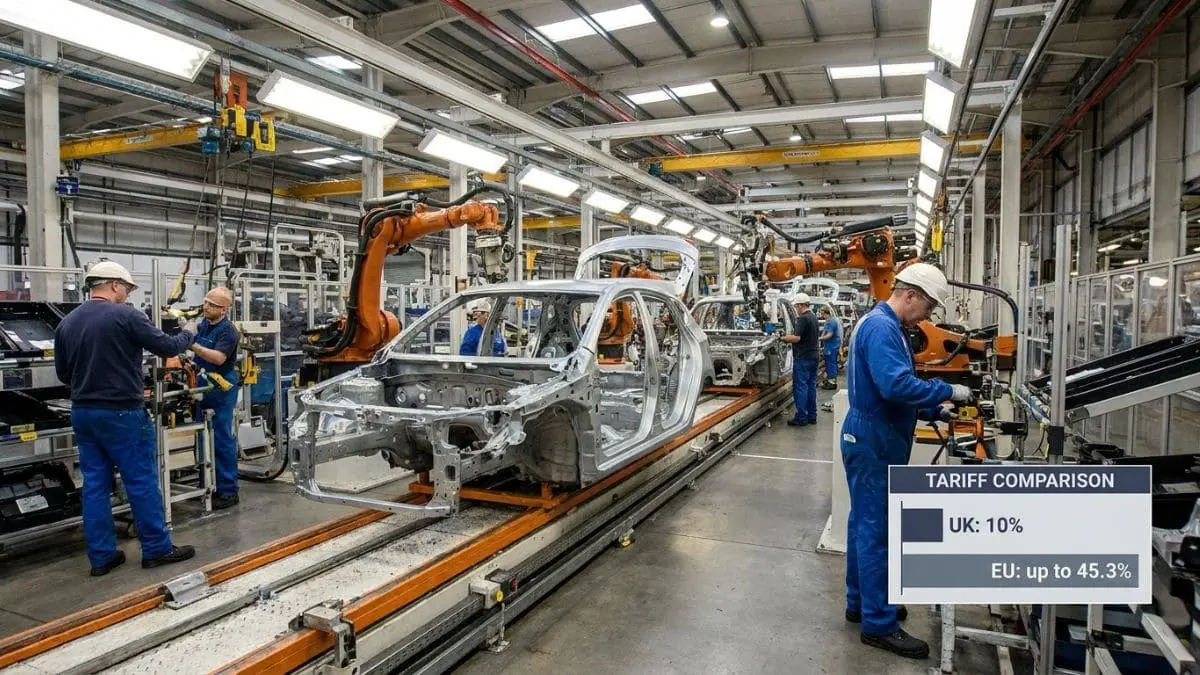
In return, Brussels will give an exemption to UK automakers from restrictive ‘Made in Europe’ trade barriers, putting the UK in hot water to decide whether to align with EU trade policy to protect British automotive exports, or maintain the current 10% tariff to ensure consumers retain access to affordable EVs during a severe cost-of-living crisis.
Why is the EU urging the UK to raise tariffs on Chinese cars?
The EU is pressuring the UK to align its tariff structure with the EU import duty tariff on Chinese electric vehicles to close a trans-Channel regulatory loophole.
Brussels fears that if the tariff does not match, Chinese automakers will route subsidized vehicles and components through UK assembly plants into the single market. In return for alignment, Brussels offers UK manufacturers exemption from restrictive ‘Made in Europe’ trade barriers and green subsidies.
This is the same leverage Brussels has consistently declined to deploy against Washington and Beijing directly, preferring to use it instead against a post-Brexit ally.
The “Made in Europe” Ultimatum vs. British Consumers
The core friction in European Union and China relations has spilled directly across the English Channel. Under its proposed ‘Made in Europe’ scheme, formally called the Industrial Accelerator Act (IAA), Brussels intends to restrict subsidies and public procurement exclusively to products with high domestic European content.
For the British automotive sector, which exports nearly 80% of its domestic vehicle production and the vast majority destined for continental dealerships, exclusion from this supply chain would be nothing but disaster.
However, raising the tariff from its current 10% baseline to 45.3% to meet Brussels requirements would directly penalize British consumers amid a persistent domestic cost-of-living squeeze.
Moreover, this move to protect legacy European carmakers would also conflict with the UK’s legal mandate to phase out internal combustion engines (ICE) by the end of the decade.
The Assembly Loophole
EU trade negotiators are now preventing tariff circumvention through secondary assembly, and they believe that without a synchronized tariff regime, Chinese manufacturers are already positioning to exploit spare manufacturing capacity in the UK.
The Chinese automaker Chery is already negotiating access to production at Nissan’s Sunderland plant. Under current rules of origin, vehicles that meet local content thresholds can enter the EU duty-free, an effective option to neutralize the EU defensive trade perimeter.
In addition, prominent Chinese EV manufacturer BYD has effectively made the impact of high tariffs ‘null and void’ through vertical integration, giving it a cost advantage that border taxes cannot erase.
The Divergent Automotive Tariff Landscape
| Regulatory Metric | European Union Stance | United Kingdom Stance | Operational Impact |
| Max EV Import Tariff | Up to 45.3% (varies by OEM subsidies) | 10.0% (standard WTO most-favored-nation) | Chinese OEMs prioritize UK market deliveries, driving market share to 16%. |
| Trade Defense Objective | Industrial preservation: shielding continental automakers from Chinese overcapacity. | Inflation management: preserving affordable consumer transition to electric fleets. | Deep structural divergence in cross-Channel automotive trade policy. |
| Regulatory Conduit Risk | High: fears UK becomes an assembly backdoor into the continental single market. | High: risks retaliatory tariffs from Brussels on UK automotive and chemical exports. | EU announces border monitoring on industrial chemicals (e.g., Teesside titanium dioxide). |
| Internal Market Split | Unified across all 27 member states. | Bifurcated by the Windsor Framework. | Northern Ireland remains bound to EU tariff regimes, creating internal UK customs friction. |
Geopolitical De-risking and the Customs Union Trap
To resolve this trade vulnerability, EU officials have privately told British Prime Minister Andy Burnham that the cleanest solution is for the UK to rejoin the EU customs union. Burnham has firmly rejected this proposal, maintaining that the UK must preserve its independent trade policy. He also warned that planned EU rules to help European auto manufacturers would damage the UK.
However, every percentage-point reduction in non-tariff barriers with the EU is estimated to raise UK goods exports by approximately £1.2 billion per year, and a customs union could double the benefit of current negotiations.
The true regulatory independence is proving difficult to sustain in the current global economic crisis, but the bloc has already signaled that divergence will carry severe costs.
Recently, the bloc launched monitoring procedures against UK exports of titanium dioxide after a Chinese firm acquired a shuttered chemical facility in Teesside.
The United Kingdom is discovering that in an era of aggressive, bloc-wide industrial policy, neutrality is an expensive luxury. The UK’s dilemma is one front in the broader great-power economic competition, where every economy is being forced to choose sides between two powers.
London will ultimately have to decide whether protecting domestic consumers from price increases is worth permanently eroding its automotive access to continental Europe.
Read more analysis in our Great Power Economics section.