How Changing China South Korea Relations Will Redefine East Asia

⏱️ 4 Mins Read
Geopolitical tectonic plates are shifting rapidly in East Asia. Washington’s approach to encouraging diplomacy with North Korea creates uncertainty for its traditional democratic partners, while Beijing is moving decisively to capitalize on the vacuum and strengthen China South Korea relations.
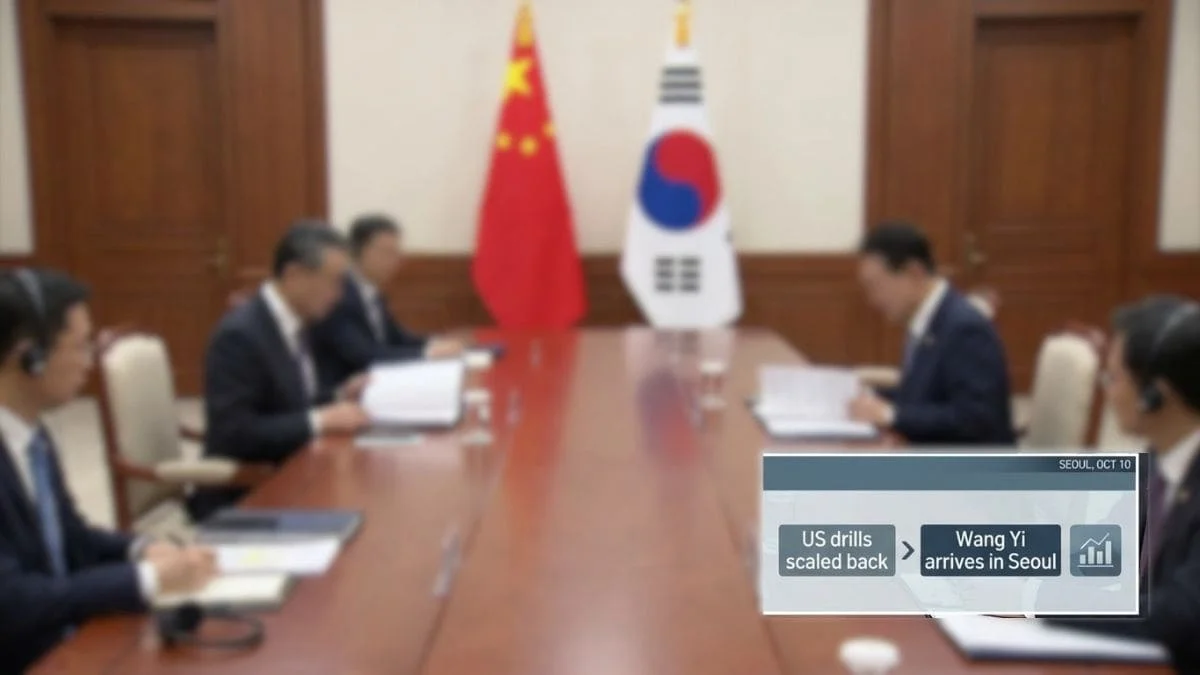
This diplomatic move was seen in August 2026, when Chinese Foreign Minister Wang Yi arrived in Seoul for high-stakes talks.
The visit came immediately after US President Donald Trump ordered the Pentagon to scale back joint military exercises with South Korea, citing his “very good relationship” with North Korean leader Kim Jong Un.
For analysts watching broader China-South Korea relations, this is a critical inflection point: American unpredictability has opened the door to a Chinese regional architecture.
The Catalyst: Trump’s Pivot and the Void It Leaves
US deterrence in the region has undoubtedly been cemented through powerful military alliances. However, recent developments in America North Korea relations have sent shockwaves through Seoul.
Trump’s decision to shorten the annual US-South Korea military drills, which primarily serve to strengthen readiness against North Korean threats, was reportedly made without consulting South Korea.
Trump’s rationale was a good relationship with North Korean leader Kim Jong Un, despite his active support for Russia, with 14,000 soldiers already deployed and plans to increase up to 50,000 troops in Ukraine. Pyongyang’s decision not to join the US war against Iran was the main catalyst for the decision.
Washington’s decision to pursue diplomacy with an authoritarian adversary over a democratic partner will embolden adversaries and erode trust among partners. And this move not only erodes perceptions of American reliability but also forces the South Korean leader into a corner, requiring them to navigate an increasingly hostile neighborhood with a less predictable superpower backer.
This American erosion of reliability is also pushing Europe toward nuclear autonomy, with Germany publicly training alongside French nuclear-capable aircraft for the first time in postwar history.
Beijing’s Calculated Embrace
Sensing the friction between Washington and Seoul, China has sent its top diplomat, Wang Yi, to capitalize on the situation by offering China as an alternative. During his visit, Wang Yi held talks with South Korean Foreign Minister Cho Hyun and President Lee Jae Myung.
Wang advised South Korea to establish independent, autonomous, and balanced external relations in a non-conflicting manner. In geopolitical translation, ‘autonomy’ is Beijing’s preferred terminology for distancing Seoul from Washington’s military orbit.
Both China and South Korea agreed to sweeten the diplomatic deal by accelerating negotiations on the second stage of their free-trade agreement, boosting cooperation in artificial intelligence, and resuming cultural exchanges.
This is the same pattern Beijing applied at the Trump-Xi summit, using concessions and investment commitments to secure strategic positioning while Washington kept its focus on deals.
Furthermore, Wang asked the United States to abandon its ‘hostile policy’ toward North Korea while expressing China’s commitment to ‘peace and coexistence’ on the Korean Peninsula.
Strategic Posture: US vs. China on the Korean Peninsula
| Strategic Component | United States (Transactional Approach) | China (Structural Approach) |
| Immediate Priority | Reactive troop reductions and isolated leadership overtures. | Proactive economic integration and continuous high-level diplomacy. |
| Leverage Mechanism | Military presence and joint defense drills (currently being scaled back). | Accelerating Free-Trade Agreements (Phase 2), tech cooperation, and cultural diplomacy. |
| North Korea Stance | Seeking unilateral summits based on personal relationships. | Urging the US to drop “hostile policies” while advocating for peaceful coexistence. |
| Message to Seoul | Demanding financial burden-sharing and transactional loyalty. | Encouraging an “autonomous” and independent foreign policy away from Washington’s orbit. |
The South Korean Leader’s Quest for Autonomy
President Lee Jae Myung is pursuing a highly pragmatic approach. The South Korean leader has repeatedly emphasized the need for military self-reliance, advocating for the acquisition of nuclear-powered submarines and proposing multilateral talks to end the 1950- 53 Korean War.
South Korea is also actively maneuvering to repair China and South Korea relations that had previously soured over the deployment of the US THAAD missile defense system in 2016.
Now, Seoul is aggressively pursuing a bilateral summit between President Lee and Chinese President Xi Jinping on the sidelines of the upcoming Asia-Pacific Economic Cooperation (APEC) summit in Shenzhen later this year.
Fault Lines on the Peninsula
The Enmity Paradox
To discuss the geopolitical reality of whether North Korea and South Korea are enemies, one must look to the 1950-1953 Korean War, which ended in a ceasefire rather than a peace treaty. Therefore, both nations remain officially at war.
While South Korea has recently proposed talks to establish a lasting peace regime, the leadership in Pyongyang has officially abandoned the decades-long goal of reunification, rewriting its constitution to designate the South as its principal enemy.
Economic Gravity and Supply Chains
To find the answer to how China South Korea relations impact the global economy, the focus immediately shifts to the technology corridors.
South Korea is a powerhouse in semiconductor and high-tech manufacturing, while China remains its largest trading partner. The proposed phase two of their free-trade agreement could insulate Asian supply chains from Western tariffs if the uninterrupted economic ties reach new heights.
The Volatility of Washington-Pyongyang Ties
Regarding the current state of America North Korea relations, the landscape is defined by volatile, transactional diplomacy. While the US administration has reduced military exercises with South Korea to appease Pyongyang, North Korea continues to advance its nuclear arsenal and deepen its military alliance with Russia by deploying thousands of troops to the Ukrainian conflict.
The Shifting Asian Architecture
This strategic realignment in Seoul is a great-power economic competition in which the United States is inadvertently accelerating the emergence of a multipolar reality by treating its security guarantees as negotiable commodities, while Beijing is using a mix of economic incentives and diplomatic assurances to draw South Korea into a more neutral role.
It is important to see if South Korea succeeds in balancing these competing titans; the ultimate casualty may not be just military drills, but the US-led security architecture in the region.
Read more analysis in our Great Power Economics section.