How Beijing Crushed Nvidia China Revenue

⏱️ 4 Mins Read
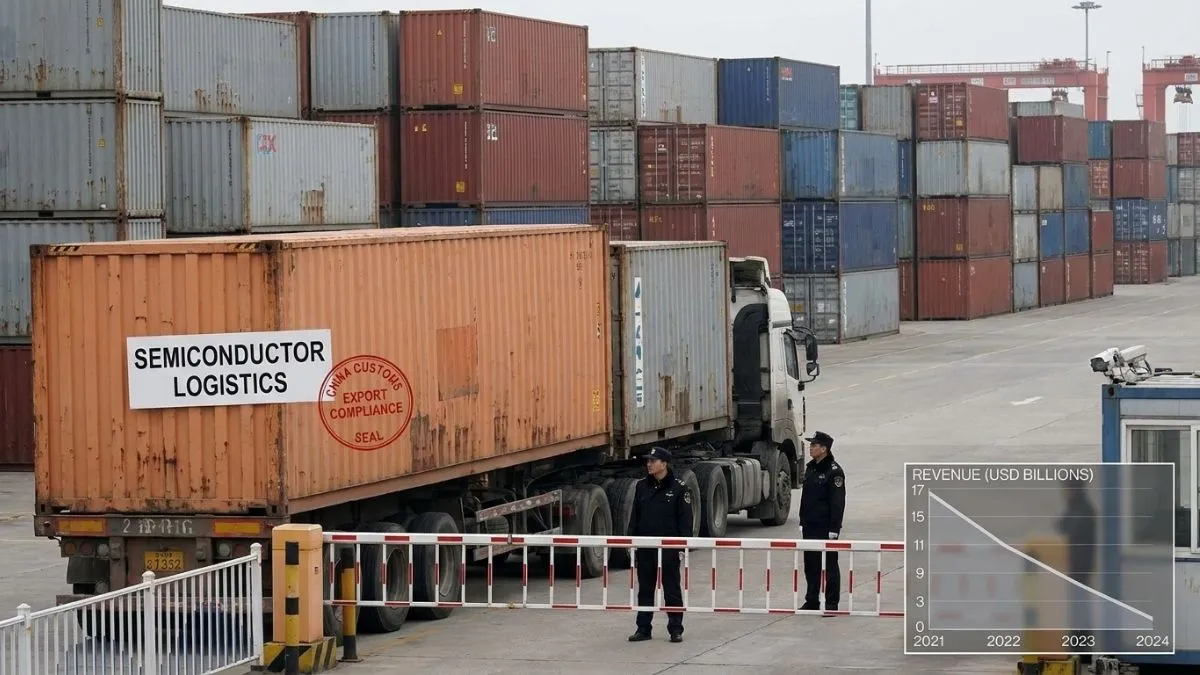
The complete collapse of Nvidia China revenue in the data center sector has hit bottom, down from nearly $17 billion in just over a year, tarnishing hopes of capturing the $50 billion Chinese AI chips market. While legacy tech and gaming sales remain, the high-margin compute market has evaporated.
What is the Nvidia China revenue percentage 2025?
The 2025 Revenue Reality: Nvidia China revenue percentage in 2025 fell to roughly 9%-13% of total global revenue, driven entirely by automotive and consumer gaming chips. Nvidia’s advanced data center revenue in China, which previously accounted for a massive share of growth, has effectively collapsed to near zero due to geopolitical import blocks.
First, Nvidia’s H200 AI chips faced export restrictions from the US. Then, after the US granted export clearance in early 2026, Chinese customs quietly began blocking H200 shipments at the border.
This looks less like a shift in Washington’s export policy and more like a shift of power toward Beijing’s import policy, though neither government has confirmed that framing on the record.
Timeline of Nvidia H200 Export Blocks and Market Consequences
| Date | Action | Party | Market Consequence |
|---|---|---|---|
| April 2025 | H20 chip export restriction imposed | US | Nvidia China revenue severed |
| December 2025 | H20 restriction reversed, H200 exports approved for ~10 Chinese firms, 75,000 unit cap | US | Nvidia projects $15B revenue resumption |
| December 2025 | H200 shipments blocked at border, no formal announcement | China | Zero Nvidia China revenue booked |
| May 2026 | Jensen Huang joins Trump-Xi delegation, flies to Beijing | US/Nvidia | H200 pipeline remains blocked |
| Mid-2026 | Huawei Ascend shipments reach 805,000 units, ByteDance commits $5.6B to Huawei chips | China | Huawei market share reaches 50% |
The Financial Hostage
The fallout from this standoff is now showing up on American corporate balance sheets, with Nvidia’s China revenue collapsing to near zero.
This complete evaporation of revenue is a calculated political strike. The Chinese deliberate import hurdle was the unspoken leverage during the recent 2026 Trump China Visit, proving that market access is now a fully weaponized diplomatic tool.
In April, 2025, the Trump administration imposed a restriction on even the export-compliant H20 chip. Then, in December 2025, the restriction was reversed with a rule allowing H200 exports to roughly ten approved Chinese firms, including Alibaba, Tencent, and ByteDance, under a cap of 75,000 units per customer.
Every shipment was required to have an individual license, and chips were subject to testing requirements tied to computational limits.
The US government and Nvidia struck a deal in which the chip company agreed to give the government a 25% cut of its revenue from sales.
Within just two days of the deal, Chinese customs authorities blocked H200 shipments at the border without any formal announcement. Six months later, no revenue was booked.
The Geopolitical Trap: Why Beijing Said No
The conditions Washington attached to the H200 deal are the most plausible explanation for China’s resistance. The 25% revenue-share arrangement effectively makes the US government a stakeholder in Chinese AI infrastructure spending.
Mandatory testing and reporting requirements raise legitimate sovereignty concerns. Beijing has spent the past three years building hardware independence.
The timing adds another layer. Huang flew to Beijing as part of the May presidential delegation, hoping the trip would unstick the H200 pipeline, but it didn’t.
Why Nvidia China Revenue is Unrecoverable
The scale of what’s stuck matters more than any estimate of recycled revenue. Huang has put China’s total addressable AI chip market at around $50 billion annually.
That’s the number worth sitting with, not because it’s likely to materialize soon, but because it illustrates the size of the bet Nvidia is not being allowed to collect on.
Bernstein estimates Nvidia’s share of China’s advanced AI chip market has fallen to roughly 8%, down from near-total dominance two years ago. Huawei, meanwhile, has moved from a peripheral player to the default option, with Bernstein putting its share at around 50%.
Huawei Ascend Chips vs Nvidia
The Nvidia block is accelerating Chinese demand for domestic silicon. Huawei has moved from a peripheral player to the default option, backed by heavy state and corporate mandates, including ByteDance’s commitment to spend more than $5.6 billion on Huawei Ascend chips in 2026.
| AI Chip Provider | 2024 / 2025 Market Reality | Estimated China Market Share |
| Nvidia (H200 / H20) | Blocked at customs; $50B TAM frozen | 8% (Down from near-monopoly) |
| Huawei (Ascend Chips) | Shipments surged from 507,000 to 805,000 units | 50% (Surging as default option) |
While a fragmented black market for smuggled H100S and older chips exists, it is fundamentally incapable of scaling to meet the needs of state-backed AI enterprises. Beijing’s mandate is absolute: the foundational structure must run on domestic silicon, deliberately closing the door on any official Nvidia revenue recovery in China.
What This Actually Tells Investors About Future Earnings
The takeaway for Nvidia shareholders isn’t that Beijing has proven import controls beat export controls, or that market access is now definitively a bigger control than technology denial.
What’s actually confirmed is narrower and more useful: Nvidia China revenue is not coming back on any near-term timeline. Every geopolitical event that might unstick it the January rule, the May Trump visit- has so far failed to move a single meaningful shipment.
The $50 billion order book sitting in limbo is the real story. Not because it’s a loss Nvidia has already absorbed; its forward earnings guidance excludes China data center revenue entirely, so there is no immediate earnings miss to point to. It matters because it is the clearest evidence yet that, in this phase of the US-China tech relationship, having an export license to sell is entirely useless if Beijing refuses to let you find a buyer.