EU China Trade Deal: Will the EU Reduce the Trade Gap?

⏱️ 3 Mins Read
The EU China trade deal was announced after talks between European Trade Commissioner Maroš Šefčovič and Chinese Commerce Minister Wang Wentao in Beijing to reduce the EU’s growing trade deficit.
Šefčovič announced it after concluding his two-day visit to Beijing, saying China has agreed to cut its exports of hybrid cars to the EU by more than half, without providing details on how the agreement will be implemented.
Šefčovič was under immense pressure and desperate to secure a tangible EU China trade deal ahead of EU member states meeting in Brussels on October 15-16. The success of these talks will be reflected in the decisions taken at the upcoming EU member states meeting.
Meanwhile, China is using a mix of negotiation, compliance workarounds, targeted retaliation, and legal challenges to pressure the EU, reflecting great-power economics.
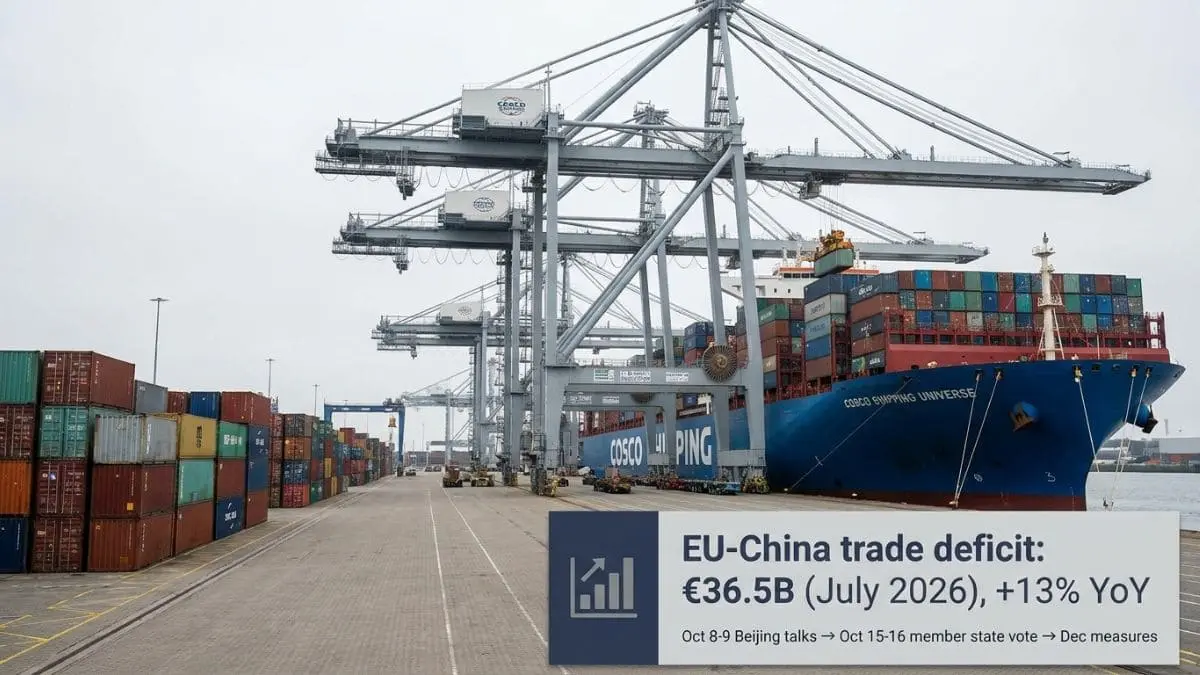
- Diplomatic Window: High-level negotiations between EU Trade Commissioner Maroš Šefčovič and Chinese Commerce Minister Wang Wentao are being held on October 8-9 in Beijing, serving as the final diplomatic test before potential legislative escalation.
- Legislative Threat: If EU member states approve new trade powers in October, they could finalize concrete anti-distortion measures by December 2026, setting the stage for sharper economic tensions in 2027.
- Strategic Deadlock: Analysts point to mutual dependencies: China needs EU demand to absorb overcapacity, while the EU’s fear of de-industrialization makes a voluntary compromise unlikely without enforcing new “decisive and systemic” legal instruments.
EU China Trade Deal Status
| EU-China Trade Surplus (July 2026) | €36.5 Billion | Represents a 13% YoY increase, indicating the trade gap is widening despite ongoing diplomatic efforts. |
| Germany-China Surplus Trend | Near Doubling | Germany, the EU’s largest economy, is feeling the impact most acutely, driving the push for stronger EU-level action. |
Can the October 8-9 Beijing Talks Bridge the €36.5 Billion Gap?
The EU and China are heading toward a trade war, and the bilateral meeting between Maroš and Wang is the last major diplomatic window to de-escalate the EU and China trade conflict. The talks center around Chinese exports to the EU, while Brussels wants Chinese commitments to narrow the trade deficit.
Beijing’s export controls on rare earths, gallium, germanium, and other critical raw materials vital to European defense, automotive, and semiconductor supply chains are also sticking points.
Beijing has reportedly signaled its willingness to discuss reducing the Europe and China trade imbalance and has also rejected Brussels’ view that overcapacity and barriers to European companies’ access to China’s market stem from Chinese state support for industry.
Reports suggest that Wang expressed his willingness to explore purchase agreements for European goods. However, such purchase agreements would not address the EU’s fundamental concerns of systemic economic imbalances.
How Will New EU Trade Powers Alter the Negotiation Dynamic?
France and Germany are pressing the European Union to fire its trade bazooka with new rapid-action measures to strike back at China.
French President Emmanuel Macron and German Chancellor Friedrich Merz, in a letter to European Commission President Ursula von der Leyen, stressed the need for urgent action against systemic market-distorting practices that are threatening the EU economy and its industrial base.
“If EU leaders back the new measures in October, proposals may take shape by December, setting up sharper tensions with China in 2027,” Grzegorz Stec, senior analyst at MERICS.
The EU New Measures Enforcement Timeline
| Member State Vote | October | Member states vote on proposed definitive trade measures (e.g., countervailing duties, tariffs) | Creates a political and administrative mandate; signals the bloc has the legal and diplomatic backing to act |
| Drafting & Publication | Late October to November | Administrative body converts the voted proposal into formal legal text and calculates definitive duty rates for cooperating and non-cooperating entities | Publication in official journals creates an enforceable baseline; provisional measures become active penalties |
| Finalization & Lock-In | December | Regulatory body formally concludes the process and finalizes definitive measures | Framework is typically fixed for a multi-year term (often 5 years); changes require interim or expiry reviews |
What Countermeasures China Takes
China has already rolled up its sleeves, using a mix of negotiation, compliance workarounds, targeted retaliation, and legal challenges as countermeasures before the EU implements new trade measures.
Chinese automakers are establishing factories inside the EU to avoid import tariffs and meet origin and procurement requirements under the EU’s industrial and green-tech rules. To pressure Brussels, the Chinese Ministry of Commerce has opened anti-dumping and anti-subsidy probes, and Beijing can add supply-chain security investigations and lean on existing export restrictions on rare earths and other critical raw materials.
At the same time, it pursues high-level talks to discuss voluntary export limits and refine a joint trade and investment consultation mechanism to avoid a full trade war.
China also challenged the legality of the EU’s definitive countervailing duties at the WTO (Case DS630) in 2024, where a dispute panel has been established; rulings are slow and cannot force the EU to withdraw measures immediately, but this lawsuit will help China in negotiations.
Beijing can use diplomatic maneuvering, bilateral lobbying, and threats of targeted economic retaliation because China knows once the vote passes, the leverage evaporates.
Read more analysis in our Great Power Economics section.