Why is a K-Shaped Economy Bad for Malaysia’s Long-Term GDP Sustainability?

⏱️ 5 Mins Read
While the International Monetary Fund (IMF) projects Malaysia GDP growth at around 5.2%, driven by high-tech exports and data centers, a K-shaped recovery pushes small businesses and average earners into stagnant real wages and high living costs.
However, Malaysia’s data center boom, driven by American and Chinese hyperscalers competing for the only genuine dual-bloc AI infrastructure hedge in Southeast Asia, is concentrating wealth in the sectors most disconnected from local labor markets.
📌 Executive Brief
- Labor Market Distortions: The “upper leg” of the economy benefits from a globalized skills premium and asset returns. In contrast, the “lower leg” is suppressed by an overreliance on low-cost foreign labor and an expanding informal-sector trap involving roughly 20% of the workforce.
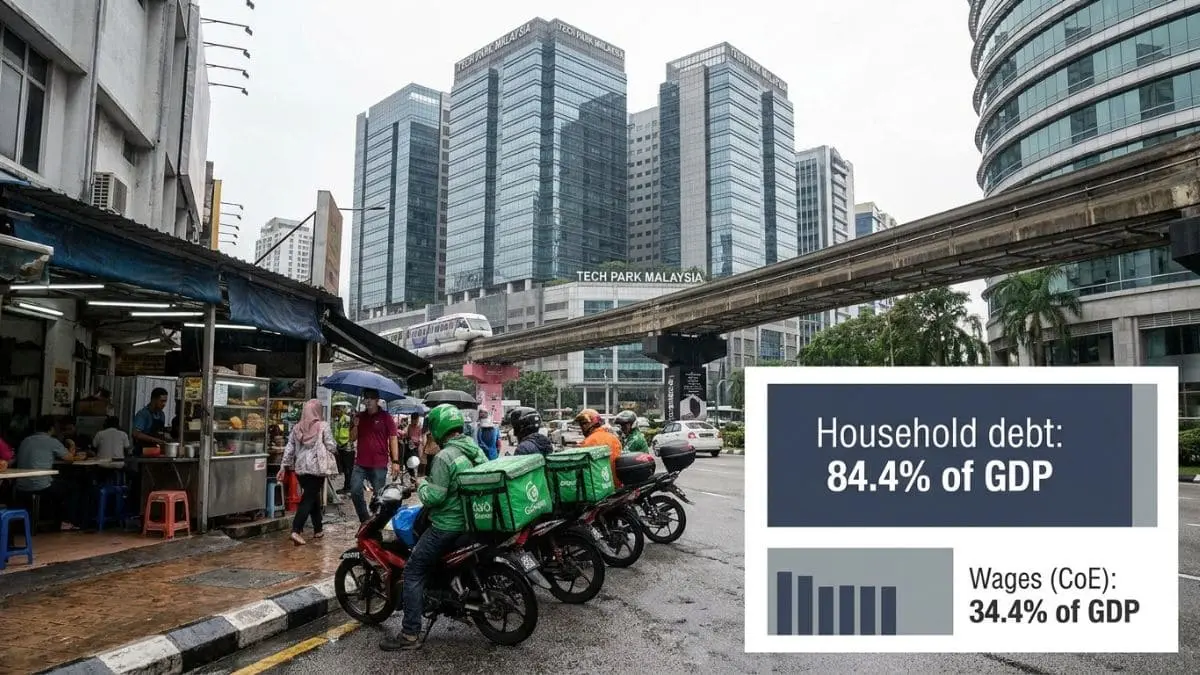
- Wage and Debt Pressures: Outstanding household debt has surged to RM1.73 trillion (84.4% of GDP). Together, the Compensation of Employees (CoE) remains low at 34.4% of GDP, showing that corporate productivity gains are not translating into shared wage growth.
- Fiscal and Social Liability Strain: The expansion of the unprotected informal sector creates a massive unfunded future welfare liability for the state. Meanwhile, the 2027 Budget allocates a rigid 82% (RM376.8 billion) to operating expenditure, crowding out long-term development and infrastructure investments.
- Strategic Reforms Needed: Securing sustainable growth requires aligning educational output with high-tech industry demands, integrating the informal sector into social safety nets, deepening domestic supply chain linkages, and shifting toward equitable taxation to prevent the middle-income trap.
What Is The K-Shaped Economy?
A K-shaped economy occurs when different segments of society recover or grow at drastically different rates following an economic shift; one group thrives (the upper arm) while the other stagnates or declines (the lower arm). According to the IMF, Malaysia’s macroeconomic top-line growth is strong, but it is heavily concentrated in capital-intensive tech sectors and multinational exports, creating a disconnect between macroeconomic figures and broad-based domestic prosperity.
This is the middle-power trap operating in real time: a nation with genuine economic leverage in semiconductors and data centers that consistently captures activity without capturing ownership of the value it creates.
Why It Harms Malaysia Economy
- Stagnant Domestic Consumption: Domestic consumption powers the economy, but lower- and middle-income groups face stagnant real wages. Even if Malaysia GDP per capita appears stable on paper, the economy loses its primary engine when most citizens cut back on discretionary spending.
- High Household Debt and Middle-Class Over-Leverage: Malaysia’s household debt is one of the highest in the ASEAN region. Bank Negara Malaysia data shows significant borrowing growth for Passenger Vehicles (19.5% YoY), Residential Property (2.9% YoY), Personal Use (23.1% YoY), and Securities (62.2% YoY). This shows a highly leveraged middle and upper-middle class using debt to sustain lifestyles or accumulate assets, creating systemic financial fragility if interest rates or unemployment rise.
- Low Compensation of Employees (CoE) Share: Malaysia’s CoE-to-GDP ratio remains structurally low at 34.4%. Productivity gains and corporate profits in capital-intensive sectors (like tech and government-linked companies) do not translate into shared wage growth for regular workers.
- Skills Mismatch and Brain Drain: Tertiary-educated underemployment affects over 1.9 million workers. Local educational output often fails to match the high-tech demands of the semiconductor and data-center sectors, pushing graduates into low-paying gig work while high-value industries struggle to find local talent.
- Regional and Sectoral Disparities: Growth is heavily concentrated in specific urban corridors (like the Klang Valley, Penang, and Johor data-center zones), leaving peripheral regions, East Malaysia (Sabah and Sarawak), and traditional Small and Medium Enterprises (SMEs) behind.
- Middle-Income Trap Risk: A model reliant on low-cost foreign labor at the bottom and imported technology at the top prevents Malaysia from shifting toward genuine domestic innovation and sustainable economic scaling.
How Structural Mismatches Distort Labor Market Dynamics
1. The Skills Premium Disparity
A primary labor distortion is a mismatch between local secondary education and global industry demands. Workers with specialized and globally competitive skills command a massive financial premium, while the broader graduate pool faces underemployment.
2. Disproportionate Wage Stagnation vs. Asset Returns
The top 10% of Malaysian households command roughly 70% of the nation’s wealth, largely driven by capital gains and equity ownership. As capital grows faster than wages, the median income can’t keep pace with inflation.
3. Over-Reliance on Low-Cost Foreign Labor
Many businesses in the lower leg depend on cheap foreign labor to maintain profit margins, with no investment in capital-intensive upgrades, suppressing entry-level wages across manufacturing and construction, and pricing out local job seekers.
Malaysia’s position in the global manufacturing scale trap, where production volume generates employment statistics without generating sovereign wealth, mirrors the structural problem facing every mid-tier economy in the US tariff realignment.
4. Expansion of the Informal Sector Trap
As formal, lower-tier jobs offer stagnant wages, a massive percentage of the workforce has shifted to informal employment. Over 80% of workers in the lowest economic decile work without formal contracts, statutory retirement contributions (EPF), or social safety nets.
5. Domestic Capital Flight and Brain Drain
When highly skilled Malaysian professionals encounter domestic wage stagnation, they increasingly look abroad for better compensation, draining the local market of top-tier talent required for high-value industries.
The Fiscal Risks to Social Safety Nets
A K-shaped recovery poses significant fiscal risks. Because this divergence widens the economic gap, it strains public finances by inflating future social welfare liabilities while constraining the tax base.
| Fiscal Risk Category | Mechanism of Impact | Consequence for Public Finance |
| Unfunded Welfare Liabilities | Expanding informal sector workers do not contribute to EPF/SOCSO. | Creates a massive future fiscal liability as the state will be forced to absorb millions of unprotected citizens into old-age welfare systems. |
| Crowded-Out Development | Recurrent social assistance commitments inflate Operating Expenditure (OE). | In Budget 2027, OE consumes 82% (RM376.8 billion), shrinking Development Expenditure to RM83 billion and starving infrastructure. |
| Escalating Subsidy Burdens | External shocks push fuel and cash aid bills massively over budget. | This traps the government in an expensive safety-net structure that is politically dangerous to unwind. |
| Narrow Tax Base | Tax base remains stuck at roughly 12.5% of GDP. | Government becomes dangerously dependent on a tiny pool of top earners and corporate taxes to fund escalating operational costs. |
Measures to Secure Sustainable Economic Growth
To bridge the widening economic divide, structural reforms must target vulnerabilities rather than relying solely on short-term budgets:
- Align Education and Formalize Protections: Public R&D and higher education must align tightly with industry needs to fix the skills mismatch. The government must also design accessible social protection frameworks (like state-matched EPF contributions) to protect the growing gig workforce.
- Strengthen Local Supply Chains: Assess major global investments in hyperscale data centers and semiconductors for their local multiplier effects. The government must facilitate tangible technology transfers from multinational corporations to domestic firms.
- Modernize and Deregulate SMEs: Streamline licensing and equity rules that limit scaling to encourage domestic innovation. Accessible financing and technology grants will help traditional businesses automate and move beyond low-wage, labor-intensive models.
- Fiscal Consolidation and Equitable Taxation: While rationalizing broad fuel and water subsidies is vital for fiscal discipline, the government must cushion lower-income families via efficient targeted cash transfers. Expanding the tax base by capturing high incomes and capital gains can fund social spending without stunting private investment.
- Geographical Decentralization: Investment and infrastructure spending must be explicitly channeled to lagging regions, including the East Coast of Peninsular Malaysia, Sabah, and Sarawak, to prevent deeper regional disparities.
Read more analysis in our Middle Power Trap section.