Digital Neocolonialism: How Stablecoins Are Cementing US Dollar Hegemony in Emerging Markets

⏱️ 5 Mins Read
Contrary to the expectation that digital innovation would democratize global finance, dollarization in emerging economies is digital neocolonialism that cements US dollar hegemony in emerging markets.
📌 Executive Brief
- The Digital Dollarization Paradox: Contrary to the crypto-utopian vision of decentralization, stablecoins are the most efficient distribution mechanism for US fiat. Emerging markets now drive the stablecoin ecosystem, holding roughly 66% of the global supply as citizens use tokens like USDT to preserve purchasing power.
- Erosion of Monetary Sovereignty: The frictionless nature of digital assets neutralizes local central banks. Capital flight accelerates via P2P networks, neutering domestic interest-rate policies and crippling local credit markets as bank deposits vanish.
- Fiscal Policy Collapse: The migration to digital dollars breaks domestic fiscal tools. The traditional expenditure multiplier fails as local stimulus instantly exits into USD tokens, severely skewing the tax multiplier formula and rendering local economic reforms ineffective.
- The Fallacy of Sanctions Evasion: While states like Iran utilize USDT (Tether) to bypass SWIFT, they trade the security of true decentralization (like Bitcoin) for the stability of the dollar. In doing so, they subject their shadow economies to the US Treasury’s ultimate veto power, as centralized issuers routinely freeze blacklisted assets.
- Euro and Renminbi Stagnation: The US dollar faces no viable digital competitors. The Euro is hindered by fragmented regulatory frameworks (MiCA), while the digital Renminbi (e-CNY) is paralyzed by Beijing’s authoritarian capital controls, trapping both in a secondary tier of global liquidity.
What is Dollarization, and How Has Technology Weaponized It?
A nation is abandoning its domestic currency in favor of the US dollar to stabilize a volatile macroeconomic environment. Emerging economies face a structural disadvantage where digital payment frictions are reduced only for dollar-denominated assets, effectively locking these nations into a digital version of traditional dollarization without the potential for competitive currency alternatives.
While fringe theorists continually predict a catastrophic dollarcollapse, the reality is the opposite.
The trajectory of global monetary multipolarity is not preordained by technology alone; it is contingent on the willingness of non-US nations to aggressively strengthen their domestic financial markets.
Thus far, they have failed. The euro and renminbi remain trapped in a fragmented second tier, lacking the unified digital infrastructure and market depth required to challenge the dollar’s reinforced position in the era of stablecoins.
The macro conclusion is stark: an unmitigated victory for dollar hegemony. However, the mechanism is entirely different. This outcome is one dimension of the broader great power economic competition where the US is simultaneously using military presence, technology access, and financial architecture to maintain structural dominance while appearing to lose ground.
The Core Trend: Grassroots Digital Dollarization
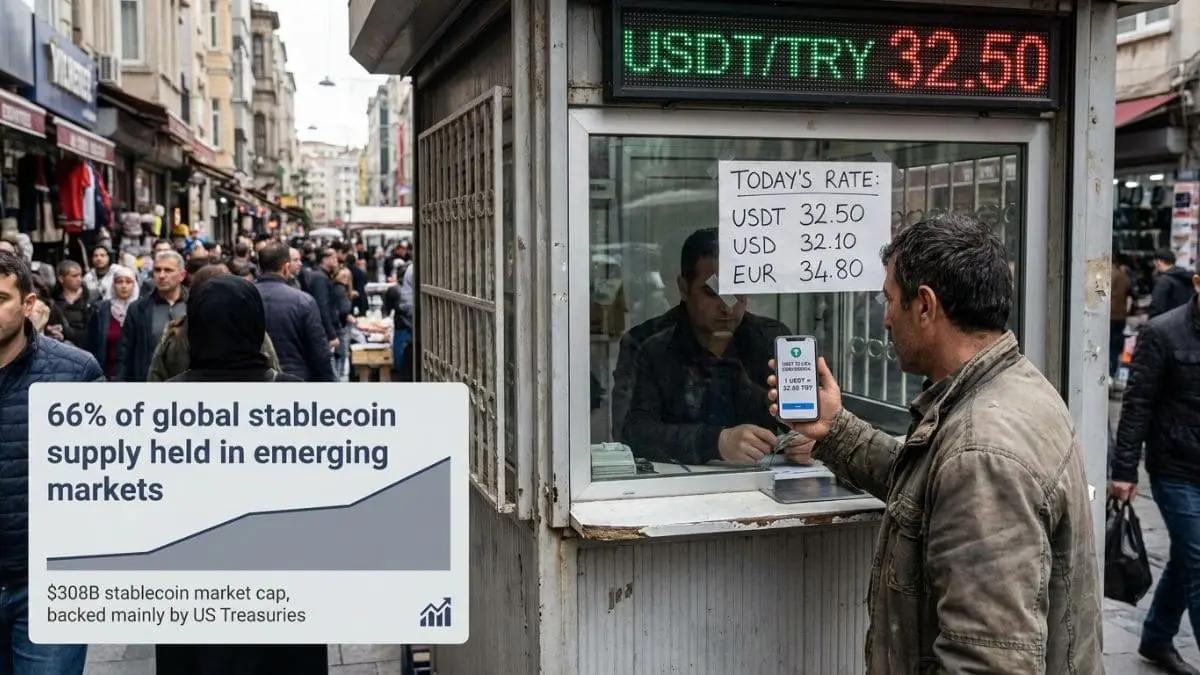
In countries facing high inflation, currency depreciation, or strict capital controls (such as Argentina, Turkey, Venezuela, Pakistan, and Nigeria), stablecoins like Tether (USDT) are no longer viewed as speculative crypto assets. They have become borderless, digital dollar savings accounts.
Nigeria’s regulatory response, formalizing crypto infrastructure rather than suppressing it, offers the most advanced blueprint for how emerging economies can capture stablecoin flows without surrendering monetary sovereignty entirely.
People do not hold USDT to trade Bitcoin; they hold it to preserve monetary value and purchasing power. Apps let users convert dozens of local currencies directly into digital dollars.
Consequently, emerging markets now drive the global stablecoin ecosystem, holding roughly 66% of the global supply. Tether CEO Paolo Ardoino confirmed his company alone has reached over 570 million users globally.
The Trap: Erosion of Monetary Sovereignty and Fiscal Collapse
While stablecoins offer a lifeline to local citizens, they present a massive threat to the local governments of emerging economies:
- The Deposit Flight Crisis: Projections indicate that roughly $1 trillion could exit emerging market banks within the next three years as citizens swap local fiat for digital dollars.
- Loss of Central Bank Control: When a population can easily shift its wealth into a digital dollar at the first sign of economic stress, local central banks lose their power. They can no longer manage interest rates or control capital flight.
- The Breakdown of Fiscal Multipliers: As the formal banking sector is hollowed out, state fiscal mechanics break down. The expenditure multiplier, the macroeconomic principle where government spending circulates through the local economy to create compounded growth, fails because stimulus cash is immediately converted into USDT and hoarded offshore. Furthermore, the shadow nature of P2P token networks breaks the tax multiplier formula, rendering conventional tax multiplier economics obsolete. Revenue collection drops, meaning any attempted economic reforms are starved of funding and fail to register accurately in government financial statistics.
The Ultimate Winner: US Public Debt
The ultimate paradox of the crypto revolution in emerging markets is that it acts as a massive funding mechanism for the US government. To maintain their $1 pegs, stablecoin issuers must back their tokens with liquid dollar assets, primarily US Treasury bills. With the dollar stablecoin market cap surging past $308 billion, every time an everyday citizen in an emerging market buys USDT to protect their savings, they indirectly buy US government debt and finance the US deficit.
The Digital Currency Landscape
| Entity / Asset Class | Current Structural Position | Digital Innovation Impact (Stablecoins/Tokenization) | Competitive Viability vs. USD |
| US Dollar (USD) | Dominant in most aspects of global finance; possesses superior “market thickness.” | Reinforcing: Reduces cross-border friction, leveraging existing dominance to lock in users via stablecoins. | High: Consolidating dominance due to network effects and deep liquidity pools. |
| Euro (EUR) | Competing in a fragmented second tier. | Neutralizing: Lacks the unified digital infrastructure to counter USD friction reduction (hampered by MiCA compliance). | Low: Remains in a fragmented tier without a clear path to challenge USD. |
| Renminbi (CNY) | Competing in a fragmented second tier. | Neutralizing: Digital initiatives (e-CNY) exist but are crippled by strict authoritarian capital controls. | Low: Unable to serve as a frictionless global medium of exchange. |
| Emerging Market Currencies | Vulnerable to traditional dollarization; limited financial market depth. | Negative: Exposure to dollar-backed stablecoins bypasses local monetary policy and destroys the expenditure multiplier. | Critical Risk: High probability of unavoidable digital lock-in without sweeping institutional reforms. |
The Market Thickness Advantage
The theoretical argument that technological innovation would democratize the global monetary system ignores a fundamental law of monetary economics: network externalities and market thickness.
Money is fundamentally a network good. The US dollar ecosystem already possesses the deepest liquidity pools and the largest share of global invoicing. When stablecoin issuers like Tether (USDT) and Circle (USDC) entered the space, they naturally pegged to the USD because it offered the thinnest bid-ask spreads.
This created a self-reinforcing liquidity loop:
1. Eliminating Cross-Currency Friction: Trading directly in a digital dollar token reduces transaction frictions specifically within the already dominant USD ecosystem.
2. The Liquidity Magnet: Because the friction of moving into and out of digital dollars is virtually zero on high-speed public blockchains, global users flock to where the market is thickest.
3. Network Lock-in: Hyper-concentration of capital makes it economically irrational for users to adopt digital assets pegged to alternative currencies.
The Sanctions Paradox: Weaponizing Crypto
In the long run, sanctioned states leveraging dollar-pegged stablecoins are playing on a field fundamentally controlled by the United States. While nations like Iran use digital assets as a short-term “escape hatch” to bypass traditional banks, they remain vulnerable because centralized stablecoins are not truly decentralized.
The global monetary order has shifted, but Washington still holds the keys:
- The Freeze Button: The two largest stablecoin issuers (Tether and Circle) are centralized entities. Their smart contracts contain blacklist functions. To protect its business model and its access to US Treasuries, Tether actively complies with the US Treasury’s Office of Foreign Assets Control (OFAC). Tether has frozen over $4.4 billion in assets to date, including hundreds of millions directly tied to Iranian-linked networks and black-market oil sales.
- The Power to Destabilize the Peg: If a sanctioned state attempts to build its entire shadow economy on a dollar-pegged stablecoin, the US government has the structural power to break that asset’s stability by severing the issuer’s access to US banking infrastructure or freezing the underlying reserve assets.
By adopting dollar-pegged stablecoins to evade traditional banking sanctions, economies are simply moving from one US-controlled arena to another. They trade decentralization’s security for dollar stability. In doing so, they surrender ultimate ownership of their funds back to an ecosystem governed by US national security parameters, cementing the digital dollar as the unavoidable international monetary standard of the 21st century. This monetary trap is one dimension of the broader middle power trap where emerging economies consistently mistake dependency management for development policy.
Read more analysis in our Great Power Economics section.