USA vs China AI Competition: The 2026 Sovereign Cloud Trap

⏱️ 4 Mins Read
The USA vs China AI competition for Sovereign AI is a marketing myth. In the race to determine the most technologically advanced nation, most countries aren’t building genuine independence; they are inheriting deep-tech dependency.
As the broader China US rivalry accelerates, Washington tightens its hardware chokepoints while Beijing aggressively expands its cloud footprint. Even the most technologically developed countries and emerging economies face a binary that sovereign AI rhetoric obscures: align with the bloc that will sell you chips, or build with the bloc you can actually afford.
Gulf states, Southeast Asian nations, India, and late entrants like Pakistan are making huge bets on ‘sovereign AI’ infrastructure right now.
The Global AI Capex Landscape:
- The Hardware Chokepoint: The ultimate power in the AI race lies in access to advanced chips, primarily dictated by Washington.
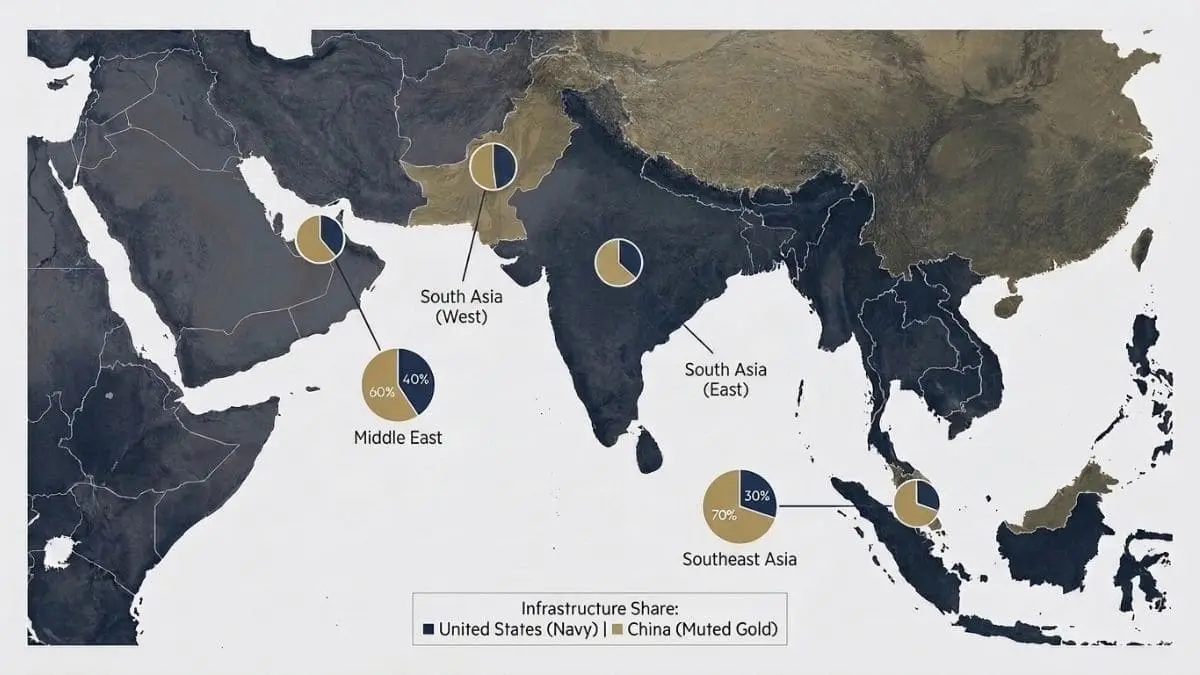
- The Southeast Asian Hedge: The only region that is successfully balancing both American (70%) and Chinese (30%) cloud providers.
- The Gulf’s Nominal Hedge: Middle Eastern wealth funds are using Chinese infrastructure solely as leverage against American hyperscalers.
- The Single-Patron Trap: Nations with hostile borders (India) or extreme economic constraints (Pakistan) are locked into single-bloc dependencies.
What is Sovereign AI?
What is sovereign AI? It refers to a nation’s self-reliance in producing artificial intelligence using its own physical infrastructure, data, and workforce. Sovereign AI is strictly administered by a state to protect domestic data privacy and national security. It depends entirely on a local sovereign AI cloud to train secure sovereign AI models, ensuring sensitive state data never crosses the country’s borders.
2026 Global Sovereign AI Infrastructure Patronage
| Region / Nation | Estimated AI Capex & Scale | Primary Hardware Patron | Strategic Posture |
| The Gulf (UAE/Saudi) | Multi-Billion (5-Gigawatt capacity planned) | US Dominant (Nominal Chinese presence) | US-Funded Hedge |
| Southeast Asia (Malaysia/Singapore) | $30 Billion by 2030 ($490M Sovereign Cloud) | US (70%) & China (30%) | Genuine Dual-Bloc Hedge |
| India | 100,000 Public GPUs by late 2026 | US-Aligned (Zero Chinese presence) | Strategic Necessity |
| Pakistan | 8.5 Megawatts (Karakoram-01 facility) | China (ZTE Partnership) | Single-Patron Dependency |
How Middle Powers are Managing the China US Rivalry
While the most advanced countries possess the fiscal headroom to invest heavily in proprietary infrastructure, middle powers and emerging economies must navigate severe strategic constraints to avoid vendor lock-in.
The Gulf: A Hedge in Name, US-Funded in Practice
The UAE and Saudi Arabia have transitioned from oil wealth to massive AI capex. Microsoft has committed billions to the UAE, and Saudi Arabia’s AI push is part of a $600 billion economic package involving Oracle, Google, and AMD.
At the capital level, this buildout is heavily American. The Chinese side offers nothing at that scale. Sovereign wealth funds face no financing constraints, yet the Gulf is discovering there is no real alternative to Nvidia. Consequently, Washington is dictating the terms of the Gulf’s AI capex, setting export security conditions and pushing out Chinese vendors.
This is the AI dimension of the broader great-power economic competition, in which Washington is systematically using access to technology, chip export controls, and infrastructure investment conditions to sort every regional economy into its strategic orbit.
Southeast Asia: The Genuine Dual-Bloc Proxy Battlefield
Southeast Asia’s data center count has surpassed 2,000; among them, Western cloud providers account for roughly 70% of hyperscaler demand, while Chinese providers (Alibaba, ByteDance) make up the remaining 30%. This is not a region choosing a side, but hosting both blocs’ infrastructure simultaneously.
Malaysia has allocated $490 million for a sovereign AI cloud in its 2026 budget, despite having a risk of simply hosting foreign compute without controlling the underlying models.
Malaysian officials fear that storing data on foreign-owned hyperscalers subjects it to foreign laws, such as the U.S. CLOUD Act, which allows foreign authorities to legally compel disclosure and bypass local courts.
Furthermore, reliance on foreign infrastructure drains long-term economic value and limits local engineering capabilities, reducing the domestic market to a permanent consumer.
The data categories at the highest risk of this extrajudicial exposure include highly regulated financial and payment records, public-sector security logs, and citizens’ healthcare and personal data.
India: Aligned by Strategic Requirement
India’s approach is a single-bloc tilt, as the IndiaAI Mission has subsidized 34,000 GPUs and targets 100,000 public GPUs by late 2026.
Unlike the Gulf or Malaysia, every supplier sits inside the US-aligned bloc. This absence of Chinese providers tracks the wider adversarial India-China relationship, which hardened following the May 2025 border conflict. Given direct geopolitical friction, India is building entirely within the US-Gulf orbit as a matter of strategic obligation.
Pakistan: The Single-Patron Dependency
Countries with no wealth and tech capacities like the Gulf and India do not get to hedge. Pakistan’s first purpose-built, AI-ready data center, Sky47’s Karakoram-01 (8.5 megawatts), highlights this reality.
Built by Mari Technologies in direct partnership with China’s ZTE, it was inaugurated as a national security asset. There is no parallel American investment. Pakistan enters this race facing a severe water crisis and balance-of-payments vulnerability.
The total disbursements under a 37-month Extended Fund Facility (EFF) and the Resilience and Sustainability Facility (RSF) have reached approximately $4.8 billion. Pakistan is projecting a primary surplus of 1.6% of GDP for FY26, mainly sustained through aggressive tax levies, albeit severe debt-servicing obligations left the overall budget balance at a -3.2% deficit.
The AI data center requires an uninterrupted power supply. On the other hand, Pakistan, under IMF conditions, is required to implement regular tariff hikes to avoid the accumulation of circular debt, thereby drastically increasing the operational costs of advanced computing.
Furthermore, tech infrastructure requires accessible capital, yet the central bank maintains a restrictive policy rate to manage inflation. The real challenge for Pakistan is between the physical and financial requirements of building a digital economy, and a macroeconomic environment optimized exclusively for debt stabilization.
The same macroeconomic constraint is examined in full in our analysis of the $725 billion AI infrastructure race, where the gap between hyperscaler capex and sovereign AI capacity is widening fastest for economies that can least afford to fall behind.
Is China More Advanced Than the US in AI?
When assessing – is China more advanced than the US, the answer depends on hardware design versus physical deployment. The United States maintains a decisive lead in frontier GPU architecture and foundational compute clusters. However, China leads in rapid, cost-effective infrastructure deployment, telecommunications integration, and the export of accessible sovereign cloud services across the Global South.
The outcome of this race depends on physical control of the semiconductor supply chain, a lever currently held by Washington.
Countries with no financial and tech capacities, unlike the Gulf and India, are forced into single-patron dependency. They take whichever bloc’s infrastructure they can afford and inherit its supply chain.
By hosting both Western and Chinese cloud providers simultaneously in the same region, nations like Malaysia and Singapore turned themselves into active proxy battlegrounds rather than conquered territories. They are the only ones leveraging capital from both sides to build out their own sovereign AI infrastructure without being locked into a single ecosystem.
Read more analysis in our Great Power Economics section.