India Pakistan Relations: How the Makkah Pact Exposes India’s Vulnerabilities

⏱️ 6 Mins Read
India Pakistan relations have entered one of their most difficult stretches in decades, and the ripple effects now reach well beyond the two countries.
Pakistan has emerged as a credible mediator between the US and Iran, signed a new defense pact with Saudi Arabia and Turkey, and has offered Iran a chance to join it, while Bangladesh also signals openness to joining that pact.
However, India, which experienced a brief reversal of its currency-driven GDP-per-capita edge over Bangladesh, is passing through extreme challenges, including domestic protests over unemployment, separatist movements, growing global irrelevance, and religious extremism, turning ‘Shining India’ from a secular state to Hindutva Raj.
None of these events would be alarming in isolation, but together over the last 14 months, they represent a genuine litmus test of India’s foreign and domestic policies.
Table of Contents
The Makkah Pact: A New Bloc on India’s Doorstep
Saudi Arabia, Pakistan, and Turkey have signed the Makkah Joint Defense Agreement in Makkah on August 7, 2026.
Under the Makkah pact, an attack on any one of them will be considered an attack on all. Turkish Foreign Minister Hakan Fidan described it as technically equivalent to NATO’s Article 5.
Now, Bangladesh has expressed its willingness to join the Makkah pact, and discussions are underway. A meeting between Bangladesh’s leadership and Saudi Crown Prince Mohammed bin Salman is expected in October, 2026. Egypt and Syria have also shown similar interest.
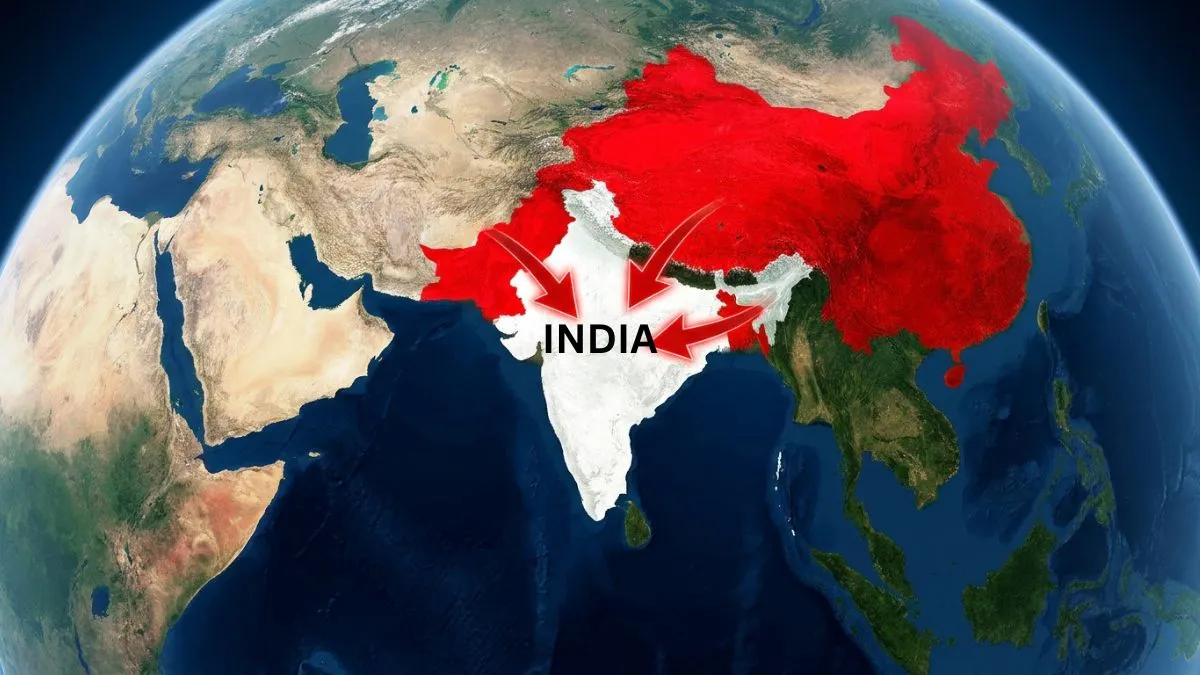
Bangladesh’s interest in joining the pact within days, under a Bangladesh-first foreign policy, is a faster gravitational pull than Delhi’s expectations. Now, for India, this potentially growing defense bloc is raising challenges on its eastern and western borders – Pakistan to the west and Bangladesh to the east.
Timeline: Pakistan’s Rise and India’s Sharp Regional Decline
| Date | Event | India’s Response | Pakistan’s Response |
| April 2025 | Pahalgam attack | India blamed Pakistan for Pahalgam attack with disputed evidence linked to Pakistan | Pakistan proposed an independent, transparent probe led by a neutral commission of international experts. |
| May 7, 2025 | India launched Operation Sindoor in the early hours of May 7, 2025 | India carried out midnight airstrikes and missile attacks, targeting nine locations inside Pakistan | Pakistan responded and claimed to have downed multiple Indian jets, including a Rafale. India later partially acknowledged losses |
| May 8 – 9, 2025 | Drone, Missiles & Electronic Warfare | India launched aerial warfare with BrahMos missiles and Israeli-made Harop and Heron drones | Pakistan responded with electronic warfare |
| May 10, 2025 | Pakistan launched Operation Bunyan-un-Marsoos | India accepted Marco Rubio’s earlier call for mediation. | Pakistan launched attacks with Fateh-1 ballistic missiles that caused heavy damage at Indian airfields in Pathankot, Bhuj, and Udhampur |
| May 16–17, 2025 | India initiated a global diplomatic outreach program | India dispatched seven all-party parliamentary delegations to over 30 countries, but failed to sell the anti-Pakistan narrative. No country, not even Israel, assured any diplomatic support to India or made any statement against Pakistan | China, Turkiye and Azerbaijan rendered full support at all levels to Pakistan |
| February 28, 2026 | US-Israel strikes on Iran begin; Iran’s Supreme Leader killed. | No condemnation from India on the killing of the Iranian Supreme Leader | Pakistan took a strong stance in favor of Iran |
| April 11-12, 2026 | Islamabad Talks | India failed to take a role in peace talks | Pakistan positioned itself as the only credible bridge between Washington and Tehran and hosted the peace talks between the two in Islamabad. |
| May-July 2026 | Cockroach Janta Party and nationwide protests | Cockroach Janta Party founded in India and nationwide protests forced resignation of India’s Education Minister | Pakistan continued its backdoor mediations with Qatar |
| August 7, 2026 | Makkah Joint Defense Agreement | India continued its diplomatic engagement with Taliban-ruled administration | Saudi Arabia, Pakistan, and Turkey sign the Makkah Joint Defense Agreement |
| Mid-August 2026 | Bangladesh signals openness to joining the Makkah pact; Egypt and Syria reportedly considering the same | India expressed concerns over Bangladesh’s possible accession to the Makkah Pact | Pakistan welcomed Bangladesh’s openness to joining the Makkah pact |
How Pakistan Rebuilt Its Regional Standing
In May 2025, India and Pakistan fought their most intense conflict in decades following a Pahalgam attack. Pakistan claimed it shot down several Indian fighter jets, including a French Rafale. India initially denied the losses, then later acknowledged an unspecified number of aircraft were downed.
In February 2026, a US-Israel military campaign against Iran that killed Iran’s Supreme Leader, Pakistan positioned itself as the only credible bridge between Washington and Tehran, drawing on decades of Pakistan-Iran relations as a neighboring Muslim-majority state.
It brokered a ceasefire and hosted the Islamabad Talks in April 2026, the first direct US-Iran negotiations on Pakistani soil since 1979. The Council on Foreign Relations called it “a remarkable role change” for a country long treated as a diplomatic pariah. The rise is real.
A conflict that tarnished India’s air supremacy and helped Pakistan’s emergence as an indispensable regional mediator, followed by a defense deal with the Saudis and later the Makkah pact with Saudi Arabia and Turkiye, is the throughline critics of Indian foreign policy point to when arguing New Delhi lost the initiative in its own neighborhood.
A Three-Sided Squeeze on India’s Borders
India’s current border situation looks genuinely difficult.
| Western | Pakistan | Makkah Pact anchor, US-Iran mediator | Elevated regional rival with new defense framework |
| Northern | China | Afghanistan leverage, CPEC | China-Pakistan-Afghanistan axis consolidation |
| Eastern | Bangladesh | CMBC corridor, Makkah Pact interest | Loss of closest regional partner |
On the western side: Pakistan is now an elevated regional power, having served as a mediator in the US-Iran conflict and as an anchor of a new regional security framework following the Makkah pact, with Pakistan allies now extending from Riyadh to Ankara.
The full economic and diplomatic consequences of Pakistan’s role as a mediator, as well as what Islamabad could extract from Washington in return, are examined here.
On the northern side: China, whose investment and influence in Afghanistan give it leverage that could plausibly help stabilize tensions in Pakistan Afghanistan relations, a dynamic that would further consolidate a China-Pakistan-Afghanistan axis on India’s northern and western borders.
On the Eastern side: Bangladesh, which used to be one of India’s closest regional partners, historically, is now signaling openness to a Pakistan-anchored bloc and pursuing an explicitly ‘Bangladesh First’ policy less deferential to Delhi.
Beyond Saudi Arabia and Turkiye, Qatar, Bahrain, Bangladesh, Iran, and Egypt have all been mentioned in discussions about the pact’s expansion, and the picture is of a widening bloc of Muslim-majority states coordinating defense policy, with Pakistan at the center. However, India allies in the Gulf region are the UAE and Israel, who are against this Islamic bloc or ‘Islamic Nato’.
The China Angle: A Separate but Parallel Pressure Point
Considering its role in the Makkah pact is a visible sign of Bangladesh’s efforts to free its foreign policy from Indian influence.
During Prime Minister Tarique Rahman’s state visit to Beijing in June 2026, China proposed reviving the China-Myanmar-Bangladesh Economic Corridor (CMBC), a transport link connecting China’s Yunnan province to the Bangladeshi ports of Chittagong and Mongla via Myanmar, extending Beijing’s existing 1,700-kilometer China-Myanmar Economic Corridor.
Although the CMBC proposal was not finalized, Bangladesh’s Foreign Office confirmed that Dhaka is currently examining the plan and has taken no position on it so far.
The CMBC and the Makkah pact are not unconnected initiatives in different domains. What connects them is a shared underlying cause: Bangladesh’s foreign policy has grown more willing to diversify beyond India-centric alignment since the government changed in August 2024.
This realignment is one front in the broader great power economic competition, in which China is systematically converting every reduction in American reliability into durable economic and strategic positioning.
Bangladesh’s parallel move toward Chinese weapons systems reflects its approach to greater freedom to make independent defense decisions since that political transition.
India’s Real Strategic Assets at Stakes
- Western and Eastern Maritime sides: A commercially built Chinese port network in Chittagong and Mongla raises the same fears India has long had about the Pakistani port of Gwadar, where Chinese-funded infrastructure could support naval intervention to squeeze India from both its western and eastern maritime sides.
- The Siliguri Corridor. The proposed route would bring Chinese-linked infrastructure and logistics closer to the Siliguri Corridor, or Chicken’s Neck, the 22-kilometer narrow strip connecting India’s mainland to its northeastern states, a chokepoint Indian military planners treat as a top-tier vulnerability.
- Bypassing the Malacca Strait. A route from Yunnan to the Bay of Bengal would also reduce China’s dependence on the Strait of Malacca for trade and energy access, a leverage India and the US currently hold over Chinese sea traffic.
- A move toward independent defense decisions: Bangladesh is all set to purchase Chinese J-10CE fighter jets and attack helicopters to modernize the Bangladesh Air Force.
The Economic Signal And Domestic Pressure: Nobody in Delhi Wanted
The IMF’s recent World Economic Outlook showed Bangladesh’s GDP per capita edging past India’s, at $2,911 to $2,812, while the IMF projects India will retake the lead by 2027.
Calling this an economic collapse would be incorrect. What it accurately represents is a symbolic setback layered onto a difficult diplomatic year, a signal that India’s regional economic dominance is not as automatic as it once looked, at a moment when its diplomatic standing is also under pressure.
Moreover, India’s external difficulties have coincided with real domestic unrest. The Cockroach Janta Party, a Gen Z-led protest movement that emerged in May 2026 after a Chief Justice compared unemployed youth to cockroaches, grew into the largest domestic political challenge of Prime Minister Modi’s twelve years in office.
Triggered by exam-leak scandals and youth unemployment, the protests forced the resignation of India’s Education Minister in July 2026 and have been described by risk analysts at Verisk Maplecroft as placing India in the top 10 of their global Civil Unrest Index.
Although this is a domestic governance and youth employment issue and has no direct connection to foreign policy, it adds pressure on the Indian government, which is managing multiple fronts simultaneously.
None of the pressures described above would collapse India into pieces, but what’s harder to dispute is the timing: structural and strategic partner shifts, Pakistan’s rise as a mediator, a new regional security framework under the Makkah pact, economic and domestic unrest have all landed in the last 12 months, putting Indian foreign diplomacy into abeyance, practically.
Whether India can simultaneously restore its regional standing, manage domestic unrest, and counter a coordinated China-Pakistan strategic architecture will define South Asian geopolitics for the next decade. The window for course correction is narrowing.
Read more analysis in our Great Power Economics section.