Why is the Strait of Hormuz Important? The $2M Toll Rewriting Asia’s Shipping

⏱️ 3.5Mins Read
If global logistics directors ever asked why is the Strait of Hormuz important, a recent $2 million transit fee imposed on a single vessel and the resulting spike in oil prices provided a devastating answer.
According to Lloyd’s List, this unprecedented toll, collected during a previous closure, has turned a vital global chokepoint into a massive financial liability. This one incident is now haunting every shipper across the globe, forcing them to treat this crisis as proof of concept to seriously consider Pakistan’s regional connectivity.
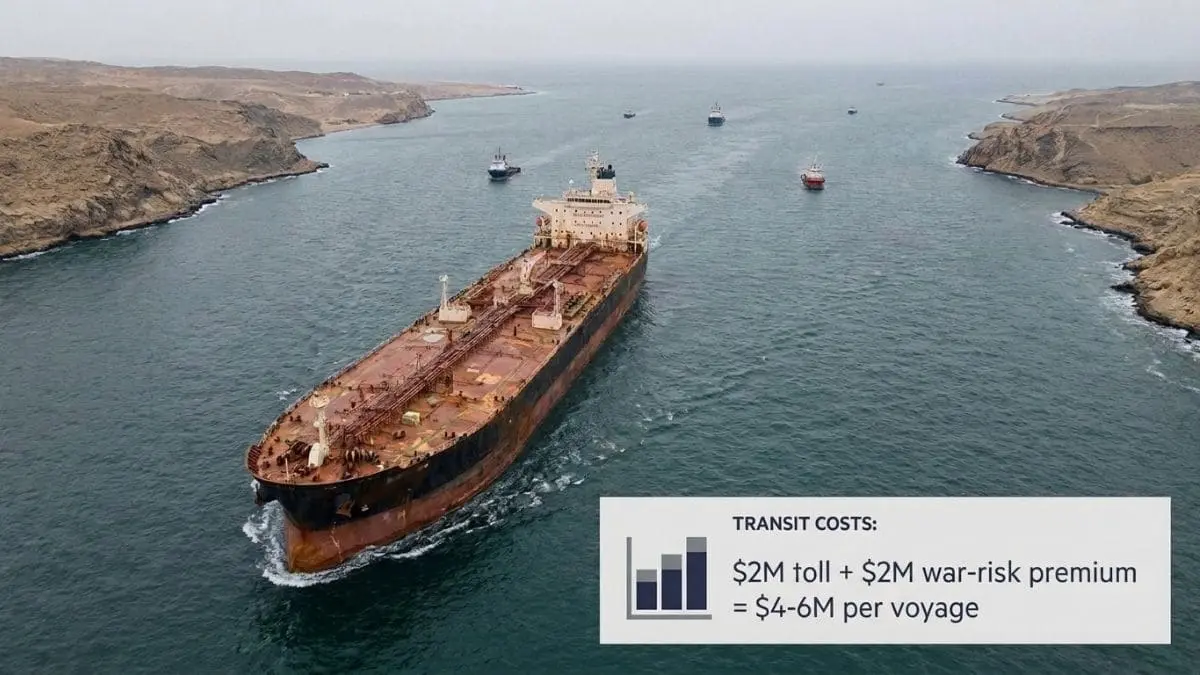
That single transaction is likely to set the benchmark for Iran and Oman, which plan to charge a transit fee on every vessel passing through the Strait of Hormuz for reconstruction purposes. The $2 million transit fee, combined with high war-risk insurance, will create an estimated burden of $4 million to $6 million per voyage.
This single US$2 million payment is now haunting shippers worldwide, and shipping-line boardrooms are weighing options: pay a toll on a politically unstable waterway. Washington’s answer to that calculation is not just military escorts; it is a $10 billion infrastructure fund designed to make the toll-paying question permanently irrelevant by building energy corridors that bypass Hormuz entirely.
This reshaping of Asia’s shipping map is one front in a much larger battle: the great power economic competition between the US and Iran that is forcing every regional player to redesign their trade architecture.
The Permanent Cost: Why the Strait of Hormuz Remains a Chokepoint
The critical question being asked of every logistics director is not whether the Strait of Hormuz is currently open, but whether it will stay open, and at what permanent cost?
Iran and Oman are expected to levy a formal transit fee during the ceasefire period, with revenues earmarked for regional reconstruction. The mechanism will be framed as temporary, but it certainly will not be because this approach is inspired by successful chokepoint monetization examples – the annual revenue of transit fees from the Suez Canal and the Panama Canal is approximately $ 7- 8 billion and $ 4- 5 billion, respectively.
Reconstruction in the region will take years. Any formalized fee structure established during this period will be cited as precedent in every subsequent negotiation, and a toll booth, once legitimized by ceasefire terms, becomes a recurring revenue stream that both countries want to revert in the future.
The Two-Week Window
Unlike oil markets, the global shipping lines react much more slowly. A two-week ceasefire is hardly enough for a mega-vessel to complete its voyage from Asia to Europe. Shipping lines will likely remain cautious until a permanent agreement is signed, most likely after the recent diplomatic talks in Islamabad.
Insurance Premiums Won’t Vanish Instantly
Even with the Strait officially reopened by Iran, underwriters will not slash those 1% to 5% war-risk premiums back to baseline overnight. The geopolitical situation remains incredibly fragile. Insurers will likely wait to see when the next ceasefire happens and how long it will hold before drastically reducing rates, meaning the financial pain of the Hormuz route persists in the short term.
The Accident That Became a Strategy
Karachi ports didn’t plan for this, nor did shipping lines intentionally choose Pakistan. They were pushed here when the strait became impassable. But in those first 24 days of March 2026, Pakistan’s ports absorbed more transshipment cargo than in the entire preceding year. The surge was accidental.
What happened next was not accidental, and it mirrors the deliberate infrastructure pivot the UAE made when it accelerated its Hormuz bypass to secure its position as the region’s dominant energy corridor.
Pakistan’s government appears proactive for the first time, making deliberate amendments to the rules to ensure maximum facilitation.
A high-level committee constituted by the Prime Minister, led by Federal Minister for Maritime Affairs Muhammad Junaid Anwar Chaudhry, has moved faster than most observers expected.
The government has formally authorized bulk and break-bulk transshipment, Roll-on/Roll-off vehicle cargo, and Less than Container Load operations: three cargo categories that were previously legally restricted. These approvals formalize capabilities that should have existed years ago.
Pakistan’s Strategic Profile Just Skyrocketed
Pakistan is no longer just offering alternative port capacity; it is now the central diplomatic bridge that brokered the ceasefire. By hosting the recent diplomatic talks in Islamabad and proving it can navigate the region’s most volatile security crisis, Pakistan has significantly boosted its credibility.
For global logistics companies, this makes utilizing Karachi port, Port Qasim, or Gwadar look much less like a desperate backup plan and more like a strategically sound, long-term pivot to a stabilizing regional player.
Compare that calculus to Pakistan’s present offer: no toll, naval escorts already positioned, and a port system that just demonstrated that it can absorb surge volumes.
The Structural Gap Pakistan Cannot Ignore
The honest analysis requires confronting what Pakistan cannot yet offer. The new policy approvals address what Pakistan is now willing to handle, but they don’t address whether Pakistan can handle it consistently at scale under the current governance structure, especially when Dubai responds with aggressive pricing to reclaim diverted traffic.
Although Pakistan has improved its ranking from 35th on the Linear Shipping Connectivity Index 2026, it has not surpassed India (9th), the UAE (16th), or Sri Lanka (20th). Similarly, UNCTAD reported that Pakistan’s merchant fleet is roughly 22 vessels, compared with India’s 1,200-plus and the UAE’s approximately 1,600.
No transshipment hub can sustain itself without feeder vessels and port technology to match the volumes. Pakistan Port documentation remains heavily paper-dependent, and integration with Pakistan Single Window is incomplete.
Turning a wartime measure into a permanent advantage is a different challenge that requires investment, not emergency policy announcements.
The Question That Matters
Will the shipping line executives evaluate whether the Strait of Hormuz, now burdened with transit fees, elevated geopolitical risk, and a ceasefire that every analyst privately considers fragile, is a single point of dependency?
Their answer will decide whether the surge at Karachi ports was merely a wartime anomaly or proof that Pakistan’s ports have achieved what its policymakers failed to do for decades.
Read more analysis in our Great Power Economics section.