How Chinese Hybrid Cars Bypass EU Tariffs: The New Trade War Reality

⏱️ 3 Mins Read
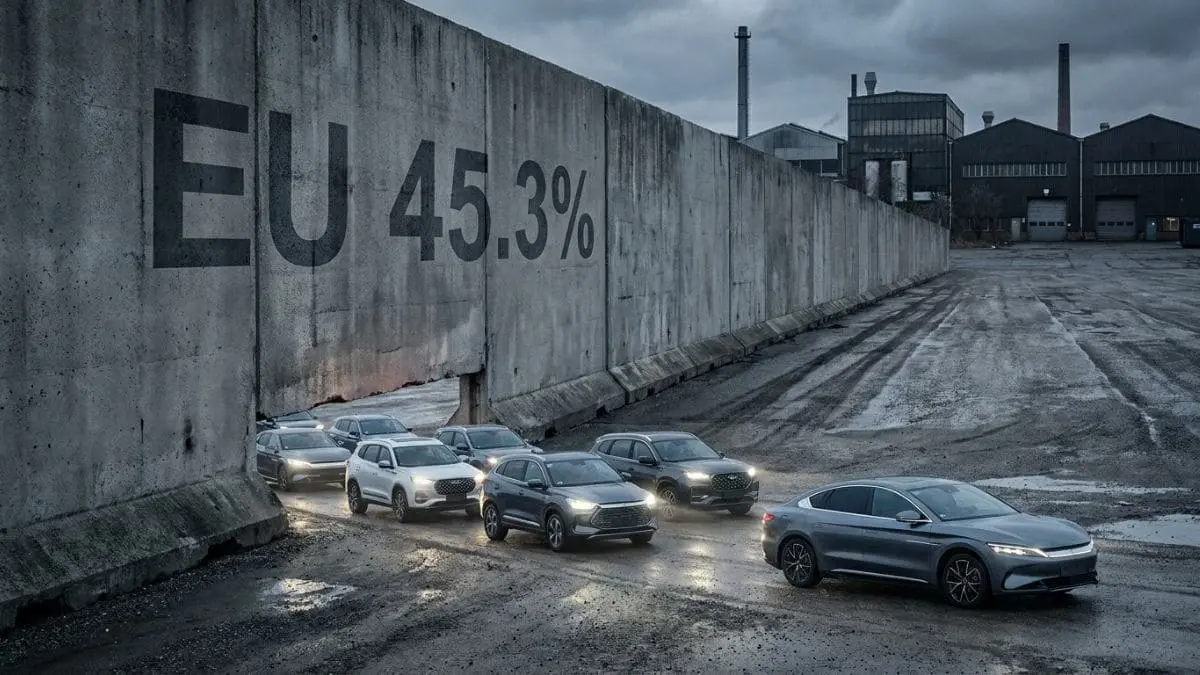
The European Union (EU) spent two years building a tariff wall against Chinese battery electric vehicles. Chinese manufacturers walked around it.
When the EU imposed additional duties up to 45.3% on Chinese BEV imports two years ago, Beijing’s automakers didn’t exit the market. They rapidly shifted exports toward Chinese hybrid cars, which continued to face only the standard 10% import duty.
As a result, Chinese automakers aggressively influenced this loophole by diverting their European exports toward hybrids.
Why the Tariff Wall is an Industrial Illusion
Exploiting a massive regulatory gap, Chinese hybrid cars rapidly flooded the market with models not subject to anti-subsidy duties.
Chinese hybrid cars brands like BYD and Chery rapidly boosted hybrid sales across the bloc, turning plug-in hybrids into their primary growth vehicle to avoid heavy penalties.
The European regulators, after recognizing the shift, initiated steps to expand the ambit of anti-subsidy probes and prepare equivalent duties on Chinese plug-in hybrids. However, this regulatory expansion didn’t yield results, especially in the BYD case, which followed its vertical integration in Europe.
In May 2026, BYD became Germany’s top-selling plug-in hybrid brand with 4,290 registrations, which is accounting for over 15% of the plug-in hybrid market segment. Chinese hybrid cars brands nearly doubled their market share, raising their combined total to around 6%.
The broader European market data for H1 2026 captures this massive shift in consumer preference:
- The Hybrid Dominance: Hybrid-electric car registrations accounted for 37.3% of the EU market (2,198,148 units), making them the preferred choice among European consumers, with strong growth led by Italy (+23%) and Spain (+20.8%).
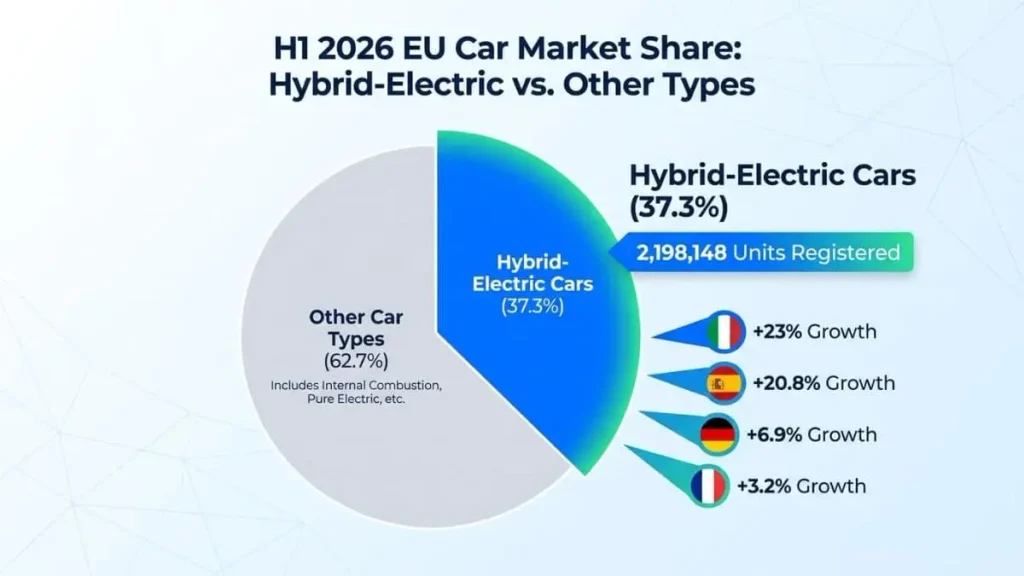
- The PHEV Surge: Around 577,735 plug-in hybrid electric cars have been registered in H1 2026, up from 8.5% of EU registrations in 2025 to 9.8%. This is driven by a major sales surge in Italy (+84.3%), Spain (+39%), and Germany (+17.9%).
- The Decline of ICE: The combined market share of traditional petrol and diesel cars declined sharply to 29.7% in H1 2026, down from 37.8% in 2025.
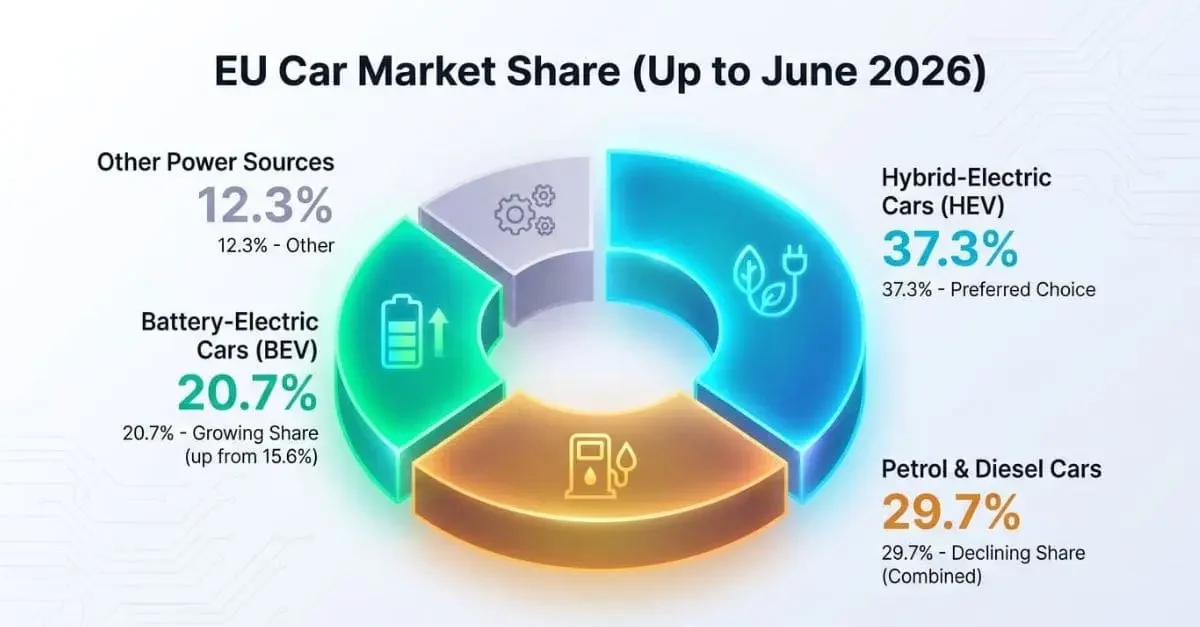
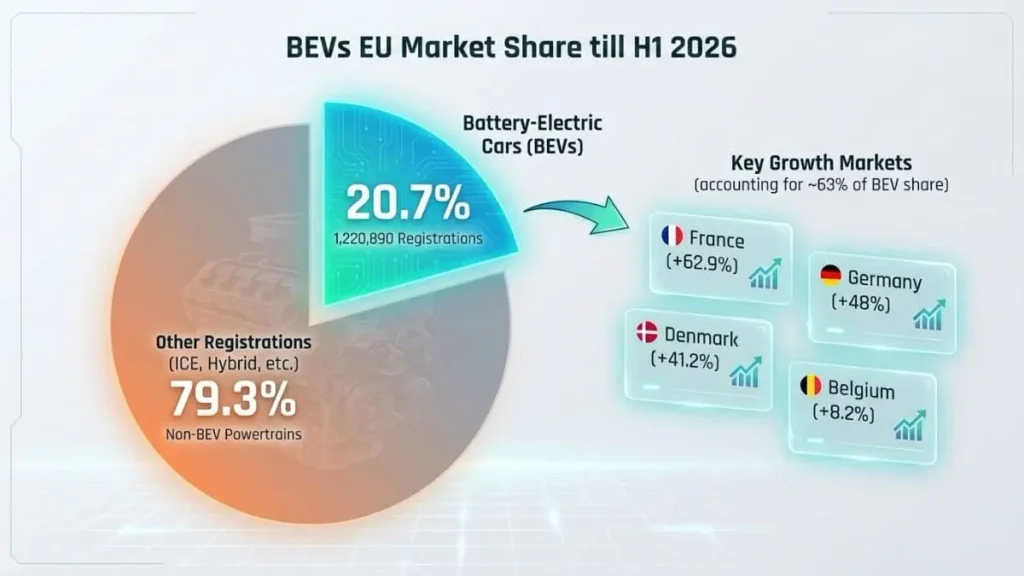
- Battery-electric cars also grew to 20.7% of the market (1,220,890 units), fueled by major gains in France (+62.9%) and Germany (+48%), but Chinese automakers cleverly captured the expanding hybrid and PHEV flank that traditional trade defenses left completely unprotected.
Market Shift & Industrial Impact Snapshot
| Metric / Indicator | Previous Baseline | Current Status | Market Impact |
| Chinese Import Share | 35% of cars shipped to EU | 54% of cars shipped to EU | Accelerated displacement of legacy imports |
| EU PHEV Import Mix | 37% from China | 60% from China | Bypass BEV tariffs |
| Supplier Redundancies | Pandemic lows (2020–2021) | Massive job cuts in a single year | Unprecedented strain on German supply chain |
| BYD German Registrations | Negligible / Market entry | 4,290 units (single month) | Becomes Germany’s top PHEV brand |
The German Auto Collapse: Beyond Volkswagen
The shockwaves are striking Europe’s industrial core. Volkswagen plans to reduce its workforce by up to 100,000 by 2030. Protests have erupted across Germany as overcapacity clashes with structural decline.
Suppliers are bleeding faster:
- ThyssenKrupp cut 1,800 jobs in its automotive division.
- ZF Friedrichshafen announced plans to gradually reduce its domestic workforce in Germany by 11,000 to 14,000 jobs by the end of 2028
- Bosch, ZF, Continental, and Schaeffler announced tens of thousands of job cuts in a single year amid a severe slump in the European EV transition, surpassing pandemic-era redundancies.
- The German Association of the Automotive Industry (VDA) estimates the sector has shed roughly 55,000 jobs over the past two years.
Why Traditional EU Trade Defense is Too Slow
Traditional trade defense instruments (TDIs) of the EU are not well aligned with the increasingly rapid lifecycle of modern clean technologies. The mechanisms are designed to protect legacy industries linked to earlier industrial revolutions, in which sectors such as steel and textiles were traditionally central to trade and defense policy.
By the time the EU’s bureaucratic machinery identifies an asymmetric economic threat, investigates it, and imposes a tariff, the market reality on the ground has already shifted, leaving local manufacturers exposed to obsolete protections.
In China’s case, the EU’s anti-subsidy tariffs are a classic example of TDIs’ limitations, as investigations under EU anti-subsidy procedures can take up to 13 months from the initial launch.
However, the Chinese competitors refresh vehicle software and battery hardware every 18 months, and this lengthy investigation process means European regulatory protections are structurally outdated by the time they are legally enforced.
The Strategic Vacuum
Global carmakers remain heavily dependent on Chinese supply chains for batteries and critical materials. The EU automobile industry, a major part of the global EV industry, is seeking alternatives before firing a trade bazooka against China.
Berlin has shifted its long-standing approach of keeping trade and politics separate. Germany is now quietly cataloging where China relies on EU technology such as chip-making gear, specialty chemicals, and industrial lasers to prepare defensive economic options and back the EU’s Anti-Coercion Instrument, as tariffs have failed to stop the expansion of Chinese hybrid cars.
Now, Chinese manufacturers, rather than paying high import duties, are accelerating their onshoring strategy in Europe. Once these assembly lines at BYD’s factory in Hungary and Chery’s joint venture in Spain go live, vehicles legally become ‘Made in Europe with zero import duties, and then the real testing time for EU legacy brands commences.
Read more analysis in our Great Power Economics section.