What If China Invades Taiwan – An Energy Strait Blockade?

⏱️ 4 Mins Read
What if China invades Taiwan and triggers an energy strait blockade? This is no longer a distant thesis, but a priced-in market reality where the immediate collapse of the ‘uninsurable waters’ premium acts as a direct tax on global trade, forcing a hard economic fracture between the Global North and South.
📌 Executive Brief
- Semiconductor indices reflect near-term risk: SMH down -19.81% and TSMC down -17.94% in one month.
- Oil Price Volatility: Signaling tightening supply expectations as shipping lanes become uninsurable.
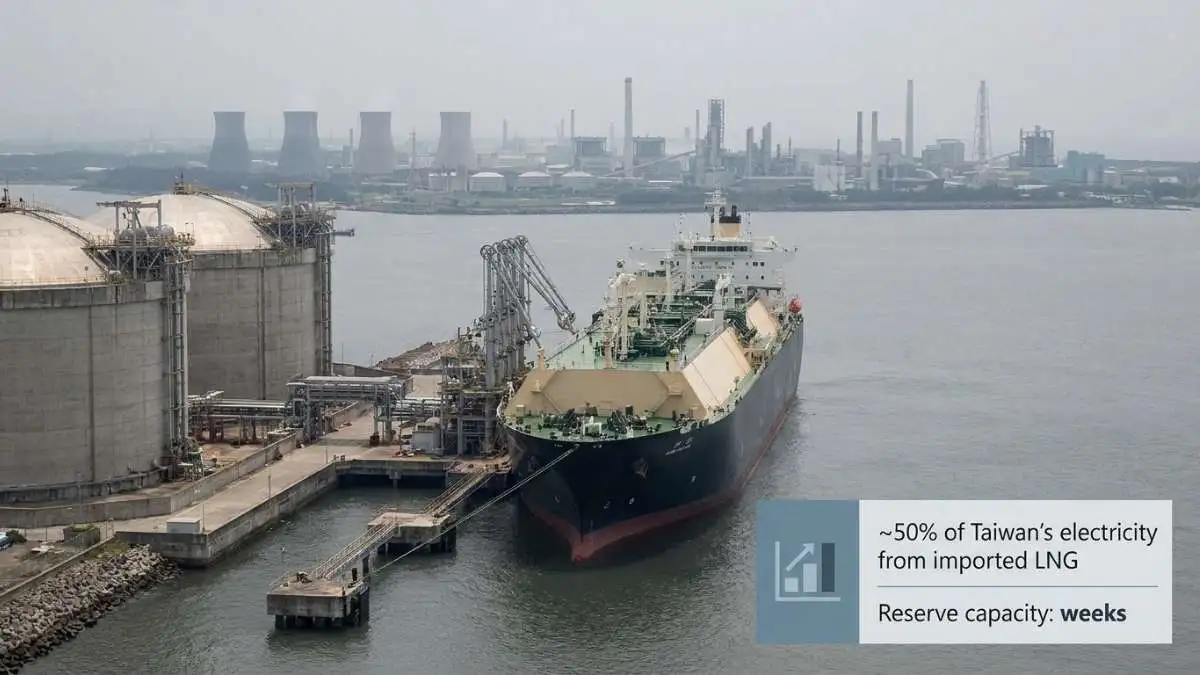
- Taiwan’s 50% LNG dependency: With only weeks of reserve capacity, this directly threatens TSMC’s operational viability during a blockade.
- Over 90% of advanced microchips are produced in Taiwan: A conflict immediately freezes global electronics, military, and automotive manufacturing.
With nearly 50% of electricity generated from imported LNG and only weeks of reserve capacity, an energy strait blockade would trigger brutal triage between civilian infrastructure and heavy industry, threatening TSMC’s operational viability.
While recent volatility in semiconductor indices (like SMH dropping 19%) is heavily influenced by AI-cycle adjustments and macro headwinds, the extreme geographic concentration of advanced chipmaking bakes a permanent ‘geopolitical risk premium’ into these assets. Investors know that any escalation in the Strait instantly transforms standard market corrections into a structural hard stop.
Market Already Signals Hard Stop Scenario
| Category | Metric | Value |
| Semiconductor Market | SMH ETF 1-Month Change | -19.81% |
| Semiconductor Market | TSMC (TSM) 1-Month Change | 17.94% |
| Energy Prices | Oil Pirce | Over $100 |
| Energy Security | Taiwan LNG Electricity Share | ~50% |
| Supply Chain | Advanced Chip Production | >90% |
What Would the US Do If China Invades Taiwan?
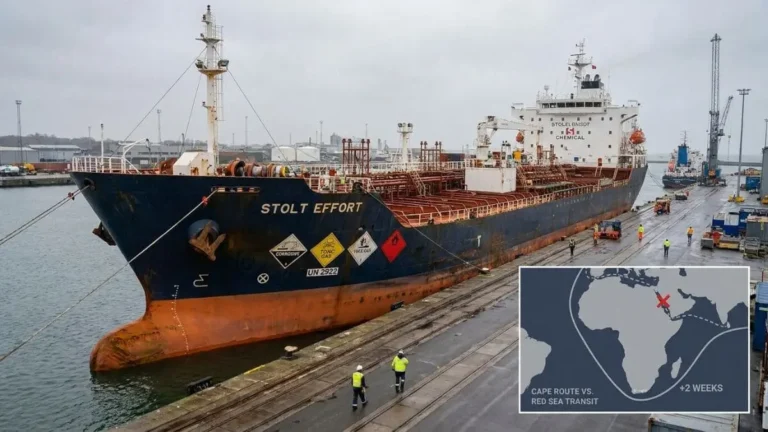
Following Trump’s recent statement about planned arms sales to Taiwan – a good negotiating chip in dealings with China- the US would likely deploy naval assets to secure uninsurable waters, forcing vessels onto circuitous routes, highlighting the great power economic competition.
This logistical friction would act as a direct tax on global trade, driving up freight costs while accelerating the pivot toward alternative energy flows from North America and Australia.
This response would not be merely military; it would be economic. With over half of seaborne oil trade passing through East Asian lanes, a blockade renders key shipping lanes uninsurable.
This would force a scramble for LNG and oil exports, creating a parallel, Russia-centric energy market for China outside Western oversight. The Taiwan Strait’s strategic dominance means conflict directly taxes global trade, making the US response a critical stabilizer for maritime logistics.
Furthermore, the US would also address the immediate financial collapse in the tech sector, as this disruption would freeze automotive and medical manufacturing globally, since Taiwan produces over 90% of advanced microchips. US intervention is essential to prevent permanent de-risking from exposure to Taiwan-based manufacturing.
Could Taiwan Defeat China in a War?
Taiwan cannot win a conventional war, but it employs a “Porcupine Strategy” to make an invasion prohibitively costly. Its domestic energy mix is a critical weak point: nearly 50% of electricity comes from imported LNG, and it has only weeks of reserve capacity, forcing triage between civilian infrastructure and heavy industry.
This domestic vulnerability amplifies the global shock. A blockade would force a hard choice: ration power for homes and hospitals or keep TSMC operational. This domestic power rationing directly threatens the foundry’s viability, meaning the global semiconductor halt is a fundamental power-supply failure. The Federal Reserve Bank of St. Louis projects the economic fallout to surpass the 2008 financial crisis, wiping out trillions of dollars from the global economy.
Financial markets are currently navigating severe macro headwinds, but their underlying volatility exposes a deeply embedded geopolitical risk premium.
While the recent drop in TSMC and heavy losses in the VanEck Semiconductor ETF (SMH) are largely influenced by AI capital expenditure cycles and shifting interest rates, this volatility underscores the extreme danger of an industry concentrated in a single geopolitical flashpoint.
With oil prices spiking due to Middle East tensions and supply constraints, the global energy market is operating with zero buffer, highlighting that the global economy is stretched to its limit.
Any disruption in the Taiwan Strait would not just add to existing friction, but act as a catalyst for an irreversible systemic shock, validating that Taiwan’s resilience is the ultimate linchpin of global stability.
What Are The Strategic and Deterrence Options?
The US and allies must secure alternative LNG flows from North America and Australia to bypass straits, disconnecting global energy security from such immediate threats.
Taiwan’s nearly 50% of electricity comes from imported LNG, and a blockade would force a triage between civilian infrastructure and heavy industry. Strategic options include accelerating the pivot toward a parallel energy market for China, while Japan and South Korea would scramble for increased exports from the West.
Strategic Action
The convergence of semiconductor fragility and energy dependency creates systemic risk that exceeds traditional geopolitical boundaries.
With oil futures already pressured by broader global supply constraints, current price dislocations expose an international market operating without a safety net.
If the Taiwan Strait is forced into becoming a zone of uninsurable risk, the global economy currently lacks the buffer to absorb the blow. The immediate imperative is to diversify energy sources and build strategic reserves, recognizing that a ‘hard stop’ in chip production would irreversibly shock global industrial capacity.
Policymakers must move beyond strategic ambiguity toward concrete energy security frameworks.
The long-term outlook requires fundamentally restructuring global supply chains to eliminate catastrophic single-node dependencies. Because the financial sector is already straining under existing macro vulnerabilities, inaction on Taiwan would impose a devastating, immediate tax on global trade.
Nations must accelerate the pivot toward alternative energy flows and redundant manufacturing, ensuring that a potential blockade does not trigger a cascading failure across the global economy.
Read more analysis in our Great Power Economics section.