APEC Summit 2026: Trump, Xi and the US-China Trade Truce

⏱️ 5 Mins Read
The Busan truce is under strain, not yet broken. Washington says Beijing is falling short on rare earths and some farm purchases; Beijing disputes that and points to US restrictions of its own; and the agreement now expires on January 10, 2027.
That mutual suspicion is already changing how supply chains are built and where commodities flow, and it will frame the leaders’ meeting at the APEC Summit 2026 to be held in Shenzhen in November.
📌 Executive Brief
- Tariff ceiling: Busan capped the tariffs the US added in Trump’s second term at about 20%, which is a ceiling on add-ons, not the whole burden. Many Chinese goods still face effective rates near 30%. Before Busan, the overall US burden was 57%, which the deal cut to 47%.
- Soybeans: China pledged at least 25 million metric tons of US soybeans in each of 2026, 2027 and 2028. US officials describe that pledge as on track; their complaints concern rare earths and other farm goods. Beijing says it will buy more US farm goods only if the US implements a reciprocal tariff-cut deal.
- The clock: The truce was extended from November 10, 2026, to January 10, 2027, but several legal deadlines fall earlier, in November.
Busan Was a Pause, Not a Settlement
The Busan deal, agreed on October 30, 2025, was an exchange of paused weapons, not a settlement. Washington halved its fentanyl-related tariff to 10%, extended Section 301 exclusions and paused port fees, and suspended its “Affiliates Rule” on export controls for a year.
Beijing suspended the sweeping rare-earth export controls it announced on October 9, 2025, promised general licenses for rare earths, gallium, germanium, antimony and graphite, committed to soybean purchases, and agreed to resume sorghum and lumber buying and suspend retaliatory tariffs. Almost nothing was repealed. Every lever sits in reserve, so each delivery shortfall is read as bad faith.
Washington’s case is now explicit. On November 6, Treasury Secretary Scott Bessent and US Trade Representative Jamieson Greer pressed Vice Premier He Lifeng to fully and immediately implement China’s commitments, particularly on rare earths, other critical minerals, and agricultural purchases. They said the US would closely assess implementation.
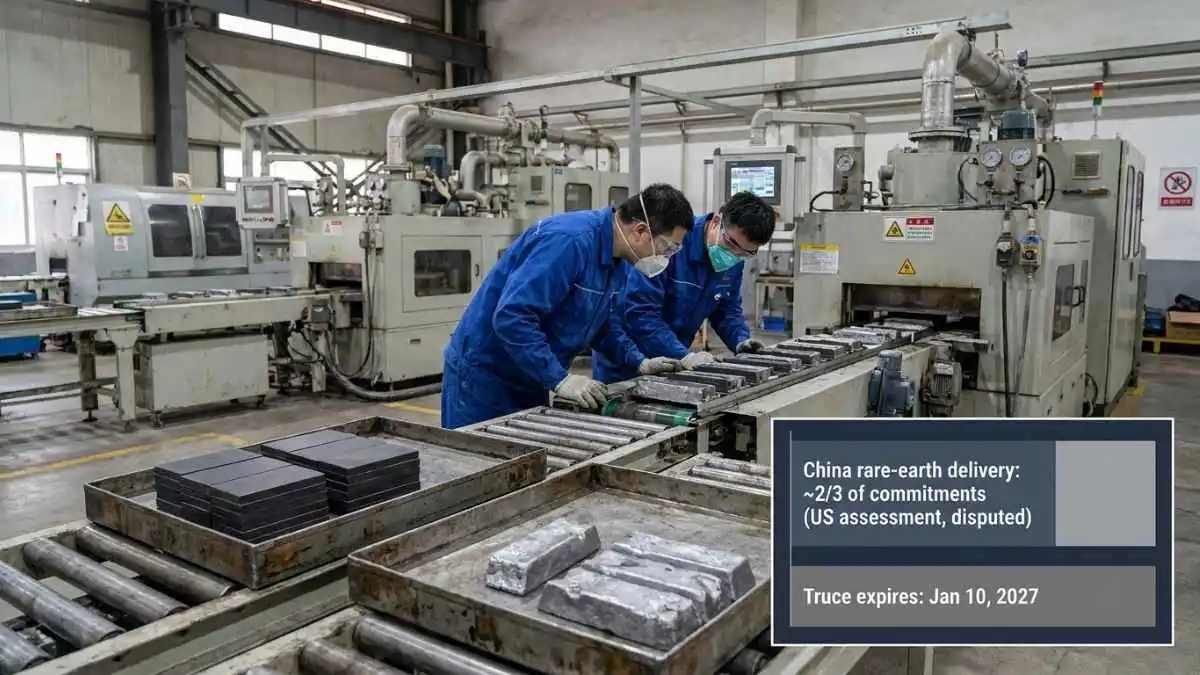
Media reports suggested that China had delivered about two-thirds of its rare-earth commitments and had not raised supply as expected; the restrictions are also hitting Japanese suppliers that serve US manufacturers.
Beijing disputes the US count and has its own grievance list. Chinese officials highlight a series of Federal Communications Commission (FCC) actions against Chinese electronics, drones, routers, robotics, and inverters that they say breach the truce and that their August sanctions on US supply-chain auditors were a response.
A handful of Chinese suppliers then stopped shipping to US companies, and some US firms had waited more than six months for licenses.
On November 5, China’s commerce ministry said it is open to buying more US farm goods only if the two sides implement their reciprocal tariff-cut agreement. Each side is making its next move depend on the other’s.
Conventional wisdom holds that economic interdependence stabilizes rivals. However, the 2026 record suggests otherwise: interdependence has become the instrument. China has not suspended its April 2025 licensing controls on seven medium and heavy rare earths, and the licensing system remains the lever.
The licensing system remains the lever, and that is the mechanism behind great power economic competition: supply chains are being used as weapons rather than as trade ties.
The US also keeps its own instruments in reserve or in use: the dormant Affiliates Rule, the paused port fees, chip-tool restrictions such as the April order to halt shipments to China’s second-largest pure-play contract chipmaker ‘Hua Hong’, and a steady stream of blocklists.
Between June and October, the Pentagon expanded its list of Chinese military companies, China put 10 US firms on its export-control list, the FCC barred foreign-made advanced robots and power inverters, and DHS added dozens of Chinese companies to its forced-labor list, with Beijing retaliating or threatening to each time. The truce has survived it all, but it has not restored trust.
Now, Trump and Xi are expected to meet at the APEC summit 2026 on November 18–19 and again at the G20 in Miami on December 14–15.
A possible three-leader meeting (Trump, Xi and Putin), but it is not confirmed yet. Trump said he would like to discuss nuclear arms control, while Putin wants to talk about Ukraine. Kyiv and European capitals fear decisions on Ukraine could be made without Ukraine, and Chinese officials are reportedly weighing whether a trilateral would overshadow their role as host.
US-China Trade Timeline, 2026
| Tariff Ceiling | US tariffs added in Trump’s second term (Busan) | About 20% ceiling on add-ons; effective rate on many goods near 30% |
| Replacement Tariff | Section 301 forced-labor duty | 12.5% since July 24, 2026 |
| Pre-Busan Burden | Overall US tariff on Chinese goods | 57%, cut to 47% |
| Agricultural Leverage | Soybean pledge | At least 25M metric tons in each of 2026, 2027 and 2028 |
| Soybean Tariff | China’s duty on US soybeans | 10% on top of a 3% baseline; purchases confined to state buyers |
| Other Farm Goods | Additional purchases claimed by the White House | At least $17B a year; not confirmed by Beijing |
| Resource Control | Rare-earth delivery (US assessment) | About two-thirds of commitments; Beijing disputes |
| Export Controls | BIS Affiliates Rule suspension | Extended to January 10, 2027 |
| Maritime | Section 301 port-fee suspension | Extension to January 9, 2027 proposed |
| Policy Deadline | Trade truce expiry | January 10, 2027 |
| Diplomatic Calendar | Expected Trump–Xi meetings | APEC Shenzhen Nov 18–19; G20 Miami Dec 14–15 |
| Diplomatic Shadow | Xi–Trump–Putin meeting | Under discussion; not finalized |
Who Holds the Largest Rare Earth Reserves, and Who Controls Supply?
By reserves, China: roughly 44 million tons of rare-earth oxide, about half of the world total, with Brazil in second place. But reserves don’t give Beijing leverage. China accounts for roughly seven-tenths of mine output and for more than 70% of processed rare-earth metals and magnets. The lever is control over refining, magnet-making and licensing, not geology.
Busan did not change that architecture. China suspended the October 2025 expansion, which reached foreign-made products containing Chinese-origin rare earths, but the April 2025 licensing regime stayed in place.
China began issuing general licenses in December 2025 for approved Chinese exporters. Yet, they do not cover defense or aerospace end users, and China has approved fewer general licenses for European companies than promised, with exports of key materials still below earlier levels.
The next test is a date: the legal suspension of China’s October 2025 controls runs out on November 10. As of early November, Beijing had not published a formal notice extending it, although Bessent says the truce extension covers those controls.
The mistrust is already redirecting investment. Washington has signed a letter of intent for $277 million in direct funding and a $1.3 billion loan for magnet maker USA Rare Earth. On June 22, Beijing added USA Rare Earth and MP Materials, the two federally backed firms furthest along in building a mine-to-magnet chain, to its export-control list; USA Rare Earth says the listing has hurt its ability to source key raw materials.
Trump and Xi at APEC Summit 2026: What Each Side Wants
Trump is expected to meet Xi in Shenzhen for the third time this year, after Beijing in May and Washington in September. He arrives with the November 6 compliance demand; Xi arrives with his own demand: tariff concessions. The leverage is not one-sided. Washington felt China had not met all of its expectations, including some agricultural purchases, and that he did not know whether a bigger deal or another extension would come by January.
The January outcome is therefore not a simple cooperate-or-collapse choice. The options are a broader deal, another extension, or a lapse that would put back several suspended measures. The truce has already been extended once, and only by two months, which China Briefing reads as a sign the two sides are still not aligned on implementation.
Meanwhile, China, while hosting the Summit in November, will bring together about 1,000 officials and executives, and mistrust over the Busan deal sits awkwardly beside that.
What is the current U.S. tariff on China?
There is no single number. Under Busan, the US cut the tariffs it added in Trump’s second term to about 20% (a 10% fentanyl tariff plus a 10% reciprocal tariff), a ceiling China has treated as a red line. In February, the Supreme Court struck down the IEEPA tariffs behind both layers.
After a stopgap global tariff, USTR imposed a 12.5% Section 301 forced-labor duty on Chinese goods from July 24, 2026, and reportedly planned a further 7.5% excess-capacity duty, which would restore the 20% combined. These sit on top of the older Section 301 tariffs and Section 232 duties, so many Chinese goods still face effective rates near 30%. For context, the overall burden before Busan was 57%, which Busan cut to 47%, and the April 2025 peak was 145%.
How the Trade War Shifted From Tariffs to Chokepoints
The dispute has moved from tariffs to control over inputs and market access: rare earths and magnets on one side; chips and tools, port fees, ownership rules and device bans on the other. The core issue is confidence in how Busan is being implemented. The 2026 sequence:
| Date / Period | Event Summary | Key Actions / Details |
| February 20 | Supreme Court Ruling & Trade Investigations | Supreme Court voids IEEPA tariffs; USTR opens Section 301 investigations in March, followed by Chinese retaliatory probes. |
| May 14–15 | Diplomatic Visit & Institutional Setup | Trump visits Beijing; the Board of Trade and Board of Investment are established. |
| June | Military & Export Controls | Pentagon expands its Chinese military company list; China adds ten US firms to its export-control list on June 22. |
| July–August | Tariffs, Bans & Countermeasures | 12.5% duty takes effect; FCC bars foreign-made advanced robots and power inverters; DHS adds 43 Chinese firms to its forced-labor list; China announces five countermeasures on August 5. |
| September 23–27 | State Visit & Tariff Truce | Xi’s state visit to Washington; the truce is extended, and the “30-for-30” tariff-cut lists are published. |
| October 28–November 6 | Entity Listing & Economic Pressure | DHS lists three BGI affiliates; Bessent and Greer press He Lifeng on compliance. |
The $30 Billion Framework
China committed to buying at least 12 million metric tons (MMT) of U.S. soybeans in late 2025 and at least 25 million MT annually for 2026, 2027, and 2028. However, the American Soybeans Association (ASA) said it expects to meet those commitments in full.
China’s tariff on US soybeans remains 10% on top of a 3% baseline, which private crushers will not absorb, so state buyers only make the purchases.
US soybean sales to China in marketing year 2025–26 fell 45% to 12.4 million tons, and Brazilian exports to China hit a record $58.3 billion in the first half of 2026.
On other farm goods, the White House says China will buy at least $17 billion a year in 2026 through 2028, but China’s commerce ministry did not confirm that figure and now ties wider purchases to tariff cuts.
The Board of Trade’s “30-for-30” lists cover about $30 billion of goods per side, valued at 2024 trade levels; they are not purchase commitments and have not yet been implemented. China’s list covers beef, corn, wheat and soybean seed, oil and meal, but not whole soybeans, which remain subject to the 10% tariff.
What to Watch Before the January 2027 Deadline
The measurable gap in Washington’s account is licensing and delivery, not soybeans. The near-term barometer is whether approvals turn into material reaching US manufacturers and their suppliers, alongside whether Beijing publishes its November 10 notice and whether the dispute over FCC actions, which China cites as a breach, is resolved.
It shows up in US-backed non-China magnet capacity and in Beijing’s listing of the firms building it, in state-run soybean buying. The Shenzhen meeting, and the G20 meeting after it, will decide how long those suspensions last, not whether the underlying distrust goes away.
Read more analysis in our Great Power Economics section.