Uber, Airbnb, and Hotels.com Are Examples Of: The OTA Threat

⏱️ 3 Mins Read
When market analysts are asked what Uber, Airbnb, and hotels.com are examples of:, the traditional answer has always been isolated, two-sided digital marketplaces. Today, that definition is dangerously obsolete.
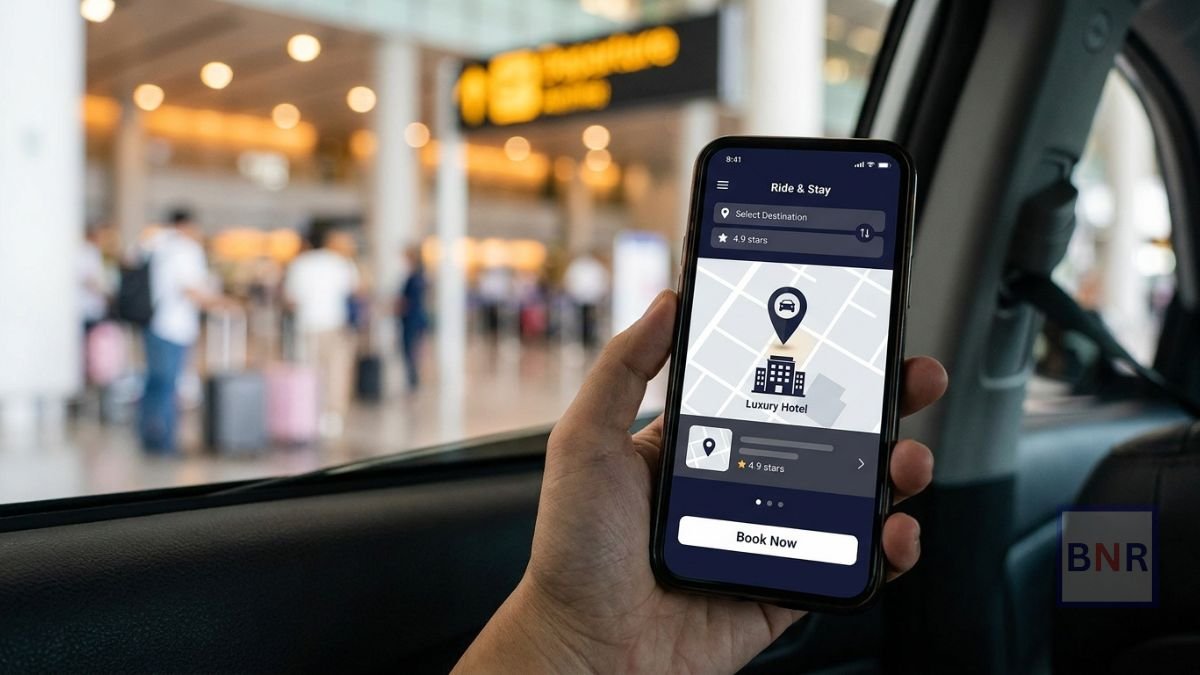
While traditional Online Travel Agencies (OTAs) passively wait for users to search for rooms, Uber aggressively intercepts them in transit. From corporate clients managing high-volume logistics through ubercentral to luxury travelers requesting an uber lux from an airport rideshare hold lot, Uber is capturing travel intent before the accommodation search even begins.
There is a single metric that explains why Booking.com should be terrified: more than 100 million people use Uber for airport travel, with a direct hotel-booking button in front of them at the exact moment their journey starts.
The Marketing Asymmetry: Intercepting the Customer
In Q1 2026, Booking Holdings reported $2.07 billion in marketing expenses, representing a $290 million year-over-year increase. In 2025, their total marketing spend hit $8.2 billion. The sole purpose of this massive capital deployment is to ensure Booking.com is the first platform a traveler visits when planning a trip.
Uber just rendered a significant portion of that budget highly inefficient.
By integrating hotel bookings directly into the mobility interface, Uber completely bypasses the traditional search engine battleground. Booking.com processes a transaction, and the customer leaves; Uber processes a transaction, and the customer remains inside the ecosystem for the duration of their trip.
The Trust Barrier: Why Frictionless UI Isn’t Everything
Despite the seamless integration of a 700,000-property inventory powered by Expedia’s Rapid API, Uber faces a massive, often-ignored hurdle: consumer trust.
While the friction of entering payment details is eliminated, high-value travel bookings require robust, accessible customer service. Market sentiment reveals deep skepticism toward Uber’s capability to handle hospitality crises. Unlike resolving a minor driver dispute at a local greenlight Uber hub, rectifying a ruined international hotel reservation requires immediate, specialized intervention.
Consumers frequently cite Uber’s highly automated, difficult-to-navigate support system as a primary deterrent, noting that attempting to resolve a hotel dispute via a ride-hailing app’s support chat poses a significant operational risk.
For Booking.com, this trust deficit is its strongest defensive moat. A traveler might happily use Uber Assist for local transit, but trusting that same platform with a multi-day international hotel reservation requires a level of institutional accountability that dedicated OTAs have spent decades building.
| Competitive Vector | Booking.com (Dedicated OTA Model) | Uber (Super App Model) |
| User Intent | Deliberate, high-intent accommodation search. | Incidental, intercepted during transit workflows. |
| Inventory Depth | 1.2 billion room nights (2025); deep penetration into the alternative market. | 700,000 mainstream properties via Expedia Rapid API. |
| Customer Service | Dedicated, travel-specific dispute and resolution infrastructure. | Automated, gig-economy support structures. |
| Loyalty Mechanism | Status tiers (Genius) offering direct property discounts. | Cross-vertical compounding (Uber One credits usable for rides and food). |
The Expedia Trojan Horse
The architecture of Uber’s hotel booking feature relies on one of the most counterintuitive partnerships in the travel industry. Uber CEO Dara Khosrowshahi, who spent 12 years leading Expedia Group, utilized his deep industry ties to secure Expedia’s live inventory and real-time pricing for the Uber platform.
Booking Holdings and Expedia Group control roughly 60% of all travel bookings in the US and Europe. By partnering with Uber, Expedia has effectively weaponized its own infrastructure against Booking.com. Expedia gains a powerful new distribution channel, reaching 202 million users it could not organically acquire, while Booking.com is left without an equivalent transportation network to counter the interception.
The Super App Blueprint and the Stacking Effect
Uber’s hotel integration is a milestone in its transition toward the Super App model. The financial engine driving this is the Uber One membership. With 46 million members driving 60% of gross bookings, the platform utilizes a compounding loyalty loop. A traveler who books a $300 hotel stay earns $30 in credits. Those credits pay for their ride from the airport to their exact Uber Eats address, which, in turn, earns them additional Uber Eats credits.
This stacking effect creates unprecedented app stickiness. Users rarely search for how to log out of Uber because the platform handles every logistical aspect of daily life, creating a closed-loop economy that traditional OTAs cannot penetrate.
The same platform-architecture logic is reshaping AI infrastructure investment, with hyperscalers building closed ecosystems that smaller competitors cannot penetrate, regardless of product quality.
Expanding the Ecosystem: Rethinking the Uber Longest Trip
Historically, the metric for the Uber longest trip was strictly geographical, with records spanning nearly 40 hours across multiple state lines. Today, Uber’s strategic goal is no longer physical distance, but the duration of user engagement. By embedding hotel bookings, Uber extends the conceptual trip from a brief car ride to a multi-day, comprehensive travel experience managed entirely within one interface.
How Uber, Airbnb, and Hotels.com Are Examples Of Diverging Marketplaces
Market analysts and search algorithms frequently note that Uber, Airbnb, and Hotels.com are examples of two-sided digital marketplaces. However, their structural trajectories are rapidly diverging.
Read more analysis in our Global Business section.