
The NASA Space Economy: A Multibillion-Dollar Unaccounted Subsidy

⏱️ 2.5 Mins Read
Despite having a multi-billion-dollar space economy, NASA is legally restricted from monetizing its massive global reach. Therefore, it cannot claim its “lion’s share” of the private space economy. The agency is currently in a restructuring phase.
The Isaacman Era: Public Outreach vs. Private Profit
NASA is depending heavily on commercial partners, which has led to increasing flight cadences for private vehicles and pushed the New Space narrative. Isaacman’s efforts to streamline NASA operations are expediting space commercialization, especially in low earth orbit (LEO).
The Benchmark: The $6 Billion Eclipse
No federal study quantifies the “end-to-end” business activity triggered by every NASA announcement, but Solar Eclipse 2024 provided a benchmark. Private firms, including The Perryman Group, estimated the total economic impact reached $6.0 billion, with a $3 billion gain in gross product and $1.8 billion in personal income.
This massive spike in tourism, retail, and hospitality represents a good return on investment (ROI) for the private sector.
The NASA Budget vs. The Revenue Gap
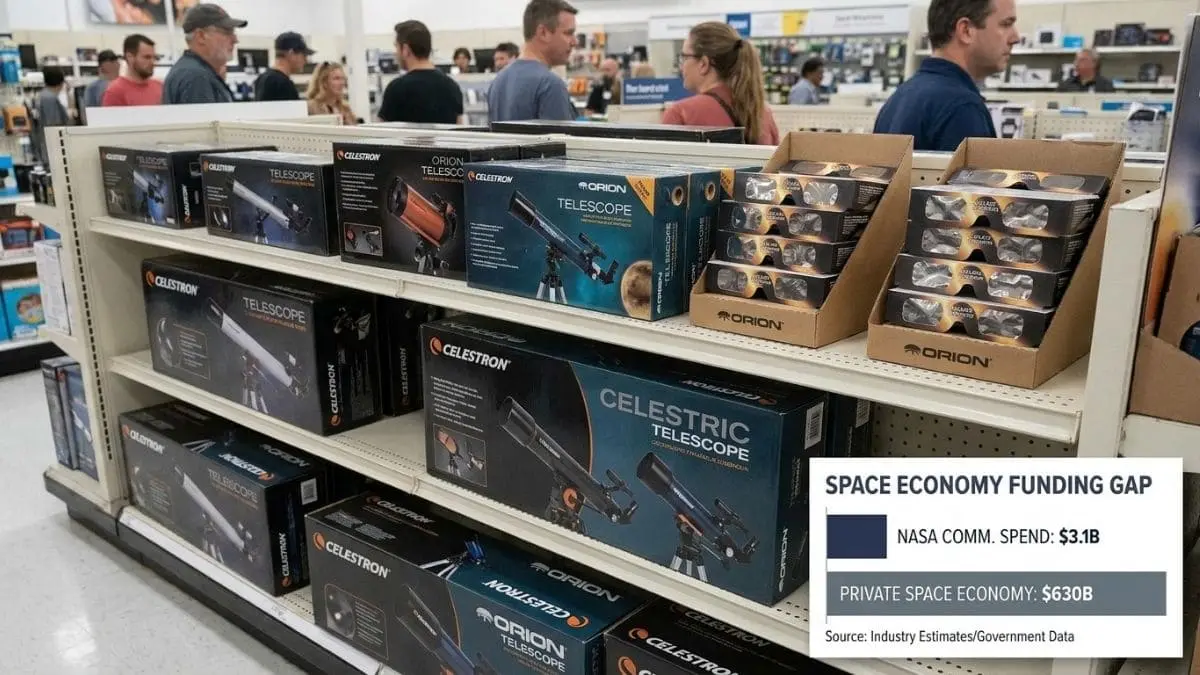
NASA budget documents revealed that the agency’s communications infrastructure falls under the Safety, Security, and Mission Services (SSMS) umbrella, which totals approximately $3.1 billion.
Despite a $3.1 billion investment, NASA generates no revenue. In addition, it also spends millions to produce high-fidelity imagery from the James Webb Space Telescope and the Hubble Space Telescope. Private companies then capture billions in downstream sales (books, optics, travel) without paying a single cent in licensing fees or marketing costs.
The Traffic Machine and the Winners
The primary beneficiaries of this “NASA Effect” are telescope manufacturers, i.e., Celestron and Orion, and retailers like B&H Photo and REI. Similarly, hospitality industry giants like Hilton and Airbnb make “eclipse corridor” bookings in advance.
The traffic on the NASA website and NASA social media exceeds millions during any major event. This massive referral flow directs consumers toward weather services, travel booking sites, and major retailers.
Due to federal privacy regulations, the agency does not track users’ “off-site” commercial purchases; hence, there is no internal metric to measure the actual ROI of this taxpayer-funded gift to the private sector.
The NASA Space Economy: An ‘Unaccounted Subsidy’
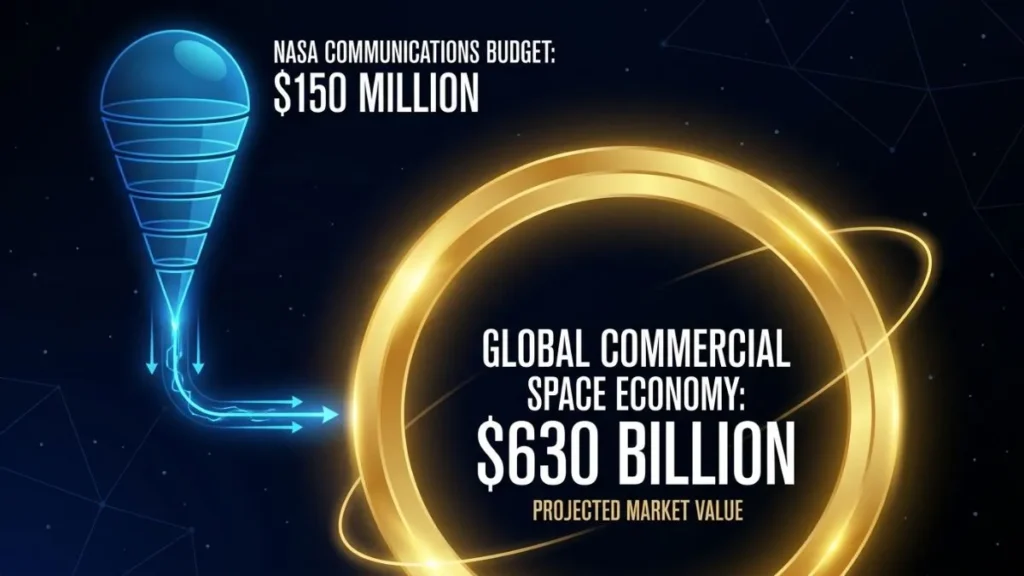
With a combined social media reach of around 150 million followers, NASA functions as a global PR wire. The NASA agency views its “What’s Up” guides as Education and Public Outreach (EPO). Industry analysts increasingly see them as professional content marketing that sustains the private space economy, valued at over $630 billion and projected to reach $1.8 trillion by 2035.
By building a global “fan base” for space, NASA effectively lowers the customer acquisition cost (CAC) for companies operating in low earth orbit (LEO), such as SpaceX and Blue Origin.
In 2026, with Jared Isaacman at the helm, the line between NASA’s public mission and commercial interest has become more porous than ever. If NASA’s communications arm were a standalone media entity like Disney or National Geographic, it would be valued in the billions based on its massive monthly active users (MAU) and engagement levels.
As these public-private partnerships deepen under Isaacman’s tenure, we may finally see a formal investigation into whether this creates an “unfair competitive advantage” for private businesses, and, if so, how these public investments will bear financial fruit for taxpayers.
How Do Space Activities Benefit the US Economy
According to the U.S. space economy stats released by the U.S. Bureau of Economic Analysis (BEA) on March 31, 2025, the space economy has reached $142.5 billion, or 0.5 percent, of total U.S. GDP. However, the real economic gains are tangible, affecting almost every sector of the U.S. economy.
Direct Job Creation
Space exploration and commercial spaceflight directly generate a significant number of jobs. In FY 2023, NASA generated over $75.6 billion in total economic output and supported nearly 305,000 jobs nationwide. This resulted in an estimated $9.5 billion in tax revenue.
Satellite Infrastructure and Services
Digital infrastructure, including Satellite broadband, television broadcasting, and secure communications in the sky, generates massive commercial revenue. The Global Positioning System (GPS) facilitates global logistics, shipping, aviation, e-hailing apps, and even the timestamps used in financial market transactions. Similarly, commercial satellite imagery allows farmers to monitor harvesting, helps meteorologists predict extreme weather, and enables logistics companies to improve supply chains.
Read more analysis in our Global Business section.