UAE Israel: The OPEC Exit That Funds a Silent Alliance

⏱️ 7 Mins Read
Both the UAE and Israel are not yet ready to answer openly, but a documented trail of arms deals, sovereign wealth investments, and a new trade corridor tells the story of the UAE exits OPEC.
The Facts as They Stand
When the UAE exits OPEC on May 1, 2026, ending its 59-year membership, it disassociates itself from a club it has belonged to since 1967, without consulting Saudi Arabia. This reflects Abu Dhabi’s long-term strategic and economic vision.
The UAE’s OPEC exit is a calculated move in the broader great power economic competition reshaping the Middle East, where Abraham Accords signatories are quietly building a parallel economic architecture outside traditional Arab consensus.
Under OPEC rules, the UAE’s production quota was capped at 3.4 million barrels per day, roughly 30% below its capacity. Its actual capacity was 4.85 million barrels per day. By leaving, it freed itself to produce and sell significantly more oil.
The UAE’s National Oil Company (ADNOC) has stated it wants to reach 5 million barrels per day by 2027 through a $150 billion investment plan. More oil means more money. The question worth asking is: where does that money go, and does any of it reach Israel? The UAE-Israel financial relationship is already on the public record.
What the UAE and Israel Have Already Built
The UAE and Israel did not have formal relations until September 15, 2020, when they signed the Abraham Accords in Washington. What followed was not just diplomacy but a rapid and systematic exchange of money, technology, and military cooperation that has only grown since then.
Mubadala Investment Company, an Abu Dhabi–based sovereign investor funded through oil surplus revenues, invested in six Israeli-based venture capital firms after the Accords. The names included Mangrove Capital Partners, Entrée Capital, Aleph Capital, Viola Ventures, Pitango, and MizMaa. These were strategic investments, designed to place Emirati oil money directly inside the Israeli startup ecosystem.
DisruptAD, the venture capital arm of Abu Dhabi’s sovereign fund ADQ, co-led a $105 million Series B investment into Israeli cultivated meat company Aleph Farms. Mubadala Petroleum purchased a stake worth approximately $1.1 billion in an offshore Tamar gas field belonging to one of Israel’s largest energy companies, Delek.
The UAE government also announced a $10 billion dedicated investment fund for Israel covering energy, manufacturing, water, space, healthcare, and agricultural technology. Every dirham of this investment originated from oil.
The Arms Deals
The UAE-Israel Arms Deals: In November 2025, the Israeli defense company Elbit Systems announced a record $2.3 billion contract with an unnamed international customer, which was later identified as the United Arab Emirates (UAE).
This eight-year deal focuses on supplying advanced J-MUSIC Directional Infrared Countermeasures (DIRCM) systems to protect UAE military and civilian aircraft. This was not an isolated deal inside the UAE-Israel relationship.
Moreover, Abu Dhabi-based defense group EDGE in January 2025 acquired a 30% stake in Israeli defense firm Thirdeye Systems, which makes AI-based drone detection systems. In October 2025, Israel’s Controp Precision Technologies, which makes surveillance systems, opened a subsidiary in Abu Dhabi with a total investment of $30 million, headed by an Israeli chief executive.
Similarly, Israel Aerospace Industries signed agreements with the UAE’s EDGE to jointly develop unmanned military vessels. Each of these transactions involves Emirati money, which originates from oil sales, entering Israeli defense companies. Some of those companies are direct suppliers of the Israeli military.
The Trade Corridor Connecting UAE Oil to Israeli Ports
Beyond investments and arms deals, the trade corridor connects UAE oil money to Israel’s physical infrastructure. The India-Middle East-Europe Economic Corridor (IMEC) is a proposed multinational trade and infrastructure route designed to link India, the Middle East, and Europe.
It was officially announced on September 9, 2023, during the G20 Summit in New Delhi, with heavy backing of the United States as a way to integrate the Middle East economically and physically, pulling partners closer together and countering China’s Belt and Road Initiative.
If completed, UAE oil and goods traveling to Europe would pass through Israeli territory and Israeli ports, generating direct revenue inside Israel and making it a permanent and necessary part of the Gulf’s trade infrastructure.
The closure of the Strait of Hormuz during the US-Iran war added urgency to the construction of this corridor, as the Gulf oil could not be transported through Hormuz. After withdrawal from OPEC regulations, the UAE, which intends to produce 5 million barrels per day by 2027, needs reliable conflict-free export routes.
The urgency behind these alternative corridors becomes clear when you examine how the Hormuz closure has already forced regional powers to accelerate bypass infrastructure, with Pakistan and the UAE now competing for the same redirected trade flows.
Why the UAE-Israel Relationship Deepened After the Iran War
Now, these are not isolated trade relations between the UAE and Israel. It is a clear and consistent strategic position that Abu Dhabi has been building since 2020 and accelerated sharply during the US-Iran war.
After coming under direct missile and drone attacks from Iran, the UAE’s response clearly reflects the depth of its relationship with Israel.
CNN reported that Israel had sent an Iron Dome air defense system and military personnel to the UAE during the Iran conflict, a direct deployment of Israeli military capability onto Emirati soil to protect UAE territory.
That single fact illustrates how deep the UAE-Israel security relationship has become. These are not two countries exchanging trade missions. They are countries protecting each other from a common enemy.
The UAE Energy Minister, when announcing the OPEC exit, confirmed that the decision was made without consulting any other country. Not Saudi Arabia. Not any other OPEC member. The UAE made its most consequential economic decision in decades in alignment with its own strategic priorities, increasingly centered on Washington and Tel Aviv rather than the Riyadh bloc.
Why did UAE leave OPEC? The Financial Reality
If geopolitical analysts ask why did UAE leave OPEC, the answer lies in the massive untapped production capability. To fully grasp what does UAE leaving OPEC mean financially, one must look at the gap between quota and capacity.
Under OPEC constraints, the gap between what the UAE was allowed to produce and what it could actually produce was roughly 1.45 million barrels per day.
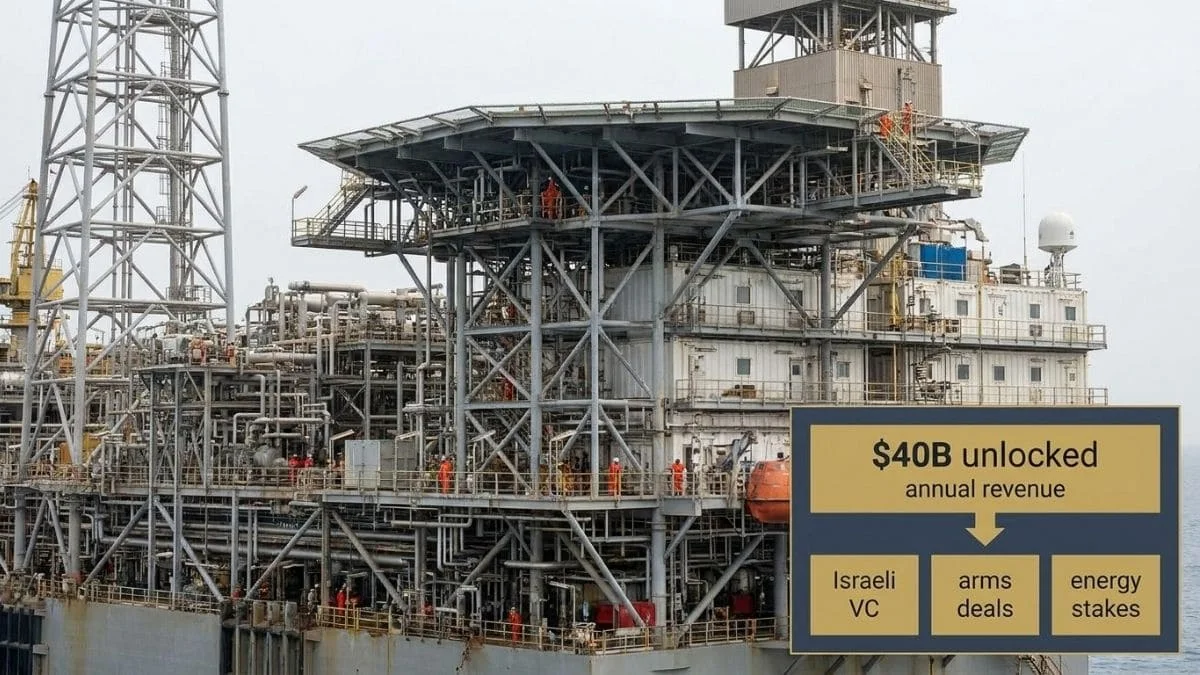
At $70 per barrel, a conservative pre-war estimate, this extra capacity will generate approximately $112 million in daily gross revenue, adding up to nearly $40 billion in annual gross revenue that had remained unrealized for decades under the OPEC restrictions.
UAE Exits OPEC: The Financial Impact
| Metric | Pre-Exit Restrictions | Post-Exit Reality |
| OPEC Quota / Capacity | Capped at ~3.4 million bpd. | Actual capacity reached 4.85 million bpd. |
| Production Target | Restricted by OPEC+ consensus. | 5 million barrels per day by 2027. |
| Annual Revenue Unlocked | Blocked under OPEC rules. | $40 billion additional annual revenue flowing into sovereign funds. |
The OPEC exit removes that ceiling, and the UAE’s plan to expand its capacity up to 5 million barrels per day by 2027 is not just a modest expansion but one of the highest-volume oil productions on the planet.
That additional $40 billion gross revenue flows directly into Abu Dhabi’s sovereign wealth funds, the same funds that have been investing in Israeli technology companies, backing Israeli venture capital, funding joint defense ventures with Israeli military suppliers, and building the trade corridor with Israel.
The Saudi Arabia Factor
Saudi Arabia has watched the growing UAE-Israel relationship closely, deepening the bitterness between the relations of these two Gulf states.
The UAE’s OPEC exit without consulting Riyadh was not just an economic decision. It was a signal that Abu Dhabi is no longer coordinating its most important decisions with Riyadh, operating independently and in alignment with a different set of partners, particularly Israel and India.
The UAE’s growing closeness to Israel may push Saudi Arabia to find its own accommodations with regional powers, and its recent defense pact with nuclear-armed Pakistan is a visible case.
Now, the Gulf is not a unified bloc – the UAE is on one side of that split, while Saudi Arabia is managing its position carefully on the other.
There is no single official document showing Abu Dhabi’s official declaration that its oil revenues move exclusively toward Israel as a matter of stated policy. That document does not exist publicly. What does exist publicly is this:
- UAE $2.3 billion commitment to an Israeli arms company.
- $1.1 billion stake in an Israeli energy company.
- $105 million investment into an Israeli food technology company
- $10 billion dedicated investment fund for Israel
- A $30 million Israeli defense technology subsidiary in Abu Dhabi
- Agreed jointly to manage a trade corridor
All of these commitments existed before the OPEC exit. The exit unlocks tens of billions more in annual revenue for the same institutions making these investments and signing these deals with Israel.
Read more analysis in our Great Power Economics section.