AI Infrastructure Investment: Capex Trade Rewriting Markets

⏱️ 6 Mins Read
The case for AI infrastructure investment is not what most analysts make it out to be. The software upgrade narrative is dead. What has replaced it is more complicated, more capital-intensive, and considerably more dangerous for those engaged in speculative software investing who fail to recognize the distinction.
The central tension now defining AI markets is structural, not cyclical: the companies building the physical compute layer are spending at a pace that their end-user revenues cannot yet justify.
How should investors think about AI infrastructure?
The Core AI Infrastructure Investment Thesis: Investors should evaluate AI infrastructure investment as a capital-intensive physical-asset trade rather than a software venture play.
The core investment thesis is that physical AI infrastructure relies on underwriting long-term power-generation contracts, data-center real estate, and semiconductor capacity rather than on volatile consumer-application revenues.
Understanding AI Infrastructure Build Out Costs and Hyperscaler Capex
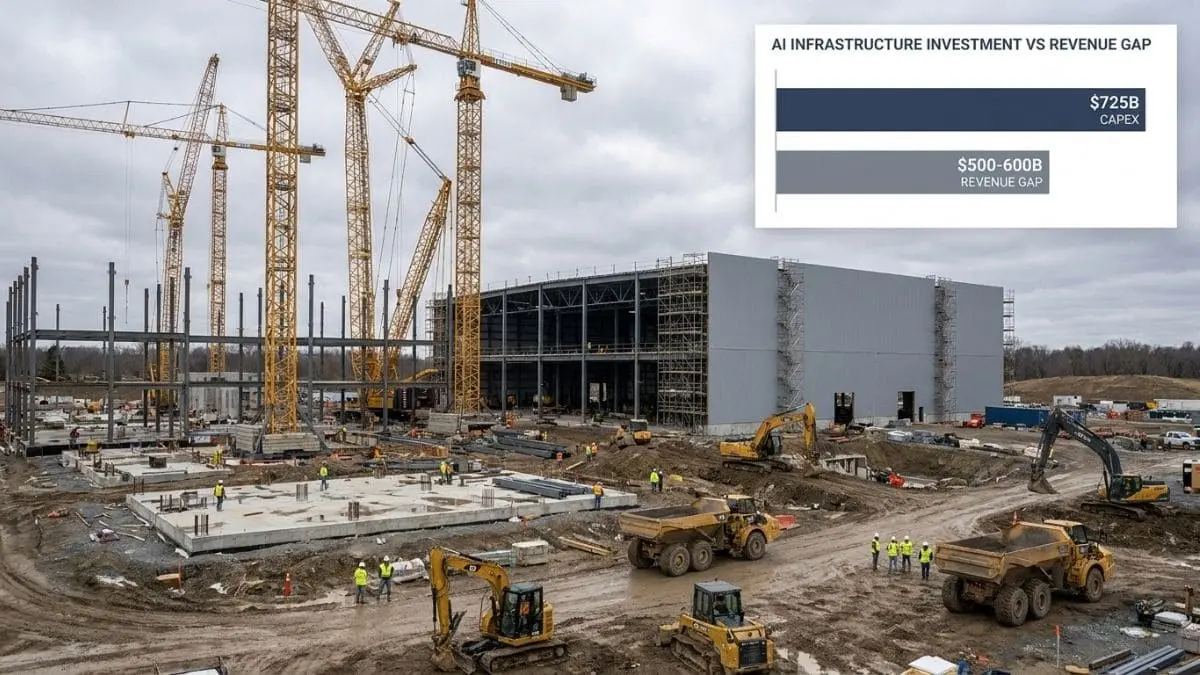
The four largest hyperscalers, including Microsoft, Alphabet, Amazon, and Meta, are on track to spend approximately $725 billion in combined capital expenditure in 2026, a 77% increase over 2025’s already record-breaking $410 billion.
After memory-chip costs rose, Amazon has now committed roughly $200 billion, Alphabet has raised its target to $185 billion, Microsoft has guided to $190 billion, and Meta has guided to $125-$145 billion.
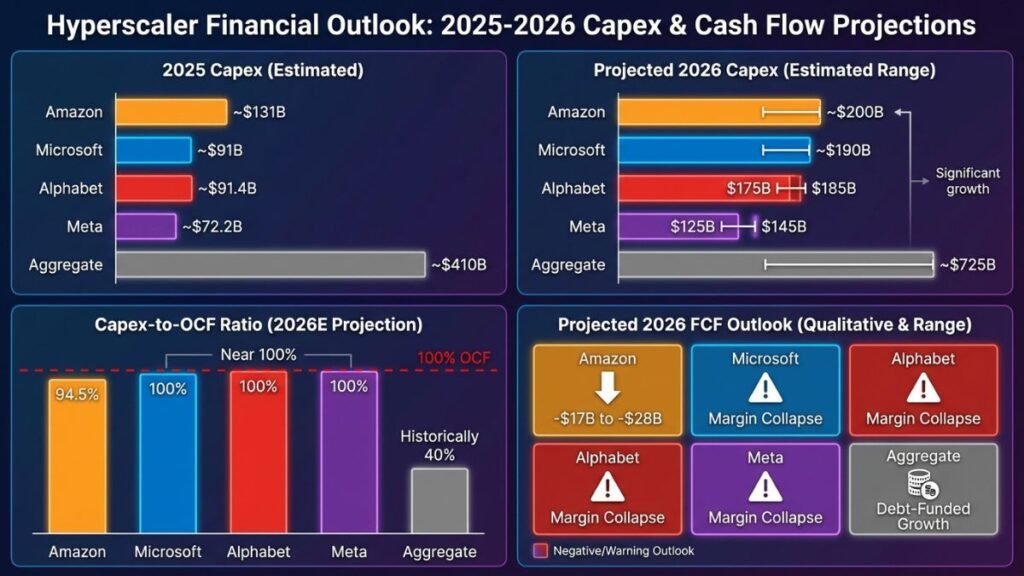
One correction is necessary here. The frequently cited ‘$690 billion capex floor’ applies to five companies: the four above plus Oracle. For the canonical four-hyperscaler group, the number reaches as high as $725 billion.
Goldman Sachs has placed the baseline aggregate capex estimate at $7.6 trillion between 2026 and 2031 across compute, data centers, and power, with a revised combined estimate of $5.3 trillion for the four largest hyperscalers alone from FY2025 through FY2030, up from $4.5 trillion before Q1 2026 earnings.
These are not projections built on optimism. They are projections built on signed contracts and backlog commitments. Google Cloud’s contract backlog alone has reached $460 billion, roughly doubling year-on-year, and infrastructure is already under construction.
| Hyperscaler | 2026 Estimated Capex | Debt / Financing Mechanism | Capacity Focus |
| Amazon | $200 Billion | Heavy corporate debt issuance | AWS AI & Custom Silicon |
| Alphabet (Google) | $175B – $185 Billion | 100-Year Century Bond & Multi-tranche debt | TPU + GPU Expansion |
| Microsoft | $190 Billion | Global infrastructure debt | Azure AI Infrastructure |
| Meta | $125B – $145 Billion | Front-loaded capital commitments | Open-source compute dominance |
AI Infrastructure Financing News: The Debt Overhang and VC Concentration
The sell-off narrative that frames capex announcements as the problem gets the causation right but misses the mechanism. Markets are not simply punishing spending. They are repricing the accounting consequences of that spending.
Alphabet issued a $20 billion, seven-tranche bond offering on February 9, 2026, upsized from $15 billion after drawing over $100 billion in orders. The offering included a 100-year Sterling bond, the first century debt issued by a technology company since Motorola in 1997.
This is not a routine treasury operation. It is a deliberate play to lock in long-duration capital from pension funds at favorable yields, funding a data center and compute buildout that the company’s own infrastructure chief has said must double serving capacity every six months.
Morgan Stanley projects AI-related global debt issuance to $570 billion in 2026, with Amazon, Meta, and Microsoft mirroring Alphabet’s approach.
Goldman Sachs estimates hyperscalers would consume 94% of operating cash flow on AI infrastructure before debt financing, meaning bonds are not supplementing cash flow; they are replacing it as the primary funding mechanism at the margin.
The depreciation problem compounds this. GPUs depreciate economically in one to three years; companies are booking them over five to six years. The gap between accounting depreciation and economic depreciation represents a silent earnings impairment that has not yet fully materialized in reported numbers.
Markets are beginning to price it. Amazon’s free cash flow is projected to turn negative this year. Microsoft is down approximately 17% and 25% year-to-date as of 2026. The front-loaded earnings hit from physical infrastructure is not hypothetical; it is arriving.
The 80% VC Concentration Needs Context
The claim that AI companies absorbed nearly 80% of all global VC funding in early 2026 is accurate, and almost entirely misleading without context.
Crunchbase data confirms that AI captured approximately $242 billion, or 80% of global venture investment, in Q1 2026.
Venture Capital Concentration vs. Ecosystem Collapse: While AI captured roughly 80% of global venture investment in early 2026, four platforms (OpenAI, Anthropic, xAI, Waymo) raised $188 billion, accounting for 65% of all global venture capital deployed in a single quarter. Excluding these megadeals, Q1 deal value for the rest of the ecosystem dropped 73%. The battle of sovereign platforms vs. ai wrapper startups is over; the startups lost.
This is not a broad AI ecosystem capturing capital. It is a sovereign-wealth-fund-driven concentration into a handful of pre-IPO platforms at valuations that price in infrastructure returns that have not yet been realized.
The Qatar Investment Authority backed Anthropic’s Series G. Temasek participated in OpenAI’s raise. These are not venture capital transactions in any traditional sense; they are geopolitically motivated pre-positioning by entities managing over $12 trillion in combined assets.
OpenAI’s position at the center of this sovereign wealth concentration carries its own structural legal risk that has received far less attention than the valuation numbers.
The practical implication for smaller participants in the AI ecosystem is the inverse of the headline: deal count fell 15% quarter-on-quarter in Q1 2026 to roughly 7,000, the lowest since Q4 2016. The wrapper-startup obituary the market is writing is accurate. The death is real.
What is overstated is the claim that ‘VC has concentrated’ as a strategy. It is more precise to say a different asset class has entered the frame and is being miscounted as a venture.
The Monetization Gap: AI Infrastructure Investment Returns vs. AI Infrastructure Investment Risks
The revenue-versus-spend problem is real, but it requires more precision than most commentary is offering.
The annual revenue shortfall, the amount the AI industry must generate to justify its infrastructure investment, has grown from $200 billion in late 2023 to an estimated $500 to $600 billion today, with the gap widening, not closing.
ChatGPT has approximately 910 million weekly active users; roughly 5% pay.
According to an NPR analysis, only 3% of US consumers pay for AI services across industries. The subscription conversion problem is structurally embedded, not a temporary adoption lag.
However, the claim that productivity gains do not always offset the exorbitant subscription and query costs significantly underweights the enterprise data. Forrester TEI studies document cost-per-task reductions of 9x to 66x in specific workflows.
Bain’s Agentic AI Benchmark for 2026 finds a median payback period of 4.1 months for customer service deployments, while McKinsey’s 2026 Global AI Survey reports that knowledge workers using production AI agents recover a median of 6.4 hours per week.
However, these micro-efficiencies are misleading. These rapid payback periods are real only because they are strictly confined to narrow, easily measurable silos like customer service deflection or code co-piloting, isolated wins that fail to scale fast enough to close the massive macro-monetization gap.
| Metric | Revenue / ROI Reality | Implication for Infrastructure |
| Macro Revenue Shortfall | $500B – $600B Annual Deficit | Infrastructure buildout costs vastly outpace aggregate software revenues. |
| Consumer Subscription Rate | 3% of US consumers pay | Consumer AI faces a structural conversion ceiling. |
| Enterprise Agentic Payback | 4.1 Months (Bain 2026 Benchmark) | High ROI strictly confined to narrow, siloed workflows. |
| Knowledge Worker Recovery | 6.4 Hours/Week (McKinsey 2026) | Micro-efficiencies that struggle to scale fast enough to close the macro gap. |
The MIT NANDA study’s finding that 95% of enterprise GenAI pilots produce zero measurable P&L impact represents the pilot stage, not production deployments. Enterprises that have moved from pilot to production are seeing different numbers.
The nuance matters because it shapes where the real risk sits. The monetization gap is not uniformly distributed. Consumer AI faces a genuine conversion ceiling. Enterprise agentic deployments in well-defined verticals are generating measurable returns. The investment thesis that conflates these two populations will be wrong about both.
Physical Compute: Companies Investing in AI Infrastructure
The market correction is separating the durable from the disposable. Those asking how to invest in AI infrastructure must look beyond software applications. At the infrastructure layer, the trade is grounded in physical assets, including power generation, cooling systems, data center real estate, and semiconductors, with yields tied to long-term lease and capacity agreements rather than speculative software revenues.
The private credit and infrastructure fund’s entry into AI financing is a direct consequence of the $800 billion-plus financing gap that hyperscale free cash flow alone cannot cover, and it is well underway.
At the application layer, the premium is concentrating on enterprise agents capable of executing multi-step workflows autonomously in verticals where the inputs, rules, and measurable outputs are well-defined.
Autonomous Agents and Agentic AI surged 31.5% year-on-year as the top technology priority among IT decision-makers in Futurum’s 2026 Enterprise Software Decision Maker Survey.
Companies with agentic deployments in customer service, legal, logistics, and financial reconciliation are commanding the valuation premiums that general-purpose AI wrapper businesses are losing.
The sovereign dimension is not secondary. The United States and China are treating computing capacity as a strategic sovereign asset. UAE-backed initiatives and BRICS-aligned compute localization efforts represent a supply chain investment opportunity in semiconductors, raw materials, power infrastructure, and cooling that carries a different risk profile than consumer AI applications.
Nations in the Global South acquiring domestic compute clusters are not buying a technology product. They are buying geopolitical optionality.
This compute sovereignty race is one front in the broader great power economic competition that is simultaneously reshaping energy corridors, shipping routes, and technology supply chains, where the prize is not territory but control of the infrastructure the entire global economy runs on.
The Structural Risk the Bull Case Ignores
The infrastructure trade rests on one assumption that has not yet been validated: that enterprise software built on top of this compute base will deliver measurable operational efficiency at a scale sufficient to justify the capital deployed beneath it.
While specific agentic workflows are currently profitable, there simply are not enough of these narrow use cases in the global economy to generate $500 to $600 billion in net-new software revenue. The enterprise pivot is real, but the Total Addressable Market (TAM) for these highly specific tasks is currently too small to justify a $725 billion physical infrastructure buildout.
The infrastructure trade does not fail if AI is transformative. It fails if the timeline is wrong. And unlike previous software cycles, this one is collateralized in concrete, power contracts, and century bonds.
Read more analysis in our Great Power Economics section.