Tech Sector Downturn 2026: Tech Industry Correction Or Structural Shift 2026?


⏱️ 6 Mins Read
The massive headcount reduction in the tech sector during the 2026 downturn is undisputed. As the year unfolds, investors and analysts are intensely debating a single question: is the tech industry’s 2026 downturn a temporary correction or a structural shift?
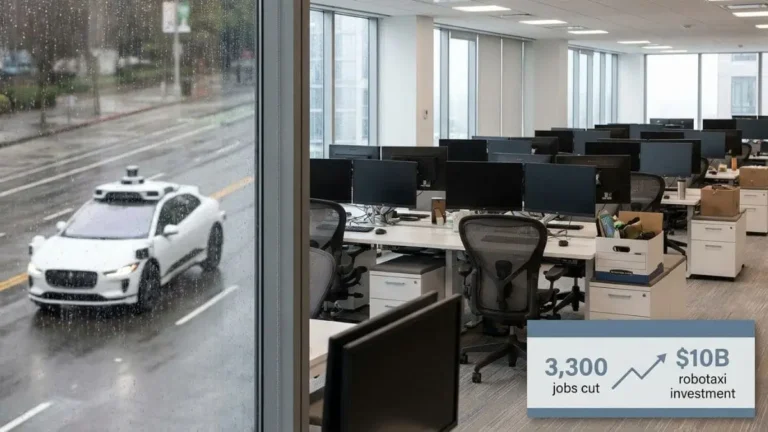
The casualties in 2026 alone span the full spectrum of the industry. Companies cutting jobs include Eventbrite, Oracle, Quora, and Spotify. Uber’s simultaneous 10% workforce reduction follows the same pattern, with official messaging focused on organizational simplification, while the real driver is a balance-sheet correction after pandemic-era over-hiring.
Meta announced plans to lay off 10% of its staff. Microsoft sent workers an internal memo offering voluntary buyouts, with around 7% of employees eligible for the program, and almost everyone pointed to the same culprit: artificial intelligence.
When examining the reasons for tech industry layoffs in 2025 and 2026, the official narrative points almost exclusively to artificial intelligence.
For instance, the tech layoffs in February 2026 saw over 22,300 workers lose their jobs in a single month, highlighted by severe cuts at companies like Block, setting the stage for an even larger surge in March.
Companies aggressively framed these cuts as an inevitable AI-driven transformation, with analysts pointing to a rising trend of “AI redundancy washing” to hide internal failures. However, the macroeconomic data tells a different story about what this tech industry correction or structural shift in 2026 will ultimately mean for the labor market.
The 2023–2026 Tech Layoff Reality
| Metric | Statistic | Official Corporate Justification | True Macroeconomic Driver |
| Q1 2026 Casualties | 80,000+ employees across 86 companies | AI Efficiency & Reorganization | Capital cost normalization |
| Total Purge (2023-2026) | 760,000 tech workers | AI / Post-Pandemic Restructuring | Zero-interest-rate era ending |
| Microsoft (2026) | 7% eligible for voluntary buyouts | AI Transition | Strategic over-hiring (2020-2023) |
| Meta (2026) | 10% workforce reduction | AI / Year of Efficiency | Margin preservation |
The AI Excuse: Why the Data Doesn’t Support It
Here is where the official narrative starts to crack. Companies have been aggressively framing current layoffs as the inevitable consequence of AI-driven transformation. But the data tells a different story.
A Yale Budget Lab report found no significant differences in the rate of change in the mix of occupations or in the length of unemployment for individuals with jobs highly exposed to AI from the release of ChatGPT through March 2026. The numbers suggested no significant AI-related labor changes at this juncture.
Martha Gimbel, executive director and co-founder of the Yale Budget Lab, was direct in her assessment, telling Fortune that “No matter which way you look at the data, at this exact moment, it just doesn’t seem like there are major macroeconomic effects here.”
The disconnect between AI’s labor market impact and the $725 billion hyperscaler capex wave raises a deeper question whether the infrastructure being built can generate returns before balance sheet impairment dominates.
A separate survey reinforces this conclusion. A study published by the National Bureau of Economic Research (NBER) found that thousands of surveyed C-suite executives across the U.S., the U.K., Germany, and Australia, nearly 90% said AI had no impact on workplace employment over the past three years. And yet AI remains the dominant public explanation for layoffs affecting hundreds of thousands of workers.
The gap between what companies are saying and what the data shows has a name (AI washing), a term that has gained traction as emerging data about the technology’s actual impact on the labor market tells a muddied, inconclusive story about how many jobs AI has truly displaced.
Why Public Companies Need a Better Story
Meta, Microsoft, Oracle, and Spotify are all listed companies whose stock prices, analyst ratings, and institutional investor confidence are directly shaped by how restructuring decisions are communicated to the market.
The most explosive confirmation of AI washing came from an unlikely source: the CEO of the world’s most prominent AI company, OpenAI.
CEO Sam Altman said at an event that almost every company that lays off people is blaming AI, whether or not it really is about AI. The man who built the AI technology that every corporation is blaming for its workforce reductions openly acknowledges that the justification is, in many cases, invented.
Gimbel of the Yale Budget Lab attributed the practice of AI washing to companies passing off diminished margins and revenue from failing to effectively navigate cautious consumers and geopolitical tensions as AI.
The technology provides a convenient excuse for companies that have to restructure for other reasons. Pointing to AI as the cause of layoffs makes AI washing not just a financial strategy but a public relations one.
Marc Andreessen, cofounder and general partner at Andreessen Horowitz, told Fortune that AI layoffs are a farce: Companies are 75% overstaffed, and AI is the ‘silver bullet excuse’ to clean house
The Real Culprit: What They Are Actually Hiding
What happened to tech valuations between 2020 and 2023, and the Federal Reserve’s role in enabling it, are central to understanding the conditions driving the current employment crisis. The narrative surrounding the recent Silicon Valley layoffs completely ignores this financial reality.
In response to the COVID-19 pandemic, the Federal Reserve slashed the benchmark federal funds rate to a target range of 0% to 0.25% in March 2020.
The effective federal funds rate, the actual rate banks charge each other, dropped to historic lows, with data showing a monthly average of 0.05% in April 2020 and holding in that range throughout the period, with reports citing levels around 0.04%.
This was an intentional expansionary monetary policy aimed at preventing a complete economic collapse by encouraging borrowing and investment.
The near-zero interest rate environment, combined with massive quantitative easing, made borrowing extremely cheap. For tech companies, this meant access to capital was almost unlimited and effectively free.
With safe investments yielding almost nothing, investors poured money into high-growth tech stocks and startups. This caused valuations to surge, particularly in software, SaaS, and pandemic-friendly tech industries. The combination of capital availability and a demand-driven boom led to aggressive expansion. Tech companies did, in fact, enter a fierce war for talent, often ignoring traditional hiring constraints to hire at any cost.
Then the reckoning arrived. The interest rate increases from early 2022 to mid-2023 helped lower core Personal Consumption Expenditures (PCE) inflation from a peak above 5.5% year-over-year in 2022 to 3.0% in February 2026. The cost of capital normalized almost overnight. Companies that had hired as though money would always be free suddenly faced balance sheets that demanded a different answer.
Admitting that publicly to shareholders, analysts, and on quarterly earnings calls meant admitting a failure of strategic discipline. AI offered a more plausible story: not that leadership over-hired recklessly, but that technology had simply moved faster than the workforce could absorb.
The Exception That Proves the Rule
Epic Games is a private company. Tim Sweeney answers to no quarterly earnings call, no institutional shareholders, and no concern about the stock price rising or falling on the narrative attached to a restructuring announcement.
Tim Sweeney, CEO of Epic Games, said in a March note to his employees announcing more than 1,000 job cuts that the layoffs were not related to AI, attributing the restructuring to a downturn in Fortnite engagement, high operational costs, and a need for greater financial stability.
Sweeney’s statement implicitly acknowledged what workers across the industry already suspected: that AI had become boardroom shorthand for decisions made for entirely different reasons to soften the blow and deflect accountability, raising questions about whether, as employee trust collapses, investor scrutiny intensifies, and regulators begin to examine the stated rationale for mass layoffs more carefully, AI washing is a sustainable corporate strategy or a liability accumulating in plain sight.
When Will Tech Layoffs Stop? The 2026 Outlook
If investors and workers are asking when tech layoffs will stop, the answer lies with the Federal Reserve, not in the deployment of artificial intelligence.
Wage gains are slowing, hiring has largely flatlined, and unemployment is the highest in more than four years. The Federal Reserve, meanwhile, is holding steady. The Fed maintained the federal funds rate in the 3.50%-3.75% range at its April 2026 meeting, keeping the benchmark rate at its lowest level since November 2022 for the third meeting in a row.
The cheap capital era is not returning anytime soon. Tech layoffs will only stabilize when the companies that built their headcounts on near-zero interest rates finish unwinding their balance sheets. Until the cost of capital normalizes with corporate revenue realities, the financial layoffs disguised as AI transitions will continue.
Why Silicon Valley Layoffs Are a Corporate Governance Failure
The 2026 tech layoffs are not primarily a story about artificial intelligence but about what happens when an industry gorges on free money, abandons hiring discipline in the chaos of a pandemic, and then reaches for the most convenient excuse available when the bill comes due.
AI washing is a corporate governance failure dressed in the language of innovation. The workers bearing the cost of that failure deserve a clearer explanation, as every announcement of AI-driven workforce reductions now is met with skepticism.