EU Energy Security: Why America’s LNG Hegemony Leaves Europe in the Cold

⏱️ 3 Mins Read
Europe’s strategic push to disassociate from Russian gas is not true energy independence, but a transfer of hegemony. The current EU energy security landscape exposes a harsh reality of Great Power Economics: Brussels traded an adversary’s coercive pipeline leverage for an ally’s maritime leverage.
📌 Executive Brief
- The Leverage Mechanism: US LNG exports are not a free-market accident; they are deeply aligned with American foreign policy, industrial strategy, and national security, giving Washington unprecedented geoeconomic leverage over European industrial survival.
- Deepening Dependency: By 2026, Europe is on track to source a staggering two-thirds of its total LNG imports from the United States, replacing a single-node vulnerability in the East with one in the West.
- The Cost of Hegemony: The transition from Russian gas to US LNG transfers the geopolitical locus of control across the Atlantic. The US now dictates the marginal cost of European manufacturing, establishing a hegemon-client dynamic that structurally disadvantages EU industry.
The Strategic Reality: Great Power Economics
Almost all mainstream US coverage treats US LNG as a commercial savior for EU energy security, ignoring the Great Power Economics at play. The United States has not merely filled a supply gap; it has structurally captured Europe’s energy architecture. By controlling the LNG required to keep Germany and France industrialized, Washington holds geoeconomic leverage over the continent.
The US can now utilize its LNG dominance to ensure European political alignment on broader US foreign policy objectives. Europe’s reliance on American energy means Brussels cannot afford to defy Washington on critical geostrategic fronts.
Washington’s Geoeconomic Veto
While energy analysts obsess over spot market exposure and flexible cargoes, the true vulnerability is sovereign. American LNG policy is an extension of its statecraft. When the US adjusts its export posture, whether through regulatory pauses on new export terminals, environmental reviews, or shifting domestic priorities, the immediate victim could be European industrial competitiveness.
Europe’s energy costs are now tied to Washington’s political cycles and domestic energy demands, permanently disconnecting the bloc from true energy sovereignty.
Global LNG market shocks push European inflation higher, creating a structural trap in which the EU must pay a premium on spot-market bids while watching its own energy-intensive industries offshore to Texas and the US Gulf Coast.
The Structural Imbalance of Hegemony
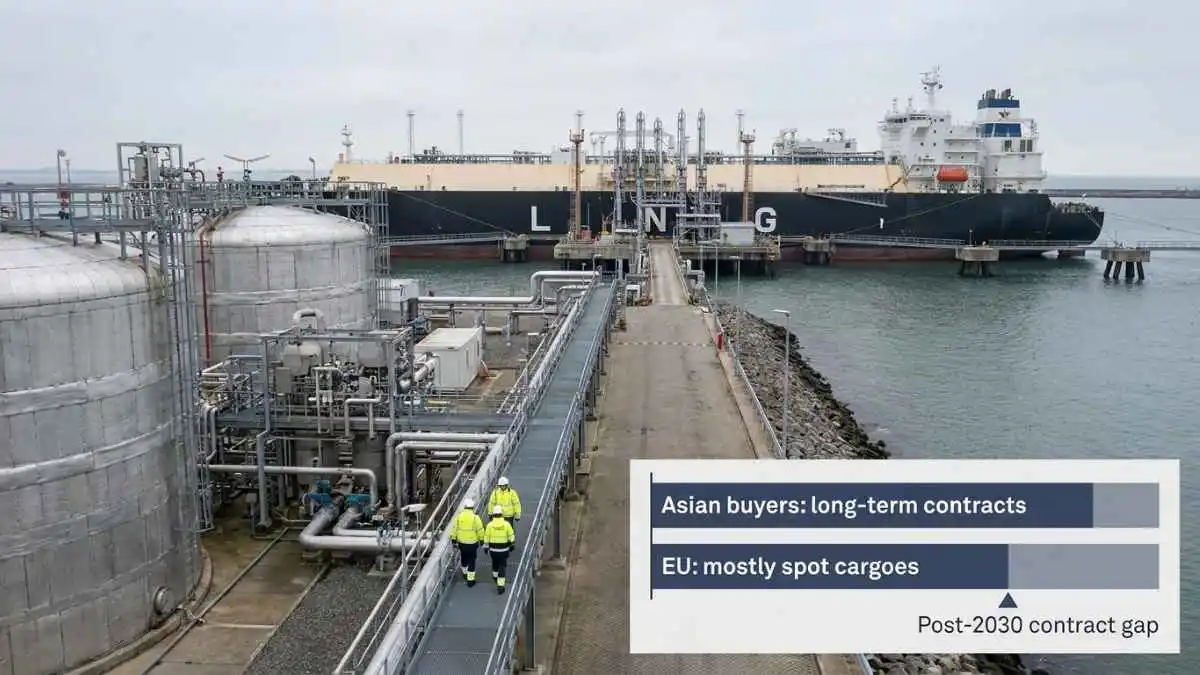
Asian buyers historically secure supply through bilateral, long-term contracts that balance regional power dynamics. In contrast, the EU’s heavy reliance on US LNG represents a structural capitulation. Europe exchanged opaque political leverage from the Kremlin for over 60% reliance on American liquefaction infrastructure and global shipping lanes.
While less overtly hostile, this dependency leaves Europe fundamentally subordinate. The US dictates the pace of liquefaction expansion and sometimes cargo allocation. This structural imbalance ensures that Europe operates at a permanent industrial disadvantage compared to the US, which enjoys cheap, abundant domestic gas while exporting premium-priced LNG across the Atlantic to its allies.
Production Limits and the Geopolitical Fallout
When US production capacity is strained, Europe’s financial health and industrial output are inextricably linked to decisions made in Washington.
As the US manages its own domestic inflation, any political move to prioritize domestic gas consumers over foreign exports would immediately trigger a crisis in Europe, determining Europe’s energy viability and cementing a relationship in which the US acts as the unipolar energy guarantor and Europe as the dependent junior partner.
How much of Europe’s LNG comes from the US?
The United States has become Europe’s undisputed energy hegemon. Market data from 2026 confirms that Europe relies on the US for approximately two-thirds of its total LNG imports.
This fundamentally rewires the continent’s import strategy. While American dominance helped reduce Russia’s LNG share to 12% in Western markets in 2026, it introduced a profound geopolitical dependency.
European economic survival now requires maintaining pristine relations with the US administration; any severe transatlantic diplomatic rift could threaten the flow of the continent’s primary energy source. Europe is no longer just purchasing a commodity; it is now purchasing American protection, paying in geopolitical compliance.
Is there an energy crisis in Europe right now?
Europe faces a persistent sovereignty crisis disguised as an affordability crisis. The current market environment reflects the reality of being a dependent state in a unipolar energy market. The economic burden of this strategic dependency is severe: European manufacturers are being hollowed out, unable to compete with US domestic firms that pay gas prices at a fraction of the cost.
The continent’s most expensive energy is a direct byproduct of America’s Great Power economics, threatening to permanently erode European industries’ economic resilience and turning the continent into a consumer of American goods rather than a global industrial competitor.
2026–2027 Strategic Takeaways
Policymakers must drop the illusion that substituting Russian pipelines for American LNG ships equals energy independence. The forward horizon demands an acknowledgment that Europe has traded one master for another.
Boardrooms and markets must prepare for the reality that the US export boom will continue to influence European economic output. Without a radical push for true sovereign energy, whether through accelerated domestic renewables, nuclear baseload expansion, or aggressively diversified geopolitical alliances, Europe will remain financially and strategically in the cold, acting as a geopolitical subsidiary of the American energy empire.
Read more analysis in our Great Power Economics section.