Meta Blocked: Why China’s AI Giants Hit a Dead End in 2026

⏱️ 6 Mins Read
When Beijing blocked Meta Inc.’s $2 billion acquisition of China Manus, an AI startup, in the last week of April, it did not just kill one deal; it seems like they have shattered the dreams of Chinese AI giants.
This sudden detonation sent shrapnel in two directions simultaneously. The engineers and founders who had relocated to Singapore, believing they could maintain a safe corridor between the two superpowers, now find that the corridor is closed.
The closing of that corridor is not a regulatory accident; it is the inevitable consequence of the great power economic competition between the US and China, where technology has become the primary battlefield.
Secondly, Chinese AI companies that never left home and were banned by the US government from receiving funding from US venture capital firms and investors are now told by Chinese authorities to reject US investments.
In response to China Manus fallout, regulatory authorities, including the National Development and Reform Commission (NDRC), issued strict directives in April 2026, instructing Moonshot AI, StepFun, and TikTok parent ByteDance to reject US investments in funding rounds or secondary share sales unless they receive explicit state approval. These instructions also extend to companies like DeepSeek and MiniMax, operating in the same regulatory environment.
The Shot Heard Across Silicon Valley
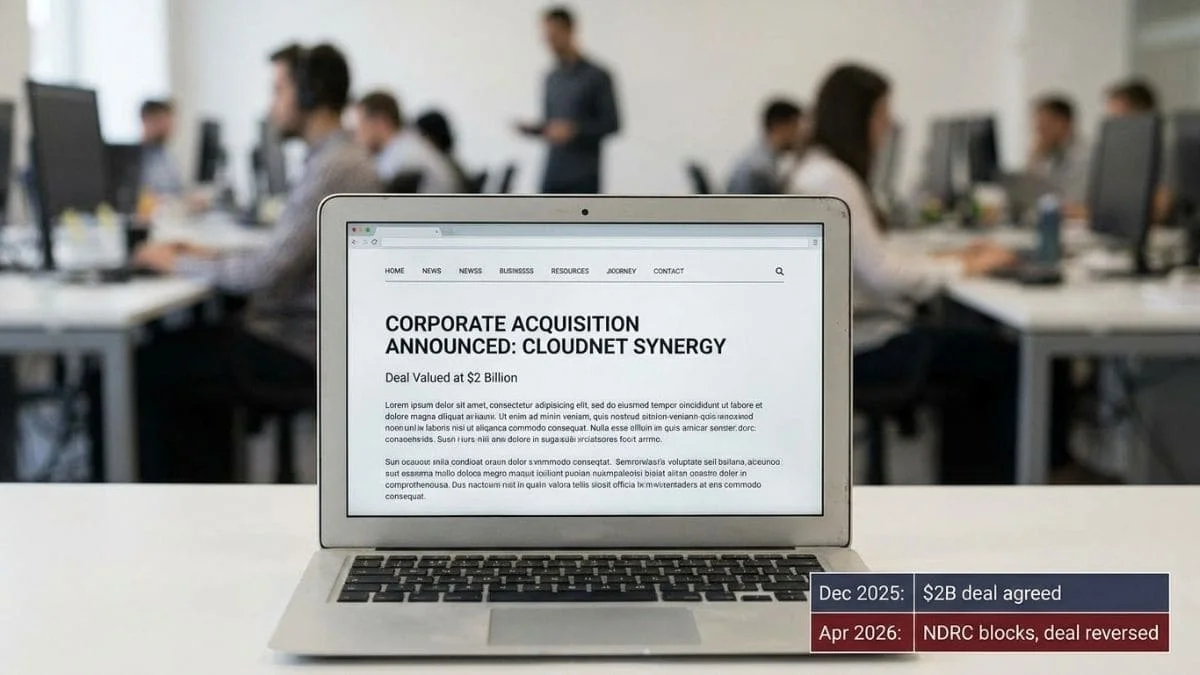
On April 27, 2026, China’s NDRC issued a single-line statement, saying that it has been decided to prohibit foreign investment in the Manus project in accordance with laws and regulations, and has required the parties involved to withdraw the acquisition transaction, trashing Meta’s $2 billion deal to acquire AI startup Manus.
Investors had been paid, engineers moved into Meta’s offices, and the company’s website already declared ‘Manus is now part of Meta’.

None of that mattered; the acquisition was prohibited, and everyone had to withdraw.
This short statement carries long consequences because it has revealed to other Chinese AI companies that Beijing is aggressively responding in kind.
The US-China trade war, which began with tariffs on steel and soybeans, has found its most consequential frontier.
Why did Meta buy Manus AI?
Meta agreed to acquire Manus AI in December 2025 for an estimated $2 billion, primarily to capture its highly advanced Agentic AI technology. Following the formal Manus AI Meta acquisition announcement in Feb 2025, it became clear that Manus’s AI agents are not normal chatbots; they can think, plan, and independently execute complex, multi-step tasks across the internet.
Meta intends to integrate Manus’s agentic capabilities directly into its ecosystem (WhatsApp, Instagram, and Meta AI) to help small and medium-sized businesses handle their customer service, manage schedules, or complete daily administrative work. In addition, the acquisition was a strategic move to stay ahead of fierce rivals such as Microsoft (with its Copilot ecosystem), Google, and OpenAI.
Building highly reliable, general-purpose AI agents from scratch is incredibly difficult. Manus had already proven its product-market fit and technological viability. For CEO Mark Zuckerberg, spending a few billion dollars was a fast-track way to inject cutting-edge automation directly into Meta’s product pipeline rather than spending years trying to replicate the technology in-house.
The Escape Route That Closed, the Singapore Story
A strategy emerged where Chinese-founded firms relocate operations to Singapore to bypass regulatory hurdles, reincorporate under Singaporean law, and approach American venture capitalists as neutral international entities, a practice called ‘Singapore washing’.
Singapore, with its legal environment and geography, became a central technology hub where Chinese innovation could meet American capital without governmental restrictions. Sequoia Capital spun off its entire China business, rebranded it as HongShan, and relocated its team to Singapore. Manus AI followed the same path.
Founded in Beijing in 2022, Manus pitched the world’s first general-purpose AI agent. By July 2025, after securing US venture capital, Manus had closed its Beijing and Wuhan offices and moved its founders to Singapore. The Singapore washing strategy seemed to have delivered beyond expectations.
But in January 2026, Chinese authorities launched a formal investigation. Global investors began asking: Is Manus AI from China legally, or is it a Singaporean entity? Beijing provided the answer in March by summoning both co-founders and barring them from leaving the country.
This saga has introduced a new doctrine to the world: technological nationality follows where the technology was developed, not where the company is registered.
It does not matter that Manus was incorporated in Singapore. The technology and engineers were Chinese. Under Beijing’s new framework, if anyone asks if Manus AI startup is owned by China, the geopolitical answer is yes, and Chinese knowledge does not travel freely, regardless of a Singapore company registration certificate.
The Meta-Manus Blocked Acquisition Timeline
| Date | Event | Geopolitical Significance |
| May 2025 | US firm Benchmark leads $75M funding round. | American capital flows into Chinese AI. |
| July 2025 | Manus closes Beijing offices, relocates to Singapore. | The “Singapore Washing” strategy is fully executed. |
| December 2025 | Meta agrees to $2B acquisition deal. | US Big Tech attempts to absorb Chinese Agentic AI. |
| March 2026 | Founders summoned to Beijing, travel restricted. | Beijing asserts jurisdiction over overseas-registered IP. |
| April 2026 | NDRC officially prohibits the deal and reverses it. | The Technological Nationality Doctrine is enforced. |
This technological nationality doctrine is China’s most aggressive move yet in redesigning the rules of the global economy; part of the same strategy visible in its Belt and Road investments, its Latin American manufacturing push, and its solar energy kill switch.
The Five Who Never Left But Got Caught Anyway
This is where the story becomes truly significant because these five companies never tried the Singapore washing strategy but were restricted not by their own ambition to escape, but by a geopolitical war they did not start and cannot control.
Moonshot AI
Moonshot AI, which is widely described as China’s answer to OpenAI, has never relocated overseas. The NDRC specifically named Moonshot as one of the companies that must reject US-origin capital in funding rounds without explicit government approval.
The timing is devastating. Moonshot was in the advanced stages of raising up to $1 billion in a new funding round at an $18 billion valuation. American institutional investors, the pension funds and university endowments that have backed Chinese technology for two decades, were expected to participate. That participation now requires Beijing’s explicit sign-off, transforming a routine fundraise into a political negotiation.
But Washington is not standing aside. The US State Department directly accused Moonshot AI, DeepSeek, and MiniMax of extracting and distilling US AI models, using American technology as raw material to train Chinese systems without compensation or permission.
StepFun
StepFun, widely regarded as one of Beijing’s strategic AI champions, was also notified by the NDRC. Consequently, StepFun, which was planning a $500 million Hong Kong listing, is now winding up its overseas corporate entities to return to China.
ByteDance, the TikTok owner
ByteDance is the most valuable private company in China, the owner of TikTok and the creator of Doubao, China’s most-used AI chatbot. ByteDance has been at the center of US-China tech tensions for years. It fought a years-long regulatory battle with Washington over TikTok’s data practices and its Chinese ownership structure. It is not a company that has ignored geopolitical risk.
Now, ByteDance has been instructed that it must not approve secondary share sales to US investors without prior government permission. ByteDance recently reached a $550 billion valuation in a secondary share sale. Under the new rules, any portion of future transactions involving American investors must clear NDRC approval before proceeding.
DeepSeek
Of the five companies, DeepSeek is the one that neither government has moved against directly yet. But the signals from both Washington and Beijing suggest it may be the most consequential confrontation still ahead.
It became the most downloaded AI app in the US almost overnight. It forced every major American AI lab to reconsider its assumptions about the pace of Chinese technological development.
DeepSeek, headquartered in Hangzhou, has neither overseas offices nor pursued a Singapore-washing strategy, staying entirely within China’s regulatory perimeter.
DeepSeek sits at the exact epicenter of the US-China AI war. It has not yet been directly caught by either government’s regulatory apparatus. When it is, the confrontation will make the Manus affair look like a rehearsal.
MiniMax
Shanghai-based MiniMax is one of the Chinese tech companies facing Washington’s accusation of extracting and distilling US AI models.
Beijing’s broader capital restriction framework applies to MiniMax’s future fundraising. US entertainment companies are pursuing it for copyright infringement. It is defending itself on three separate legal fronts simultaneously.
What This Means
The architecture of this tech war is now fully visible. On the American side, outbound investment rules prohibit backing Chinese AI without Treasury approval. On the Chinese side, the NDRC has instructed top AI companies to reject US capital.
The Ministry of Commerce has established that Chinese-built technology falls under Chinese regulatory authority. The Singapore escape route has been closed. Manus’ team tried to escape, but Beijing stopped them. These five never tried to leave, but both governments stopped them anyway. That is the story the post-Manus world has written, and it is only beginning.
Read more analysis in our Great Power Economics section.