The Solar Grid Chinese Kill Switch: Why EU Banned Inverters

⏱️ 5 Mins Read
María José Fernández, a homeowner in Seville, represents thousands of Spaniards who have installed residential solar panels, secured their domestic energy needs, and received tax incentives. What they did not know was that their system contained a potential Chinese kill switch.
The Chinese inverter, a device considered the heart of the solar system that converts sunlight into electricity, is connected to a server in Shenzhen, China, sending every single detail to its manufacturer.
Neither the government nor the solar system provider mentioned this to its users. However, the inevitable happened on April 28, 2025, when Spain went into darkness for almost 24 hours, a time when solar energy contributed nearly 60% of Spain’s total power supply.
A series of generation ‘trips’ (sudden disconnections) caused a loss of 2.1 GW in seconds, and the grid could not compensate, leading to a complete blackout across Spain, Portugal, Andorra, and parts of France.
This was one of the largest blackouts in Europe during the past 20 years. Hospitals ran on emergency generators. Traffic systems failed. Businesses shuttered, and official explanations were rapid voltage surges.
Initially, panic pointed toward this massive solar dependency. However, official investigations by ENTSO-E proved that solar dependency and renewables did not cause the blackout, correcting the premise that grid collapse was driven by a solar failure.
But this official clearance created a massive geopolitical contradiction: If solar failure didn’t collapse the grid, why did the European Commission ban these devices?
The Spain blackout is not an isolated infrastructure failure; it is a front in the great power economic competition where China has embedded strategic control inside the energy systems of the powerful nations.
The ENTSO-E Contradiction: Why Ban the Chinese Inverter?
If ENTSO-E investigations officially cleared solar renewables of causing the Spain blackout, the subsequent political reaction makes no sense on the surface. In early May 2026, the European Commission (EC) announced that the Chinese inverter would be phased out of all EU-funded solar energy projects through the European Investment Bank.
The language was diplomatic, but the implication was not. By citing severe cybersecurity risks and the threat of future Chinese cyber attacks, the EC effectively admitted a terrifying reality: while a targeted attack may not have triggered the 2025 blackout, the infrastructure to do so is already fully operational inside Europe’s grid.
The ban applies to EU-funded solar energy projects, not to existing installations, not to privately financed projects, and not to the residential solar systems that have exploded across European rooftops over the past decade.
The EC stated that inverters from China, Russia, Iran, and North Korea would be restricted from November 1, 2026. This ban is a silent acknowledgment by Western intelligence of the solar panel kill switch threat.
It proves that whether dealing with national energy grids or AI synthetic identity fraud in the banking sector, global regulatory frameworks are dangerously behind the technological curve.
The EU’s primary cybersecurity framework applies to large-scale solar utilities. It does not apply to rooftop installations on warehouses or houses. Across Europe, this unregulated segment is the fastest-growing and falls entirely outside the new security perimeter.
If Chinese solar energy inverters are dangerous enough to be banned for future projects, what exactly makes them acceptable in the existing infrastructure that European households depend on today?
The uncomfortable reality is: if any replacement program were announced, it would come at extraordinary cost, and it would be an acknowledgment of a policy failure by the governments of EU countries.
Why Chinese Solar Inverters are Flagged as Cybersecurity Threats
Solar energy panels produce direct current. The power grid runs on alternating current. An inverter bridges that gap, converting solar energy output into electricity that can be used in homes or transferred to the grid. Without inverters, solar energy installations remain inactive, making them an essential component.
These solar inverters are not simple converters. They are networked computers that connect to the internet and send or receive data. On top of it, they can be monitored remotely.
The manufacturers of solar energy inverters do not sell hardware. They sell hardware with built-in data communication capability. In the case of Chinese manufacturers, Western countries are now treating them as a cybersecurity threat.
In May 2025, US energy officials discovered rogue communication devices inside Chinese-manufactured solar inverters installed in American power infrastructure. The devices, including cellular radios, were not mentioned in any customer manuals. They appeared capable of establishing backdoor communication channels that could bypass network firewalls, a pathway for remote access to solar energy hardware from outside any monitored perimeter.
In response to US energy officials’ claim, the Chinese embassy in Washington said: “We oppose the generalization of the concept of national security, distorting and smearing China’s infrastructure achievements.” However, US energy officials described it as potentially catastrophic.
The European Union Institute for Security Studies (EUISS) had already called Europe’s dependence on Chinese solar energy technology unacceptable. “The EC should phase out and exclude Chinese components from Connecting Europe Facility for Energy (CEF-E) funded cross-border projects,” EUISS said.
EU Grid Vulnerability to Chinese Inverters (2026 Assessment)
| European Nation | Peak Solar Grid Dependency | Chinese Inverter Exposure | Strategic Vulnerability Assessment |
| Spain | 60% (During April 2025 Blackout) | Dominant across both utility & residential | Critical: 60% grid integration makes remote inverter access a massive national security threat, even if ENTSO-E cleared renewables of the 2025 failure. |
| Germany | High (Primary EU solar market) | Despite strict domestic compliance and grid-connection codes, Chinese Inverters are dominant across both utility & residential | High: Largest industrial base exposed to remote data links. |
| Netherlands | Highest per-capita residential solar | Massive residential penetration | High: Residential installations fall entirely outside the EC ban. |
| France | Maintains a moderate solar profile relative to its grid size | Less dependent on solar electricity, the solar panels and inverters physically installed in France are still overwhelmingly Chinese. | Low: Protected by nuclear base |
How China Came to Own the Switch
Chinese manufacturers dominate the solar sector through state financing; the cost of capital for solar energy component production has been reduced to levels that no Western competitor could match.
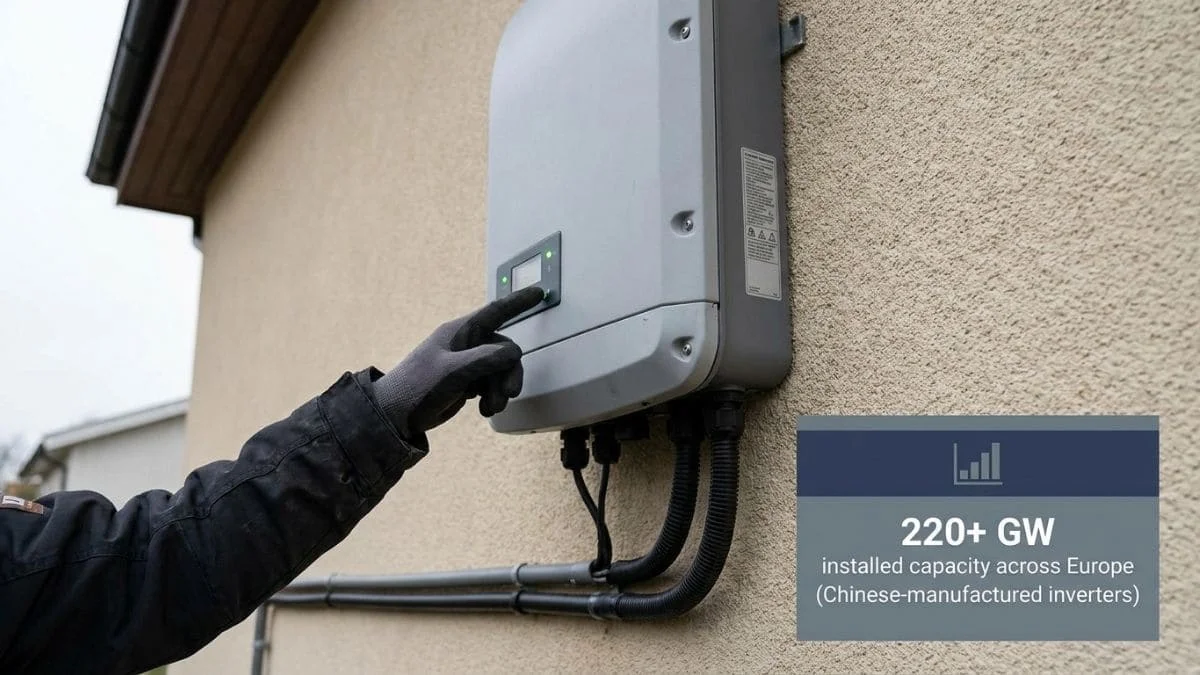
Massive domestic solar energy consumption also drove unit economics to an extreme extent that made Chinese solar hardware unbeatable on price. Coordinated industrial policy ensured Chinese firms were not competing in a neutral market; they were competing with the productive capacity of the world’s second-largest economy behind them. In Europe alone, Huawei and other Chinese solar manufacturers control more than 220 gigawatts of installed solar energy capacity.
The numbers are similar across the United States, Australia, Japan, India, Southeast Asia, the Gulf states, Africa, and Latin America. All running significant solar infrastructure on Chinese inverters. Connected to Chinese servers. Dependent on Chinese firmware. Theoretically accessible to whoever in China holds the administrative keys.
The world spent a decade building a global solar infrastructure and handed the master switch to one country (China).
Solar Energy Subsidy Programs
The global dependence on Chinese solar hardware is the direct and measurable outcome of government policy. These were the solar energy subsidy programs that ran aggressively throughout the 2010s and into the 2020s, launched by Western and Eastern governments to maximize solar adoption by minimizing cost barriers.
Those subsidies worked. Solar energy capacity grew from negligible to substantial in less than a decade. But these policies, which helped families in Germany, Spain, the United Kingdom, Australia, and the United States to afford Chinese solar energy, were implemented without security reviews.
The solar energy transition was sold as energy independence, but it delivered something closer to its opposite.
The Chinese Kill Switch: A Strategic Weapon for Global Grids
When Iran closed the Strait of Hormuz in response to US-Israel airstrikes under Operation Epic Fury in February 2026, the cost was immediate and staggering. Oil markets convulsed, and approximately 20% of the world’s oil supply was suspended.
A solar panel kill switch has not been pressed yet, but the architecture for it exists. It is installed on the walls of homes, warehouses, schools, industries, and hospitals across every continent. It is connected to the grids, receiving firmware updates directly from Chinese servers. The world learned the cost of the Hormuz closure at enormous expense, but nobody is prepared for the catastrophic cost if a Chinese kill switch within the global energy grid were ever activated.
The Hormuz closure already demonstrated how a single geopolitical chokepoint can simultaneously redirect oil flows, collapse shipping routes, and force regional powers to rebuild their entire trade architecture overnight.
Unlike the Strait of Hormuz, a chokepoint on a map that governments have known about for decades and built naval doctrine around, the solar system kill switch is invisible, inside the infrastructure, and has no coordinates. There are no warships positioned to defend it.
China does not need to threaten anything. The leverage already exists. Beijing did not infiltrate the Western solar energy supply chain. It was invited in, subsidized, and celebrated while it arrived.
The possible moves exist on a spectrum. The West has been trapped, and the ban on Chinese solar equipment, retaliatory tariffs, export restrictions, suspension of VC funding to Chinese startups, weaponizing Taiwan, etc., were nothing but a frustration of strategic defeat being shown by the West over China.
If the geopolitical and trade war escalates beyond anyone’s intention, the remote-access capability that sits inside Chinese solar hardware does not need to be pre-authorized. The world’s solar infrastructure has made that decision, if it ever comes, dramatically easier to execute and dramatically harder to defend against.
The Chinese Solar Energy Audit Nobody Is Running
The EC ban covers future EU-funded projects. The US has moved to restrict Chinese solar hardware in federally funded infrastructure. Other developed states, including Australia, are also reviewing their exposure. These are meaningful steps at the margin of a problem that lives in the center.
No government has announced a comprehensive audit of Chinese solar hardware in residential and commercial installations. No government has established a replacement program for inverters already in the national grids. No government has written to the homeowners sitting on this vulnerability and told them plainly what their own officials believe about the hardware on their rooftops.
The families who got subsidies on the installation of solar energy panels have received no communication from any official authority about the security status of their inverters. They have not been told that their solar energy systems connect to servers in China. They have not been told that the European Commission now considers that hardware a potential risk to European security. They have not been given any information at all.
The switch exists. It is connected. Whether it is ever pressed depends on decisions made in Beijing, in Brussels, and in Washington, based on the relations between them. What does not depend on any of those decisions is the fact of its existence.
Read more analysis in our Great Power Economics section.