Uber Layoffs: The 10% Cut Funding the Robotaxi Platform Wars

⏱️ 3 Mins Read
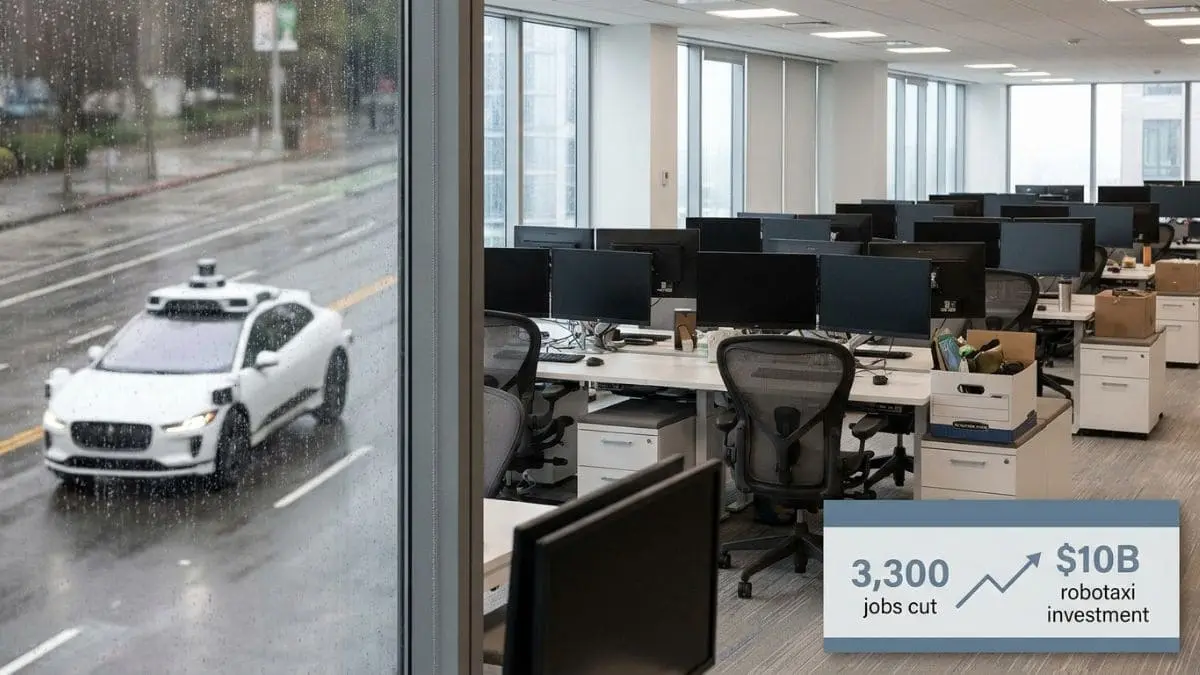
Uber layoffs in 2026 will affect roughly 10% of its workforce, or about 3,300 jobs, as part of a massive restructuring to streamline operations.
CEO Dara Khosrowshahi said that the decision is aimed at making the company simpler and faster by removing management layers and concentrating teams in key hubs.
The savings from this headcount reduction are expected to be explicitly earmarked for a $10 billion investment in robotaxi partnerships.
Why is Uber Cutting 3,300 Jobs? The ‘Simpler and Faster’ Narrative
Why is Uber laying off employees in 2026?
Uber layoffs in 2026 are targeting approximately 10% of the corporate workforce, or 3,300 employees, to streamline operations and remove excess management layers.CEO Dara Khosrowshahi stated that the restructuring will make the company faster by reducing the number of employees who sit seven or more layers below the CEO by 20%. The savings are intended to fund future growth, including autonomous vehicle partnerships.
Are Uber drivers affected by the 2026 layoffs?
Uber layoffs will not affect drivers. It only hits Uber’s corporate workforce, including the engineering, product, and operations teams. Uber drivers work as independent contractors, not corporate employees, and are not part of this restructuring.
While Khosrowshahi noted that Uber’s revenue has nearly tripled over the last five years, this expansion brought fragmentation. To counter this, Uber is reducing the number of employees sitting seven or more reporting layers below the CEO by 20% and cutting teams with one or two direct reports by nearly half.
The Autonomous Platform Bet: Downstream Consequences of a $10 Billion Pivot
Uber is not building autonomous vehicles to compete with developers; it is planning to become the inescapable digital infrastructure for the entire AV industry. By offloading capital-intensive hardware development to partners such as Rivian, Lucid, Nuro, and Wayve, and by implementing its current layoff plan, Uber has shown its growth strategy.
Uber’s strategy triggers a specific set of downstream consequences across multiple sectors:
- Automotive partners gain immediate, guaranteed vehicle utilization without spending billions to acquire retail ride-hailing customers.
- As human-driven Uber rides transition to autonomous corporate fleets, the multi-billion-dollar personal auto insurance market will contract violently, shifting premiums directly to commercial fleet underwriters.
- A highly subsidized, heavily scaled robotaxi network undercutting traditional pricing models poses an existential threat to already strained public transit ridership and city revenue models.
The RTO Mandate: Is the 1% Remote Rule a Stealth Layoff?
What is Uber’s remote work policy?
As part of its 2026 restructuring, Uber effectively ended remote work, mandating that regional and global teams relocate to designated hubs like New York or San Francisco. Going forward, only about 1% of the company will be fully remote, and compliance with the mandatory three-day-a-week in-office policy will be strictly enforced.
The tech industry is now increasingly using strict RTO mandates as a ‘stealth layoff’ tactic used to force resignations and avoid paying severance.
By requiring the vast majority of remote employees to relocate to a designated physical office, Uber is actively reducing its workforce through geographic attrition to avoid the financial and public-relations costs of a larger, formal layoff.
Regional Disparities in Uber Employee Benefits
As the Uber layoffs unfolded, a severe disconnect emerged in Uber employee benefits across different global hubs.
Workers in India reported a distinct double standard in exit packages compared to their US counterparts on Blind and Reddit. According to internal discussions, US employees were allegedly offered two months of garden leave alongside two months of stock vesting.
However, Indian employees, many of whom were part of recent aggressive hiring drives in Bangalore and Hyderabad, reported receiving only one month of severance with no garden leave.
This disparity has sparked backlash among offshore teams who argue they are treated as disposable assets despite paying the ‘timezone tax’ to support US operations and routinely working irregular hours.
The Uberai Factor vs. Overhiring
The tech layoffs in 2026, which are a 40% jump from the previous year, cited artificial intelligence as a primary driver. Corporate leadership frequently uses AI productivity as a smokescreen to appease investors, masking the reality of efforts to correct bloated payrolls from previous expansion cycles.
However, unlike other tech giants, Khosrowshahi notably did not blame Uberai or artificial intelligence for these cuts. Tech professionals widely believe the current wave of terminations is a reckoning for the 2020-2022 zero-interest-rate hiring binge.
Uber had expanded to 34,000 employees globally by the end of 2025; this 10% cut brings staffing levels back down to just under 30,000, aligning with their 2021 footprint.
This restructuring is directly funding Uber’s broader platform ambitions, including its aggressive move into hotel bookings, which threatens Booking.com’s $8.2 billion marketing dominance.
The Uber 2026 Restructuring: Official Memo vs. Market Reality
| Restructuring Aspect | Official Corporate Stance | Employee & Market Reality |
| Targeted Roles | Focused on flattening management; cutting roles 7+ layers below the CEO by 20%. | Individual Contributors (ICs) and junior developers across engineering and risk operations were heavily impacted. |
| Remote Work | Ending remote work to improve in-person collaboration, limiting remote staff to 1%. | Viewed by the tech workforce as a ‘stealth layoff’ tactic to force resignations and avoid paying severance. |
| Global Operations | Concentrating teams in key geographic hubs to reduce fragmentation. | Severe impacts reported at massive engineering centers in Bangalore and Hyderabad, despite recent expansions. |
| Severance & Benefits | The company intends to reinvest savings into future growth and AV technology. | Impacted employees report stark geographical disparities: US workers allegedly received two months of garden leave, while Indian workers received one month. |
| The Catalyst | Restructuring is driven by organizational complexity following a 3-fold increase in revenue over five years. | The layoffs reverse pandemic-era overhiring, returning the workforce to 2021 levels to secure capital for a $10B robotaxi platform war. |
By aggressively trimming its workforce and consolidating global operations, Uber is clearing the deck for a capital-intensive platform war. The 2026 restructuring is less about correcting past inefficiencies and entirely about hoarding resources to ensure that when autonomous fleets scale globally, they operate exclusively on Uber’s routing network.
Read more analysis in our Global Business section.