Should AI Be Banned? The Cartelization of Compute and the New Geopolitical Arms Race

⏱️ 4 Mins Read
It is quite incomprehensible that US tech giants and AI companies, which used to spend billions lobbying against the European Union’s AI Act, have suddenly started asking the federal government for AI regulations, which raises a question: Should AI be banned?
Recently, OpenAI’s Sam Altman and Anthropic’s Dario Amodei have publicly called on governments to slow frontier development. Similarly, Senator Bernie Sanders escalated the rhetoric with legislation seeking to criminalize the development of artificial superintelligence, threatening developers with up to 20 years in prison.
However, President Donald Trump dismissed calls for additional restrictions, warning that such action hands total global hegemony to China, a view echoed by his technology adviser David Sacks, who called the push for regulation a politically motivated panic.
Meanwhile, open-source advocates argue that the sudden frontier AI labs’ hue and cry for safety, which are also burning billions in debt to finance massive physical data center infrastructure, is because of the rapid rise of efficient, open-source, locally run models that bypass their proprietary compute entirely, suspecting this AI giants’ move to crush open-source competitors.
The scale of that infrastructure bet, $725 billion in combined hyperscaler capex in 2026 alone, and what it means for the AI investment thesis is examined here.
Should AI be banned or halted?
Although the Donald Trump-led administration is reluctant to impose guardrails on the technology, the White House proposed a voluntary frontier AI framework. The White House has not yet made the exact details public, but the main idea was that AI labs would give the US government access to leading models for up to 30 days before wider release. Therefore, an outright ban is not on the cards.
The Sanders bill represents the most aggressive legislative push to date, proposing a dedicated cabinet-level federal agency empowered to halt commercial research and penalize developers with two decades of imprisonment. Yet, the fundamental flaw in any attempt to ban superintelligence is that neither Congress nor the AI research community has established an objective, measurable threshold for where statistical machine learning ends and superintelligence begins.
By targeting the individual software engineers writing the algorithms rather than the executive corporate boards financing them, such proposals would halt the entire software industry.
Why Big Tech Wants Rules
AI labs’ sudden focus toward government intervention has drawn skepticism across Washington. Vice President JD Vance recently questioned why leading frontier companies are actively lobbying the federal government to impose restrictions on their own sector.
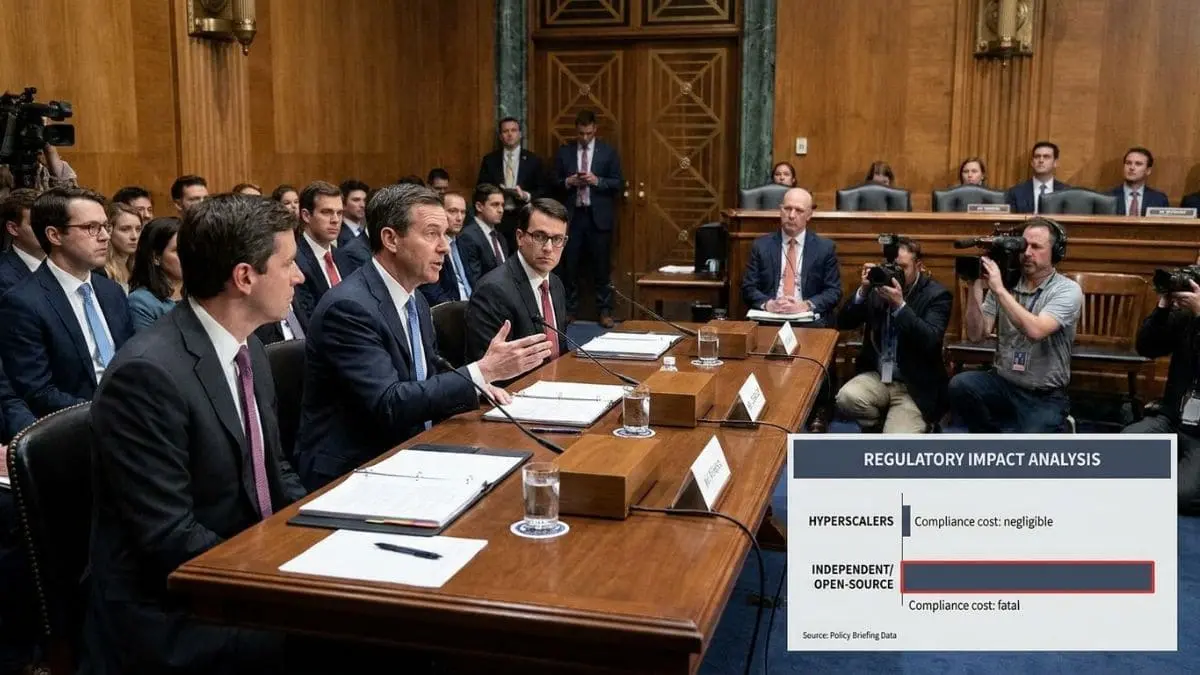
Historically, established monopolies encourage regulation when compliance costs become their strongest competitive advantage. Imposing multi-million-dollar safety audits, red-teaming mandates, and government-approved licensing registries poses zero existential threat to multi-billion-dollar hyperscalers.
Microsoft, which recently published a Humanist AI Code of Conduct for its superintelligence models. For an independent researcher running an open-weight model on consumer hardware, however, those same bureaucratic compliance mandates are fatal.
AI Regulations: Public Stated Narrative VS Business Reality
| Corporate Incentive | Public Stated Narrative | Operational Business Reality |
| Open-Source Suppression | Preventing dangerous, unaligned models from falling into rogue hands. | Neutralizing free, decentralized, and locally run LLMs that eliminate the need for enterprise cloud subscriptions. |
| Tort Liability Shield | Establishing proactive consumer protection and safety guardrails. | Passing compliance audits to establish a legal safe harbor against massive future copyright, bias, and negligence lawsuits. |
| Infrastructure Debt Protection | Pacing the technological race to ensure safe societal deployment. | Slowing release cycles to artificially protect high-margin valuations ahead of delayed public offerings. |
| Capital Moat Construction | Demanding strict third-party verification for catastrophic compute thresholds. | Ensuring that only well-capitalized corporations with dedicated compliance departments can legally train frontier models. |
What are the primary AI Governance Challenges?
The core AI governance challenges are twofold: overcoming the coordination problem of international enforcement and preventing domestic regulatory capture. Because AI models are fundamentally open-weight software that can run locally, domestic restrictions cannot restrict foreign adversaries. Consequently, any governance model that ignores hardware supply chains or imposes strict domestic software pauses creates an immediate competitive deficit against foreign adversaries.
This geopolitical reality underscores the Trump administration’s stance, treating frontier development as a controllable domestic industry. However, Beijing is accelerating state-backed deployments as China’s National Energy Administration has already integrated mandatory energy storage pairings for AI data centers and aggressively scaled domestic compute, making an American regulatory pause (if imposed) a form of unilateral technological disarmament.
How different regions, from the Gulf to Southeast Asia to Pakistan, are navigating the choice between American and Chinese AI infrastructure is tracked in full here.
Meanwhile, Europe plans to regulate AI technology. European Central Bank President Christine Lagarde warned of the unprecedented risk posed by modern economic infrastructure.
While the EU has pioneered aggressive regulatory frameworks, European firms remain almost entirely dependent on importing compute and models from the United States. Lagarde noted that Europe’s domestic data center deficit is projected to widen more than sixfold over the coming decade, creating a structural dependency that gives Washington unmatched leverage in future trade and tax negotiations.
Who Controls Artificial Intelligence
The pertinent question is not ‘Should AI be banned?’ but who controls artificial intelligence.
If policymakers want to mitigate systemic risk, they must shift their focus from software censorship to the physical resources like energy grids, water consumption, specialized memory manufacturing, and critical mineral supply chains.
The modern AI race is defined by finances, energy grids, and trade corridors; regulating software only consolidates power in top AI giants that can pay the compliance fee.
This compute control race is one front in the broader great power economic competition where the US and China are systematically using technology access, infrastructure investment, and regulatory architecture to sort every economy into dependency relationships.
The real fight for AI’s future will be decided by who controls the power plants, the fabs, and the silicon pipelines that feed them.
Read more analysis in our Great Power Economics section.