Do Iran’s Drone Strikes on Cloud Infrastructure Put the Gulf’s Trillion-Dollar AI Dream at Stake?

⏱️ 2.5 Mins Read
Iran’s drone strikes on cloud infrastructure in the UAE and Bahrain in early March 2026 opened a debate: can the billion-dollar partnerships between US tech giants and Gulf states to build the Middle East into a technology and AI hub survive being treated as a target in a live regional war?
Iran’s targeting of digital infrastructure is not a tactical decision made in isolation. It is a front in the great power economic competition between the US and Iran, where disrupting the region’s technology ambitions carries strategic weight alongside more conventional targets like energy infrastructure, shipping and oil routes.
From Oil Fields to AI Epicenter
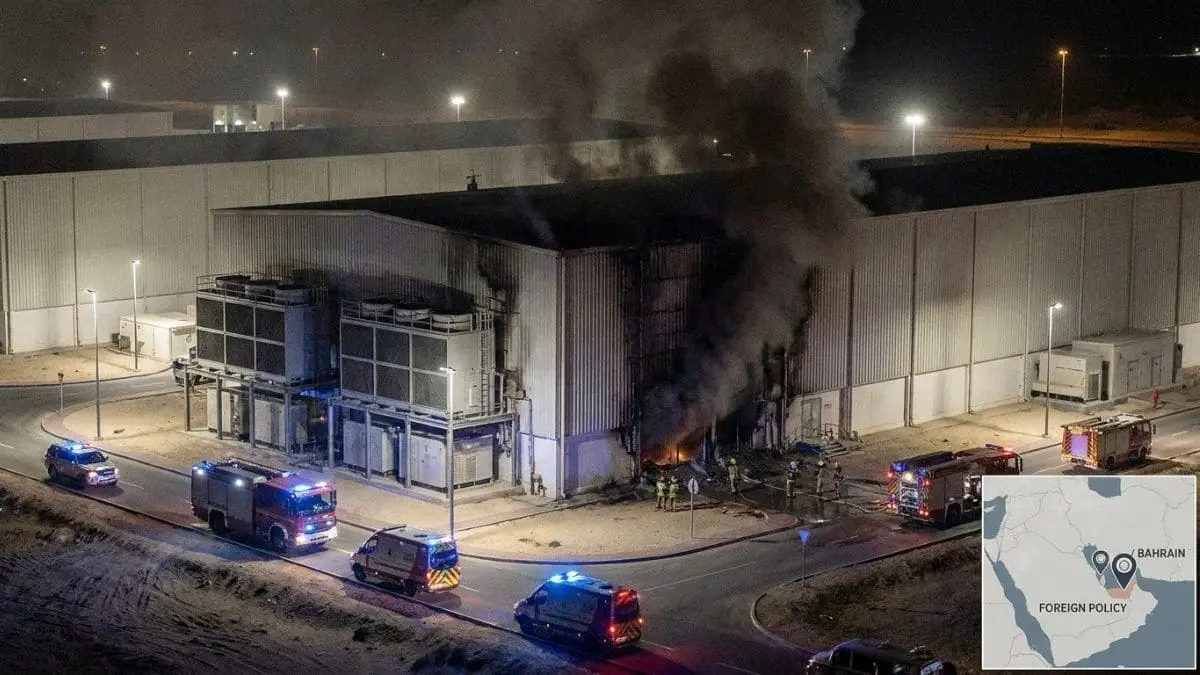
AWS’s own statement confirmed the incident that two of its data center facilities in the UAE were directly struck by drones, while a separate drone strike near a third facility in Bahrain caused physical damage to nearby infrastructure, on March 2, 2026.
The strikes knocked out power and triggered fires, with water damage following from fire suppression efforts. Outages rippled into consumer apps, banking platforms, and enterprise software across the region.
Reuters later reported that at least one affected UAE insurance platform sought to temporarily shift its workloads outside the region, but was blocked by local rules requiring insurance-related data to be hosted domestically.
Although it remains unconfirmed whether the struck facilities were being used for military-linked operations, the incident drew attention to the potential connection between commercial cloud infrastructure and military activity in the region. Amazon and Google already have a $1.2 billion cloud and AI services deal with the Israeli government under Project Nimbus.
These attacks have also highlighted AI hubs, data centers, energy infrastructure, and fiber chokepoints as potential targets in modern warfare.
The Escalation Since March
The March strikes were not an isolated incident. On March 31, Iran formally designated 18 US technology companies, including Amazon, Microsoft, Google, Apple, Meta, Nvidia, Oracle, HP, Tesla, Boeing, Cisco, and IBM, as legitimate military targets.
Iran viewed these companies’ infrastructure as supporting US and allied operations. On April 2, Iran struck the same Bahrain-based AWS facility for the second time.
Regional security analysts have separately reported that Iran circulated a list of roughly 29 tech-related targets across the Gulf.
US tech giants have so far not signaled any plan to pull back from the region. But they have visibly updated risk management protocols and revised contingency plans for cloud infrastructure management.
Evaluating the Middle East Power Stability Impact on Data Center Operations
The recent drone strikes expose a critical vulnerability in the region’s cloud infrastructure. When the power grid is disrupted, data centers immediately shift to UPS battery systems, keeping servers and cooling systems online while backup generators start up, a process that typically takes 10-30 seconds.
But the real risk isn’t a few seconds of interruption. Modern servers have thermal margins measured in minutes. If the generators fail or have a delayed start, UPS backup can’t hold the load, forcing emergency shutdowns to protect hardware. In addition, prolonged cooling loss increases cloud service downtime and operating costs. In a conflict scenario where grid damage could take days to repair, this technical fragility directly threatens the Gulf’s AI ambitions and investors’ confidence.
What’s at Stake for the Gulf’s Diversification Bet
The economic diversification strategies underpinning this build-out. Saudi Vision 2030, Dubai’s D33 initiative, and similar national plans depend on data centers and IT hubs that require immense, constant power and cooling.
Gulf states have attracted tech giants’ investment by offering exceptionally low, stable power pricing. The regional escalation has driven up global oil and gas prices, which in turn raises the operational cost of power generation, including from alternative energy sources.
Separately, several industry analysts and security consultants have argued that Gulf governments should begin treating commercial data centers as critical national infrastructure comparable to oil fields, ports, and power plants, and extend the same protective frameworks for cloud infrastructure security, accordingly.
That shift has not been formally enacted as policy across the Gulf states. Some officials have floated missile-defense coverage for major data center sites as one option under consideration.
If security measures of that kind are eventually adopted, the added operational and insurance costs could work against the investment pitch that attracted hyperscalers to the region.
The well-constructed narrative of Gulf technological leadership from smart immigration gates at Dubai Airport to AI-assisted traffic and utility management has taken a blow following such attacks.
It has been reported that the Gulf states have not walked back their AI ambitions; multiple analyses of the buildout, including from the Middle East Institute and Foreign Policy, argue the fundamentals of the region’s compute strategy remain intact even as the pace and security calculus shift. It means the Gulf’s AI dream is being tested under the current crisis.
The same conflict that is redirecting oil through alternative pipelines and shipping through Pakistani ports is now threatening to redirect technology investment away from the Gulf entirely.
Read more analysis in our Great Power Economics section.