Country Risk Analysis: How Changing Geoeconomics Alters Qatar Economy Valuations

⏱️ 4 Mins Read
During country risk analysis, valuation models for the Qatar economy are undergoing a structural recalibration. Market and economy intelligence indicates a shift from growth-centric projections to risk-adjusted returns. Geopolitical volatility directly inflates the cost of capital for sovereign and corporate entities alike.
📌 Executive Brief
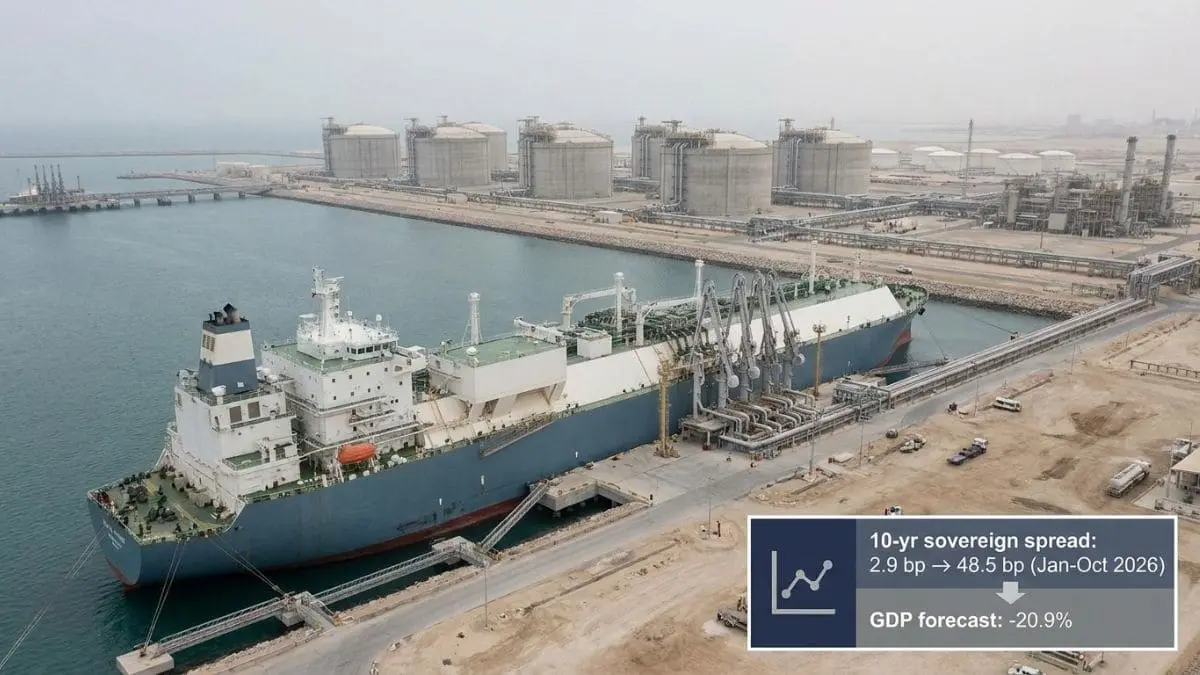
- Sovereign Spread Widening: Qatar’s 10-year US dollar sovereign bond spread over US Treasuries expanded from 2.9 bp to 48.5 bp between January and October 2026. This repricing of FDI risk drove up discount rates and compressed corporate project margins.
- Debt Market Expansion & Sukuk: Qatar’s Debt Capital Market (DCM) grew to over USD 140 billion. Sukuk penetration rose to 23%, acting as a hedge, leveraging regional liquidity and, alongside the Euroclear link, a tool for global diversification.
- Fiscal Expansion: Gross government debt is forecast to rise to 64.1% of GDP in 2026 (up from 51.3% in 2025), driven by sovereign funding needs amid regional instability.
- Historic Contraction: The World Bank forecasts the broader Middle East economy will contract by 2.1% in 2026, with Qatar GDP projected to collapse by 20.9%, its worst performance in five decades.
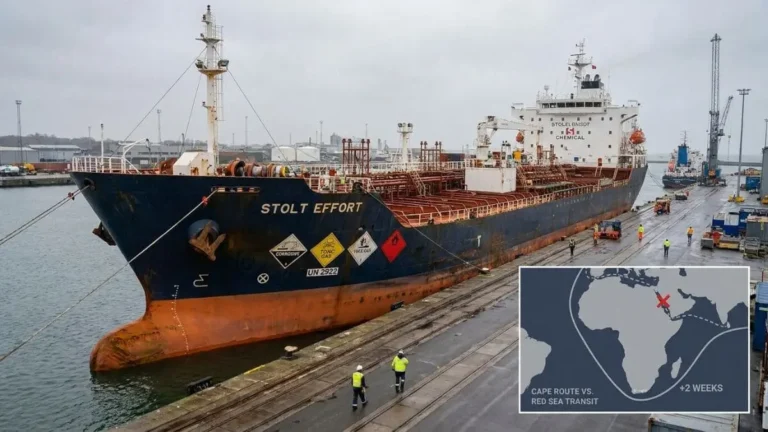
- Chokepoint Vulnerability: Escalating conflict near the Strait of Hormuz directly threatens Qatar’s export-reliant economy, stalling anticipated growth from the North Field East LNG expansion.
Washington’s strategic response, a $10 billion infrastructure fund to build permanent Hormuz bypass capacity, is designed precisely to prevent this kind of sovereign risk repricing from recurring.
Widening sovereign bond spreads signal that geopolitical risk premiums are no longer isolated to defense sectors but are permeating all asset classes. Investors are demanding higher yields to compensate for the uncertainty surrounding regional stability and supply chain economics.
The escalation in risk premiums changes the attractiveness of long-term infrastructure and energy investments, prompting a shift toward short-term assets and decreasing the net present value of long-term FDI projects.
Similarly, rising tensions are also speeding the diversification of financial infrastructure. The growth of local debt markets and alternative instruments minimizes exposure to external shocks while securing trade and economic stability.
Structured Data: Qatar Debt Market Dynamics
| Metric / Entity | Baseline (2025/Early 2026) | Current Period (Q3/Q4 2026) | Change / Impact |
| 10-Year Sovereign Bond Spread | 2.9 bp (2 Jan 2026) | 48.5 bp (2 Oct 2026) | +45.6 bp. Reflects geopolitical volatility and US peg correlations. |
| Qatar DCM Outstanding | ~USD 134.6 bn | > USD 140 bn | +4% YoY Growth. Continued expansion despite headwinds. |
| Sukuk Penetration | 18% (Q3 2025) | > 23% (Q3 2026) | +5 pts. Shift toward Islamic finance. |
| Gross Govt Debt to GDP | 51.3% (2025) | 64.1% (2026 Forecast) | +12.8 pts. Driven by sovereign funding needs. |
| Currency Composition | N/A | 69% USD / 27% Riyal | Sustained reliance on USD for access to international investors. |
Redefining the Cost of Capital for Regional FDI
The widening of Qatar’s 10-year sovereign bond spreads from 2.9 basis points in early 2026 to 48.5 basis points by October 2026 shows a fundamental repricing of risk in the Gulf.
Qatar’s debt yields remain closely correlated with US Treasuries due to the currency peg. It acts as a direct proxy for the heightened risk premium foreign capital requires to deploy in a volatile zone. When evaluating Qatari projects, multinational corporations build their discounted cash flow (DCF) models from this sovereign baseline.
- Higher Discount Rates: The 45.6 bp increase raises the cost of debt and equity. A higher discount rate applied to future cash flows decreases the net present value (NPV) of potential FDI.
- Tighter Project Margins: Projects that previously cleared hurdle rates at a 3 bp spread may now fall short. Local subsidiaries must generate higher absolute cash flows to justify the elevated cost of capital.
The same risk repricing is simultaneously threatening the Gulf’s AI infrastructure ambitions, where Iranian drone strikes on cloud data centers in the UAE and Bahrain have forced Amazon and Google to overhaul their risk protocols entirely.
Historically, Gulf states served as safe havens in the emerging market landscape. However, the current rapid volatility disrupts that paradigm.
The market is pricing in a premium that affects the entire capital stack, stress-testing the assumption that Gulf stability inherently protects long-term project returns.
The Strategic Shift Toward Sukuk and Global Links
Over 23% Sukuk penetration shows a deliberate geopolitical strategy to insulate the state’s capital stack from regional volatility while broadening its base.
- Tapping Sticky Regional Liquidity: The primary buyers of Gulf Sukuk are regional Islamic banks and domestic institutional investors that operate on “buy-and-hold” mandates. This anchors the funding base against panic-selling.
- Asset-Backed Reassurance: The asset-backed nature of Sukuk provides tangible collateral reassurance to investors that conventional unsecured sovereign bonds do not.
- Global Diversification (Euroclear): Rather than strictly retreating from global markets, Qatar is utilizing new settlement links with Euroclear to improve global investor access to eligible Riyal government bonds and Sukuk. Geostrategically, this prevents the state from being entirely reliant on volatile US dollar fixed-income flows.
Geoeconomic Shocks and the Historic GDP Contraction
Escalating regional conflicts and shifting global energy markets are altering Qatar’s economic trajectory. These shifts in geopolitics, economics, and policy have driven up Qatar’s World Uncertainty Index (WUI) and are triggering a sharp contraction.
1. The Spike in Economic Uncertainty
The World Uncertainty Index shows a sharp spike for Qatar, moving from 0.230 in Q3 2025 to 0.391 by Q1 2026. A higher WUI is directly linked to stock market volatility, higher risk premiums, and lower GDP growth. For Qatar, this reflects evaporating investor confidence as regional tensions eclipse domestic stability.
2. The Historic GDP Collapse
Qatar GDP is currently facing its worst performance in five decades. In October 2026, the World Bank projected the broader Middle East economy will contract by 2.1%, while Qatar’s GDP is forecast to plummet by 20.9%.
The primary vulnerability is geographic. Most of Qatar’s exports must be shipped through the Strait of Hormuz. Any instability threatening this maritime chokepoint immediately strangles export revenues, heavily impacting the economy and trade. Output losses worsened when Qatar’s average monthly gas production fell sharply between March and July due to localized site damage.
3. Geoeconomic Impacts on Hydrocarbon Expansion
Qatar relies heavily on energy exports for fiscal inflows. Prior to the escalation in regional conflict, economic growth was pegged to the North Field East LNG expansion project. However, geoeconomic fragmentation threatens the immediate realization of these growth benefits.
Qatar possesses immense geoeconomic defenses, including significant assets via the Qatar Investment Authority (QIA), the immediate geopolitical crisis has driven uncertainty to a level that overrides these fundamentals, culminating in a historic contractionary outlook for 2026.
Qatar’s economic contraction is one measurable consequence of great-power economic competition, as Iran’s Hormuz strategy reshapes energy corridors, financial markets, and sovereign risk premiums across the Gulf.
Read more analysis in our Great Power Economics section.