The Middle Power Trap: Why National Assets Rarely Become Sovereign Wealth
⏱️ 10 Mins Read
The Middle Power Trap is when a nation possesses genuine economic leverage: control over a mineral the world cannot substitute, geographic position competitors cannot replicate, a demographic scale that powers foreign economies, or a market large enough to reshape financial infrastructure. But consistently fails to convert that leverage into lasting sovereign wealth because it becomes an impediment to the transformation it was supposed to encourage.
This is not a universal governance failure. Superpowers can absorb structural dependency. Failed states lack the institutional capacity to attempt conversion.
The Middle Power Trap is specific to the middle tier, where the asset is real, the alternative is genuinely feasible, and the window for transformation is time-limited. That specificity is what makes it analytically distinct from existing frameworks, and practically urgent.
How This Differs from the Resource Curse
This framework is analytically distinct from the resource curse literature, though the two are frequently conflated.
The resource curse, first systematically described by Richard Auty in 1993 and empirically tested by Jeffrey Sachs and Andrew Warner in 1995, identifies the paradox of poor economic growth in resource-rich economies. The Dutch Disease variant describes how resource export revenues appreciate a country’s currency, making non-resource manufacturing less competitive and accelerating deindustrialization.
The Middle Power Trap is not a variant of these theories. The resource curse applies to Gulf monarchies and failed states with roughly equal diagnostic accuracy. The Middle Power Trap does not. It applies specifically where the asset is real, the alternative is genuinely feasible, and the state has sufficient institutional capacity to attempt conversion, but it consistently resolves the political tension between activity and ownership metrics in favor of the former.
The two failure modes examined here have different mechanisms from those of the resource curse. Indonesia did not suffer from Dutch Disease. It suffered from a processing strategy that generated ownership transfer to foreign firms rather than to the state.
Pakistan’s deindustrialization is not primarily caused by resource export revenues appreciating its currency. It is caused by remittance inflows inflating non-tradable sectors while the tradable manufacturing base hollows out — a related but mechanically distinct process.
Understanding the difference matters because the policy implications are different. The resource curse theory recommends sovereign wealth funds and export revenue diversification.
The Middle Power Trap diagnoses a deeper problem: the political economy that makes diversification structurally unattractive until an external constraint forces it. The correct prescription is not a fund. It is a government willing to pay the short-term political cost of building institutional alternatives before the external constraint arrives.
In this piece, we examine seven countries through two distinct failure modes and two comparative benchmarks. These countries have different economic mechanisms but share a common outcome: the failure to convert a national asset into sovereign capital formation.
What Successful Conversion Looks Like
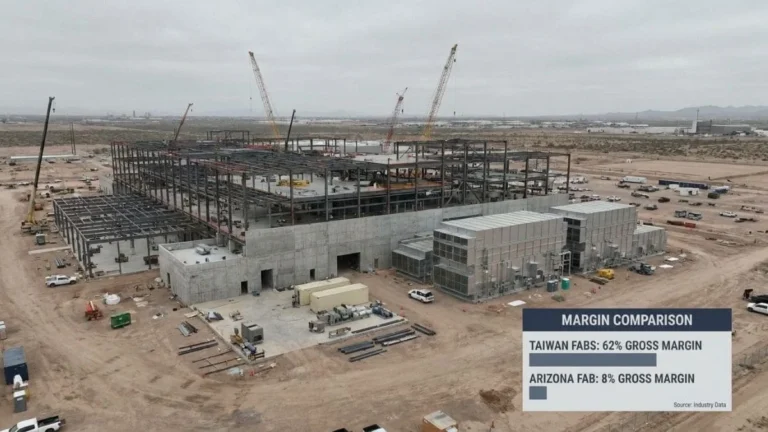
Taiwan represents the ceiling of what deliberate state direction can achieve. Taiwan possessed no natural chokepoint. In the 1970s, it was an assembler of other nations’ designs, earning thin margins on hardware it did not invent. TSMC’s dominance stems from a revolutionary business model, early government backing, and relentless execution.

TSMC’s revolutionary business model, whereby it only manufactures chips and never designs its own, guarantees clients like Apple, Nvidia, and AMD that their manufacturer would never become a competitor.
As a result, TSMC now holds approximately 71 percent of the global foundry market and dominates a near-exclusive position at the most advanced logic nodes (sub-5nm process technology).
What Craig Addison called the “Silicon Shield” in his 2001 book is not geography but an accumulated knowledge that took three decades to compound into irreplaceability that now sits at the center of the most consequential geopolitical standoff of our era, one whose economic consequences extend far beyond Taiwan’s borders.

Morocco represents a more conditional and still-developing case as a benchmark rather than a confirmed success, because the outcome depends on structural choices the country has not yet fully made.
According to the US Geological Survey, Morocco holds approximately 68 to 70 percent of the world’s phosphate reserves. Phosphate is a key input for lithium iron phosphate batteries, which now represent roughly half the global EV battery market.
Rather than exporting raw phosphate at extraction margins, Morocco has combined its resource position with free trade agreements covering both the US and EU markets, making it one of the very few African countries whose resources qualify for critical mineral supply chain credits under the US Inflation Reduction Act.
Chinese battery manufacturers, including Gotion High-Tech, CATL, BTR, and Huayou, have committed billions to manufacturing facilities on Moroccan soil, partly to circumvent tariff barriers on Chinese-origin goods by manufacturing within an IRA-eligible jurisdiction. Gotion alone committed $6.5 billion to a battery gigafactory in Kenitra.
The protectionist architecture, however, underpinning Morocco’s position is politically contingent. It was constructed by specific administrations with specific policy preferences. The IRA critical mineral provisions and potential EU carbon tariffs can be modified or dismantled. Morocco’s current advantage is real, but it is leased from the geopolitical preferences of others rather than owned outright.
Whether it escapes the trap depends on whether it can ensure that value, not merely activity, stays within the domestic economy before the policy architecture that enabled it shifts.
Failure Mode One: Industrial Leverage That Never Transfers
The first failure mode applies to nations that possess a genuine physical or industrial asset and execute strategies that generate activity and investment without generating domestic ownership of the value chain that activity creates. The asset produces revenue but does not produce industrial sovereignty.

Indonesia executed the most aggressive version of this strategy in the critical minerals era. In 2020, the Indonesian government banned raw nickel ore exports, forcing Chinese and Western firms to build processing facilities inside Indonesian territory.
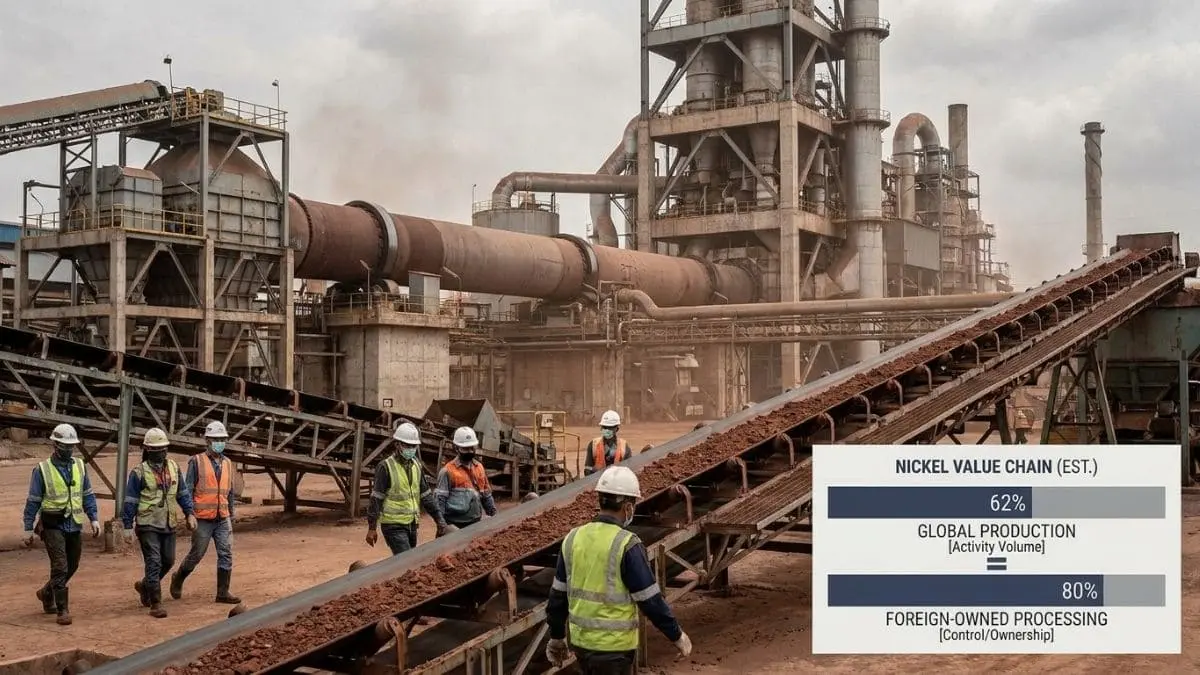
The logic was correct: capture value-added processing rather than raw extraction margins. By 2025, Indonesia controlled approximately 62 percent of global nickel production and had attracted over $40 billion in downstream investment. The strategy worked exactly as designed. However, it was not designed to solve the battery evolution problem.
Lithium iron phosphate batteries (LFP), which held less than 10 percent of the EV market when Indonesia’s ban took effect, now represent a share roughly seven times as high as in 2020. LFP chemistry does not require nickel, and China, which dominates approximately 80 percent of global EV battery cell manufacturing, drove the LFP shift partly because it reduces dependence on inputs China does not control and partly because LFP batteries are over 40 percent cheaper than nickel-based alternatives.
Indonesia’s export ban accelerated the technological substitution that erodes its leverage. In Indonesia’s own domestic EV market, over 90 percent of electric vehicles sold in 2025 used LFP batteries. BYD’s $1 billion Indonesian investment is in an LFP-based assembly plant, a direct institutional contradiction of the nickel-driven government strategy.
More critically, Chinese companies hold stakes in an estimated 80 percent of Indonesia’s nickel refining capacity. The processing moved to Indonesia. The ownership did not. China’s ability to dominate ownership of processing infrastructure while appearing to invest in host economies is not accidental; it is one dimension of the great power economic competition that is simultaneously reshaping energy corridors, shipping routes, and technology supply chains across the globe.

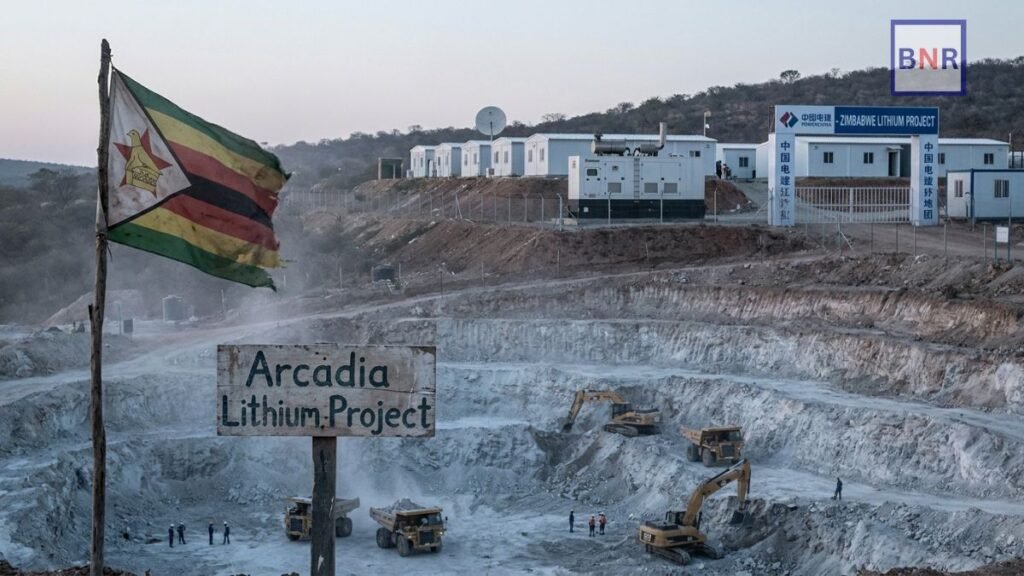
Similarly, Zimbabwe attempted the same strategy, holding Africa’s largest lithium reserves, which represent only 15 percent of China’s total lithium imports. Zimbabwe announced an export ban on raw lithium to force domestic refining investment.
The leverage logic requires that the counterparty cannot route around you. Indonesia had a near-monopoly on nickel growth reserves and could make that argument credibly. Zimbabwe cannot.
Global spodumene supply is diversified across Australia, Chile, Argentina, and China’s own domestic stockpiles. Chinese mining firms have invested over $1.4 billion in Zimbabwean lithium assets since 2021, enough to acquire political entanglement without creating dependency.
When the refinery eventually arrives, the question is not whether processing happens in Zimbabwe. It is who owns the refinery. Zimbabwe lacks the domestic capital to co-finance processing infrastructure, which means the firms that build it will own it. The ban forces infrastructure investment. It does not automatically redistribute ownership. That distinction is the entire difference between a resource export strategy and genuine sovereign wealth creation.

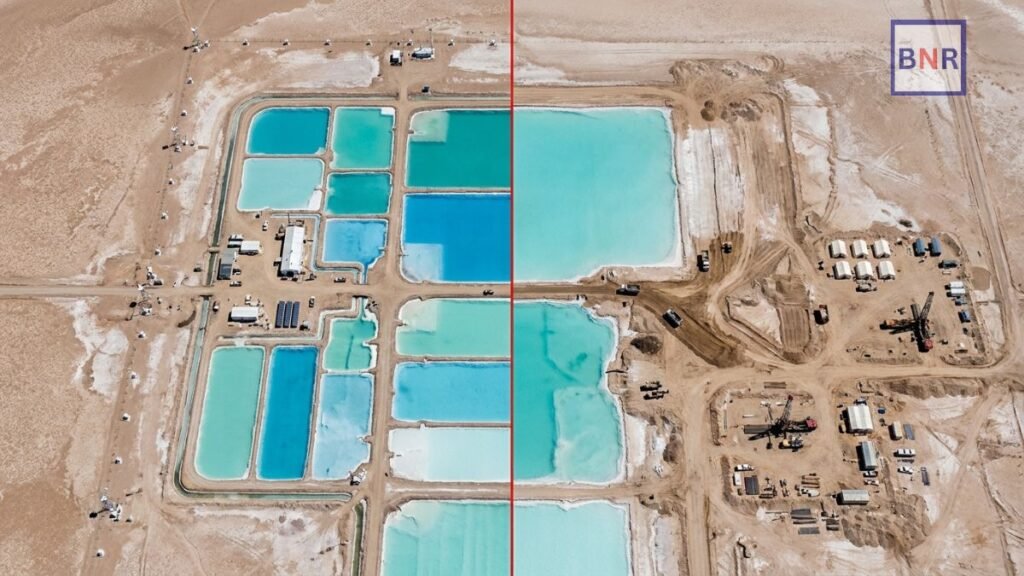
Chile possesses some of the world’s highest-quality lithium brine reserves and a functioning technocratic state. Its National Lithium Strategy correctly identifies that state ownership stakes in processing infrastructure are necessary to capture value-added margins.
The implementation of Chile’s strategy is failing, not because the strategy is wrong, but because insisting on state majority ownership without the bureaucratic agility to deploy capital at market speed creates permitting and structuring paralysis that private investors will not wait out.
While Chile negotiates ownership percentages, alternative brine projects in neighboring Argentina are scaling. Chile’s lithium leverage is depreciating not to a competitor with better resources but to a neighbor with fewer bureaucratic requirements. Strategic vision without execution machinery is not a strategy. It is a policy document.

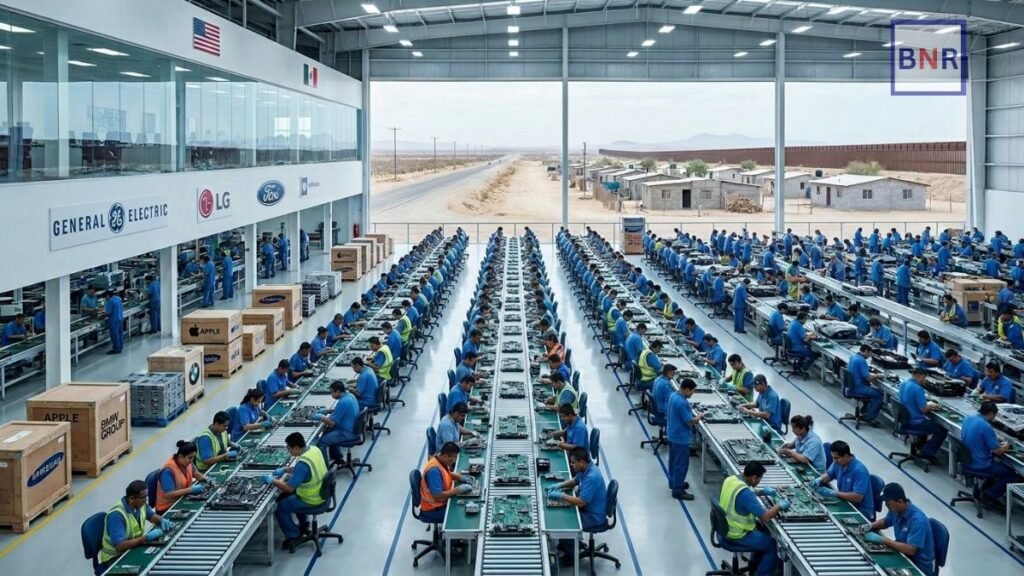
Mexico sits in an unprecedented geographic position following the post-pandemic near-shoring boom, having displaced China and Canada as the United States’ top trading partner, with bilateral trade exceeding $976 billion annually. The numbers are real.
The structural problem beneath them is equally real. The Federal Reserve Bank of Dallas confirms that despite a massive surge in Mexico’s exports, actual new foreign capital (greenfield investment) has hit multi-decade lows since 2022.
Foreign firms, whether through direct subsidiaries or third-party shelter arrangements registered under IMMEX, retain intellectual property, design rights, and capital expenditure decisions with US or Asian parent companies, regardless of the ownership structure of the Mexican operation.
The manufacturing sector, including IMMEX-registered firms, accounts for 17 to 18 percent of Mexico’s GDP. However, the domestic value-add is structurally capped because the technology and the IP belong to the foreign principal.
Mexico’s geographic advantage generates employment statistics and trade figures. It does not generate sovereign wealth until Mexico produces IP-owning manufacturers rather than execution facilities for foreign-designed processes.
Failure Mode Two: Dependency Flows That Prevent Reform
The second failure mode is categorically different from the first. It does not involve supply chain leverage or physical asset extraction. It involves nations where a significant external flow, whether demographic or monetary, has become so structurally embedded in the national economy that the state has organized its institutions around managing the dependency rather than eliminating it. The result is that the dependency reproduces itself across political cycles until the external condition that sustains it changes faster than the state can adapt.

Pakistan’s situation is not a policy failure in isolation; it is a structural one compounded across decades. In the three fiscal years from FY 2023-24 to FY 2025-26, Pakistan accumulated an estimated $107 billion in remittances and approximately $92.6 billion in total goods exports.
In FY2025, remittances reached a record $38.3 billion, representing 9.4 percent of GDP, approximately 20 times annual FDI, and more than the total value of every good the country shipped abroad.
The State Bank revised the FY2026 projection upward to $41billion. Every one of these figures is presented domestically as evidence of economic strength. None of them is. They are evidence that over five decades, Pakistan’s remittance-to-GDP ratio has climbed while its export-to-GDP ratio has declined in direct proportion.
Research published in 2024 by Taguchi and Bushra Batool establishes that when Pakistan’s remittance-to-GDP ratio exceeds 6 percent, it actively accelerates deindustrialization and slows capital accumulation. Pakistan is at 9.4 percent.
As remittances inflate domestic purchasing power, non-tradable sectors, particularly real estate and construction, become more profitable than tradable manufacturing. Capital, labor, and investment shift toward real estate and away from export industries.
A significant share of remittance savings flows directly into property, creating speculative price inflation in DHA and Bahria Town, while the housing shortage stands at 12 million units.
The tradable sector hollows out. Exports stagnate. The state becomes more dependent on the remittance inflow to cover the trade deficit that the hollowing out of exports created. The dependency compounds the structural weakness that created the dependency. Pakistan sent over 0.6 million workers abroad in 2025 and described it as a labor policy. It is not. It is the managed continuation of a structural failure written in the 1970s that no subsequent government has been willing to pay the political cost of reversing.
The full architecture of this dependency, how it was built, how it self-reinforces, and what breaking it would actually require, is examined in detail here

Nigeria’s trajectory is structurally different and more instructive because it illustrates the precise institutional choice that determines whether a dependency flow becomes sovereign capital or remains a managed liability.
Between July 2024 and June 2025, Nigeria processed over $92 billion in total on-chain cryptocurrency value, nearly triple South Africa’s volume in the same period. The scale matters less than the mechanism that produced it.
Nigerian citizens built this parallel financial infrastructure not as speculation but as survival. Chronic naira inflation, currency instability, and a formal banking system that had demonstrably failed its customers at scale drove millions of Nigerians toward stablecoins for remittances, savings, and commercial payments.
The state’s initial response in 2021 was prohibition. The Central Bank banned financial institutions from servicing cryptocurrency exchanges. The result was predictable: a peer-to-peer economy operating entirely outside regulatory oversight, generating no tax revenue, building no compliance infrastructure, and invisible to the sovereign. The ban did not eliminate demand. It formalized the state’s exclusion from a market it could not suppress.
The instructive chapter is what follows. Faced with a parallel financial system too large to ignore and too embedded to dismantle, Nigeria made the harder institutional choice: it built regulatory infrastructure around the market that existed rather than attempting to restore primacy to the market it preferred.
The Investment and Securities Act of 2025 permanently recognized digital assets as securities. Virtual asset service providers became licensed entities with AML and KYC obligations. The Nigerian Inter-Bank Settlement System began integrating decentralized liquidity into the formal banking infrastructure.
This sequence failed a formal system, built an alternative, and then formalized it. It appears wherever sovereign institutions fail to serve their populations at scale, and populations respond by constructing functional alternatives. The state faces a binary choice: suppress the alternative and lose fiscal relevance, or formalize it and capture the institutional infrastructure that citizens have already validated.
Nigeria chose formalization. Pakistan, facing analogous structural failures in its formal banking system and export sector, has chosen continued management of failing formal institutions.
Nigeria is not finished. Enforcement capacity and judicial infrastructure remain underdeveloped. The critical next step, channeling private digital asset liquidity into productive capital formation, has not yet been taken.
The regulatory container has been built. It has not yet been filled with sovereign content. But Nigeria identified a structural failure, acknowledged that citizens had built a more functional alternative, and moved to capture it rather than suppress it. That institutional choice is the operative distinction between a state building sovereign capacity from a dependency and a state using a dependency to manage sovereign failure.
Why Some Escape
Both failure modes share the same political logic: dependency discourages reform because reform requires accepting the fiscal pain the dependency was built to avoid.
That logic alone cannot explain why Taiwan escaped and Pakistan has not. One variable consistently breaks the mechanism across every case that successfully converted a national asset into sovereign wealth: the credibility of the status quo’s collapse.
States escape the trap when the cost of inaction becomes demonstrably more expensive than the cost of reform, not theoretically more expensive in a long-run model, but immediately and visibly more expensive in a way that removes the political option of continued management.
For Taiwan, the existential military threat from mainland China made the comfortable path of low-margin assembly unsurvivable. Industrial transformation was not a growth strategy. It was a sovereignty strategy with a security deadline.
For South Korea, Cold War US policy explicitly conditioned aid on industrial upgrading rather than consumption subsidy, converting what could have been a dependency-sustaining transfer into a time-limited investment with performance requirements.
For Nigeria, the naira’s collapse was severe enough that the formal banking system became functionally irrelevant, forcing the state to choose between formalizing the alternative or surrendering fiscal relevance to its own economy. In each case, inaction was not cheaper than reform. It was existentially more expensive.
The Unified Diagnosis
What connects these eight cases across two failure modes is not a single mechanism. It is a common outcome generated by two distinct institutional failures operating under the same political logic.
The industrial leverage cases fail because the state captures activity without capturing ownership. Indonesia built smelters it does not own. Zimbabwe will build refineries it does not control. Mexico assembles products whose IP it does not hold. The flow of investment, employment, and export revenue creates the appearance of industrial development, while the value accumulation happens elsewhere.
The political economy of attracting investment is incompatible with the policy requirement of owning it, because demanding ownership reduces the investment, and demanding the investment means surrendering ownership.
Governments consistently resolve that tension in favor of the activity metric over the ownership metric because activity metrics are visible and immediate, while ownership consequences are structural and delayed.
The dependency flow cases fail because the state manages the flow rather than transforming the structure that generates it. Pakistan manages remittance volumes through Roshan Digital Accounts and bilateral labor agreements. Nigeria managed crypto through prohibition and then through formalization.
Managing the flow generates institutional capacity around administering the dependency. It does not generate institutional capacity around eliminating the structural weakness, deindustrialized exports, and failed banking infrastructure that made the dependency necessary.
The bureaucracy gets better at processing the remittance. The economy does not get better at not needing them.
The Middle Power Trap is the political economy of the activity metric defeating the ownership metric, and the management imperative defeating the transformation imperative, in the specific context where transformation was feasible but politically more expensive than continued management until the moment it wasn’t, at which point the institutional capacity for transformation had frequently atrophied beyond rapid reconstruction.
Structural Pressure Points
The Middle Power Trap requires the convergence of three conditions: a visible deterioration in the existing dependency, a demonstrated alternative that citizens or markets have already validated, and a government willing to pay the short-term cost of building the superior institutional structure rather than managing the inferior existing one.
These conditions have been available in various forms for decades, but the reliability of the buffers that have historically made inaction viable.
For remittance-dependent economies, the structural shift in diaspora demographics is the relevant pressure. First-generation migrants remit, driven partly by economic calculation and partly by familial obligation and emotional ties to the homeland.
Second and third-generation diaspora populations whose primary identity is with their country of birth, not their country of ancestry, remit on purely economic terms. Their behavior is more sensitive to exchange rate differentials and investment returns than to homeland loyalty premiums.
Economies that have structured their external accounts around historically elevated remittance volumes are carrying exposure that their current data obscures. Any economy where a single flow accounts for more than 9 percent of GDP and 20 times annual FDI is structurally fragile to a step-change moderation in that flow, regardless of its current trajectory.
For mineral-leverage economies, the pressure is battery chemistry evolution and energy transition acceleration. The LFP shift that eroded Indonesia’s nickel position illustrates a broader principle: the technology stack that determines which minerals are strategic is not fixed. An export ban strategy that captures value today may accelerate the technological substitution that renders the leverage obsolete.
The correct question for every mineral-leverage economy is not how do we capture processing value from our current commodity? It is what is the probability distribution of technological substitutions that could reduce demand for this mineral, and do we have ownership positions in the successor chemistry?
For industrial nearshoring economies, the pressure is AI-driven labor substitution. Mexico’s nearshoring advantage is partly geographic and partly labor-cost arbitrage. As AI-enabled automation progressively substitutes for the assembly, quality control, and logistics coordination tasks that constitute most nearshoring value, the labor-cost component of that advantage compresses. What remains is geography and regulatory positioning, which are durable but insufficient on their own to generate sovereign wealth without domestic IP development.
The common thread is that the external conditions historically subsidizing inaction, steady remittance flows, stable mineral demand, and labor arbitrage are each under structural pressure from forces operating independently of any individual government’s policy choices.
The Middle Power Trap is not permanent. Every case examined here retains a viable path to escape. The cases that have historically escaped share one characteristic that is available to all that have not: a government that chose to build the superior institutional alternative rather than manage the inferior existing one.
The irony is that waiting for the external constraint to make that choice unavoidable is itself the trap. The cost of building the alternative does not decrease with time because the institutional capacity required to execute the transformation atrophies precisely during the period when management of the dependency appears to be working.
That choice is available to every government in this analysis. The external constraint is tightening. The window is not.