Saudi Vision 2030 Progress 2026: The Triage of Projects in Saudi Arabia

⏱️ 4 Mins Read
The financial buffers of Saudi Vision 2030, which enabled measurable societal reforms, have been removed, exposing its established structural failures after the Middle East crisis in 2026.
The recent US-Iran conflict and ensuing shipping disruptions have exposed deep fiscal vulnerabilities, forcing Riyadh to triage its most ambitious projects in Saudi Arabia.
What is the main aim of Saudi Vision 2030?
The primary purpose of Saudi Vision 2030 is to significantly reduce the Kingdom of Saudi Arabia’s economic dependence on hydrocarbon revenues. Overseen by the ADAA agency and fueled by the Public Investment Fund (PIF), the 15-year plan targets expanding private-sector contribution to 65% and boosting non-oil GDP to 65%.
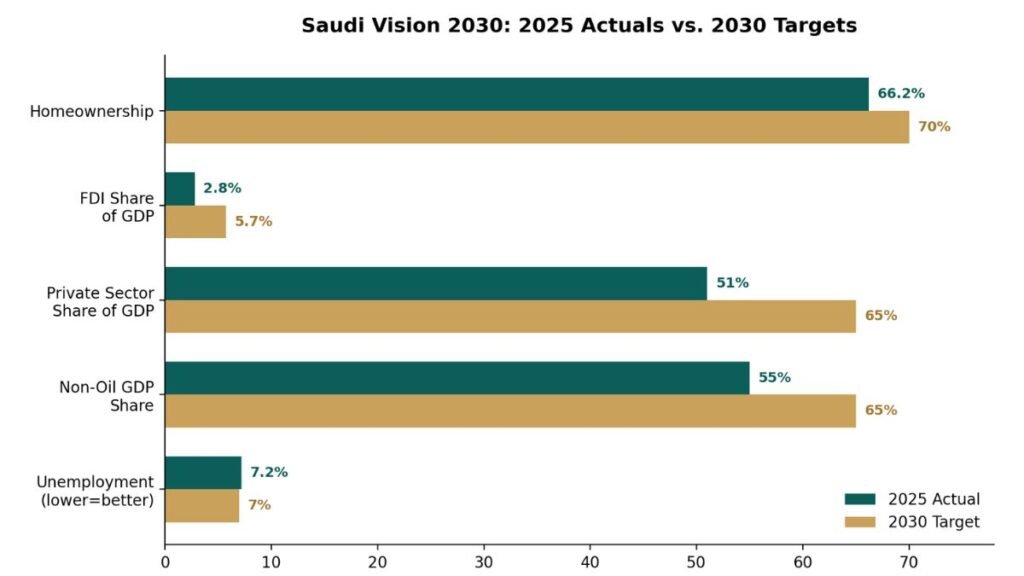
The 2025 Annual Report: Evaluating the Progress of Saudi Vision 2030
The latest data disclosed a deep reality about Saudi Vision 2030’s progress, achievements, and challenges in 2026.
Societal, healthcare, and digital infrastructure targets are largely succeeding, while core metrics for foreign investment and non-oil exports remain severely stalled.
| Macroeconomic Indicator | Vision 2030 Target | 2025/2026 Reality | Status |
| Non-Oil GDP Contribution | 65% | 55% (Up from 45%) | Progressing |
| Female Workforce Participation | 30% | 36% | Exceeded |
| Unemployment Rate | 7.0% | 7.2% | On Track |
| Foreign Direct Investment (FDI) | 5.7% of GDP | 2.8% of GDP (Declining) | Failing |
| Non-Oil Exports | 50% | 22% | Stalled |
| Healthcare Coverage | 100% | 97.5% | Progressing |
Where the Strategy Succeeded
Domestic and societal reforms remain the undisputed successes of the 2025 Annual Report.
Non-oil activity climbed to 55% of GDP, up from 45%. The unemployment rate plummeted to 7.2%, and female workforce participation surged to 36%, surpassing the 30% target.
Furthermore, homeownership reached 66%, and tourism surpassed the 100-million mark, prompting a revised target of 150 million. PIF assets swelled from $152 billion to $925 billion.
Where the Strategy Failed (Pre-2026)
However, long before the war, core economic indicators stalled. FDI stubbornly hovered at 2.8% of GDP, less than half the target, and has actively declined since early 2026.
Non-oil exports remained stagnant at 22% of the 50% target, while the private sector stalled at 51%. Of 1,290 tracked initiatives, only 225 are fully implemented; 935 remain ‘on track’ on paper, leading to target revisions.
This pattern of a nation holding genuine economic leverage – oil wealth, strategic geography, market scale- while consistently failing to convert it into sovereign industrial capacity is the defining characteristic of the middle power trap.
The Public Investment Fund (PIF) AUM Growth: 2015 to 2030
A core driver of Saudi Vision 2030 is the aggressive capitalization of the Public Investment Fund (PIF). Serving as the central financial vehicle for the Kingdom’s economic diversification, the fund officially closed its 2021–2025 roadmap and is currently executing its 2026–2030 strategy.
Despite recent market corrections and a $38.8 billion reduction in the Saudi Aramco dividend, the PIF’s asset growth trajectory reflects one of the fastest rates of capital accumulation in sovereign wealth history.
| Year / Milestone | Assets Under Management (AUM) | Catalyst for Growth / Market Status |
| 2015 (Baseline) | $150B – $152 Billion | Structurally repositioned under Crown Prince Mohammed bin Salman to anchor Vision 2030. |
| 2021 (Phase I Close) | ~$530 Billion | Steady growth via government capital injections and domestic asset revaluations. |
| Early 2024 | $925 Billion | Surpassed milestone following the transfer of an additional 8% stake in Saudi Aramco to the PIF portfolio. |
| 2025 / 2026 (Current) | $910B – $1.15 Trillion | Third-party tracking (SWFI) estimated peaks near $1.15T; official internal audits hover near $913B due to local market corrections and heavy domestic spending. |
| 2030 (Target) | $2 Trillion | Official 2026–2030 strategic target required to fully fund remaining giga-projects and transition to AI/Tech portfolios. |
The Status of Mega Projects in Saudi Arabia: A 2026 Triage
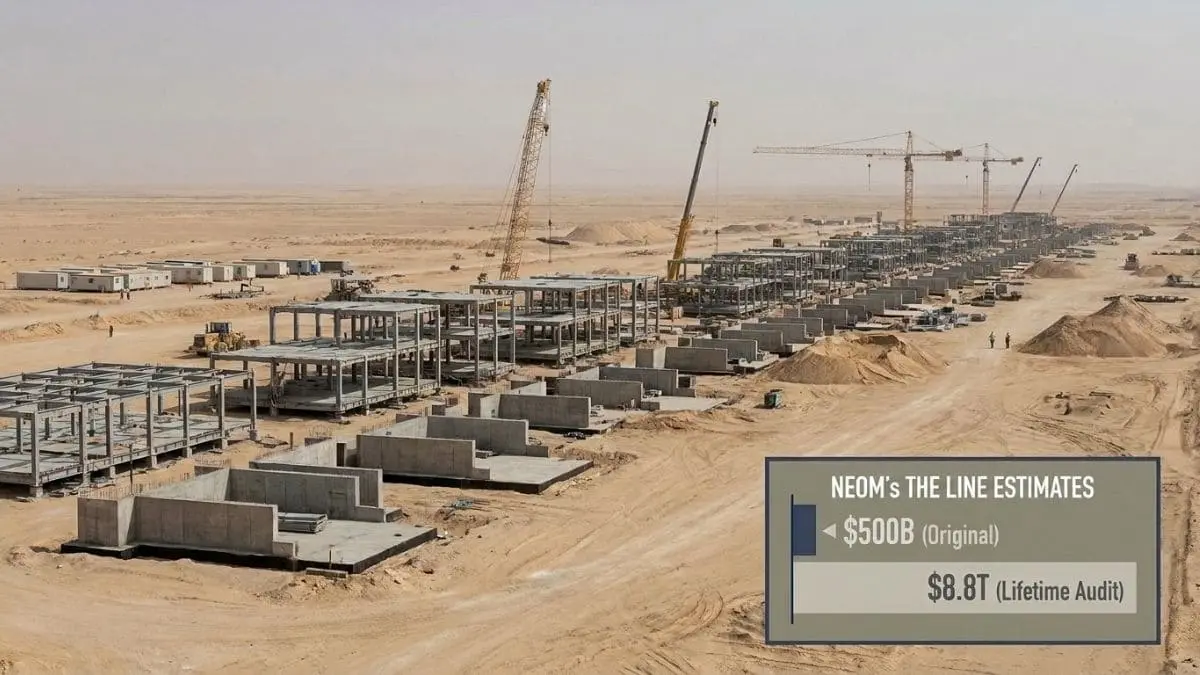
Anyone tracking Saudi giga projects news knows that the most severe pre-war breakdown occurred in the nation’s real estate and infrastructure portfolio. Originally unveiled at $500 billion, a 2025 internal audit priced NEOM’s lifetime cost at a staggering $8.8 trillion. This forced an immediate, aggressive recalculation of all Saudi Arabia mega projects.
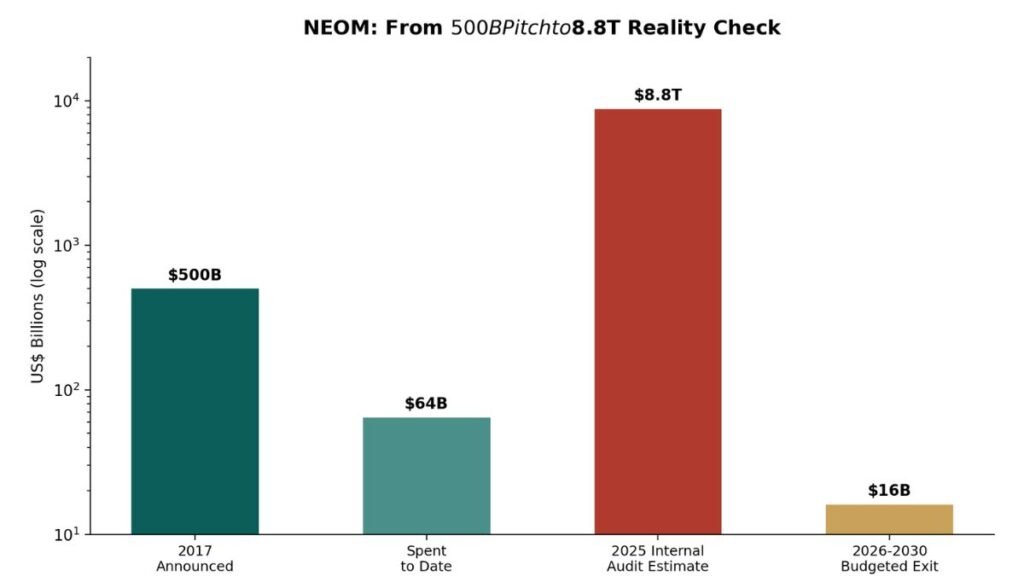
To protect the reported yields of healthier PIF assets, Riyadh isolated NEOM into a separate financial ledger. The state absorbed $64 billion in sunk costs on NEOM, plus an additional $16 billion explicitly allocated to terminate contractor agreements for various construction projects in Saudi Arabia. While essential Saudi new projects tied to global events remain funded, many ambitious Saudi projects are being actively downsized.
| Giga-Project | Original Scope | 2026 Adjusted Reality | Current Status |
| The Line (NEOM) | 9 million population capacity | Scaled back to 300,000 capacity | Construction Suspended |
| Sindalah | Luxury island resort | Stalled throughout 2024–2025 | Delayed |
| Trojena | Year-round mountain ski resort | Scope severely scaled back | Downsized |
| Expo 2030 Infrastructure | Global exhibition facilities | Fully funded and prioritized | Active |
| 2034 World Cup Stadiums | Nationwide sports infrastructure | Fully funded and prioritized | Active |
What economic challenges is Saudi Arabia facing?
The primary economic challenges facing Saudi Arabia in 2026 include a stalled Foreign Direct Investment (FDI) rate, stagnant non-oil exports, and a rising budget deficit Saudi Arabia exacerbated by regional conflict. A 26% spike in Q1 defense spending combined with Aramco slashing its dividend by $38.8 billion has severely thinned Riyadh’s fiscal margins.
How has Saudi Vision 2030 evolved since its launch?
The strategy has shifted from unchecked, simultaneous mega-development to strict capital prioritization. PIF governor Yasir Al-Rumayyan has pivoted fresh capital away from tourism megaprojects and directly toward AI infrastructure, green hydrogen, and digital government services.
Ultimately, while the Saudi Vision 2030 progress 2026 reflects a successfully modernized society, the architectural ambitions surrounding the Saudi Vision 2030 progress NEOM giga-project 2026 have collided with hard macroeconomic ceilings, forcing Riyadh to adapt to a much leaner economic reality.
Read more analysis in our Middle Power Trap section.