The $40 Billion Shield: Taiwan Defense Budget and the Global Chip War

⏱️ 5 Mins Read
Amid war in the Middle East, another geopolitical front, Taiwan, the world’s largest chip-making nation, remains the most volatile flashpoint in the US-China relationship following the Trump-Xi summit.
At the heart of this confrontation is Taiwan defense budget, a proposed $40 billion package that acts as the ultimate protective bubble or an insurance policy for the global semiconductor industry. Every recent geopolitical move, from opposition visits to Beijing to new airline routes, is directly connected to this strategic military expenditure.
Taiwan, an island that manufactures over 90 percent of the world’s most advanced semiconductors, has now gained significance between the world’s two superpowers.
In recent years, major developments have emerged on both sides, with Taiwan’s $40 billion defense budget serving as the central battleground.
The semiconductor battle over Taiwan is not an isolated trade dispute; it is also the most consequential front in the great power economic competition that is simultaneously reshaping energy corridors, shipping routes, and technology supply chains across the globe.
Why Taiwan’s Chips Are the Real Bargaining Chip
The world’s AI economy runs through a single island, Taiwan, where one chip-making company, TSMC, alone produces chips that power everything from fighter jets to AI data centers. Every political move around Taiwan, whether a visit by Taiwan’s opposition leader to Beijing or an airline route, has semiconductor and defense budget consequences.
The full economic consequences of Taiwan’s vulnerability, a verified $10.6 trillion first-year shock that would exceed both COVID-19 and the 2008 financial crisis combined, are laid out in detail here.
Ties between the two countries have long been beleaguered by resentful events ranging from trade friction to tech competition and geopolitical tensions.
Both countries have made several major developments in recent years, placing Taiwan at the center of the global debate.
A Proposed $40 Billion Taiwan Military Budget
In Taipei on November 26, 2025, Taiwan’s President Lai Ching-te proposed a $40 billion action plan to safeguard democratic Taiwan and national security over the next eight years, following the Trump administration’s push to increase defense spending to deter a potential Chinese attempt to regain control of the territory.
Taiwan, whose previous annual defense spending was 3 percent of GDP, raised it to $40 billion, or around 5 percent of its $800 billion GDP, after the US demand.
A significant portion of this proposed budget is intended for research, development, and deployment of a multi-layered, AI-integrated air defense shield ‘T-Dome’, precision munitions, advanced long-range strike, and unmanned U.S. systems.
However, Taiwan’s main opposition Kuomintang (KMT), led by Chairperson Cheng Li-wun and its coalition partner, the Taiwan People’s Party, stalled approval of the proposed budget and raised transparency issues.
China’s Move to Neutralize Taiwan’s Proposed Defense Budget
Now, Taiwan’s main opposition leader, Chairperson Cheng Li-wun, visited China on the Chinese invitation and met President Xi Jinping.
To understand why the Chinese Communist Party (CCP) extended this historic invitation to KMT Chairwoman Cheng Li-wun, who made her trip on April 7–12, 2026, we look at both the official narrative and the underlying geopolitical strategy.
This is the first time a sitting KMT chairperson has visited China in a decade. The Chinese official statement said the purpose of this visit was to promote the peaceful development of relations between the Communist Party and Kuomintang as well as across the Taiwan Strait.
However, the timing of the KMT chairperson’s visit to China was highly calculated, a month before U.S. President Donald Trump was scheduled to visit Beijing in May 2026.
A successful KMT chairperson visit sent a powerful narrative to Washington that Taiwan is an internal Chinese matter, and a significant portion of Taiwan’s political leadership wants peace and integration, not American weapons.
Unsurprisingly, Taiwan’s ruling DPP, in its response, declared this visit as an active Chinese interference with Taiwan’s domestic defense policies, characterizing the invitation as Beijing’s way of rewarding Cheng Li-wun for hindering the arms purchases, a strategy of blocking arms sales in exchange for a Xi-Cheng meeting.
Why the US Doesn’t Back Taiwan’s Defense Budget, Openly
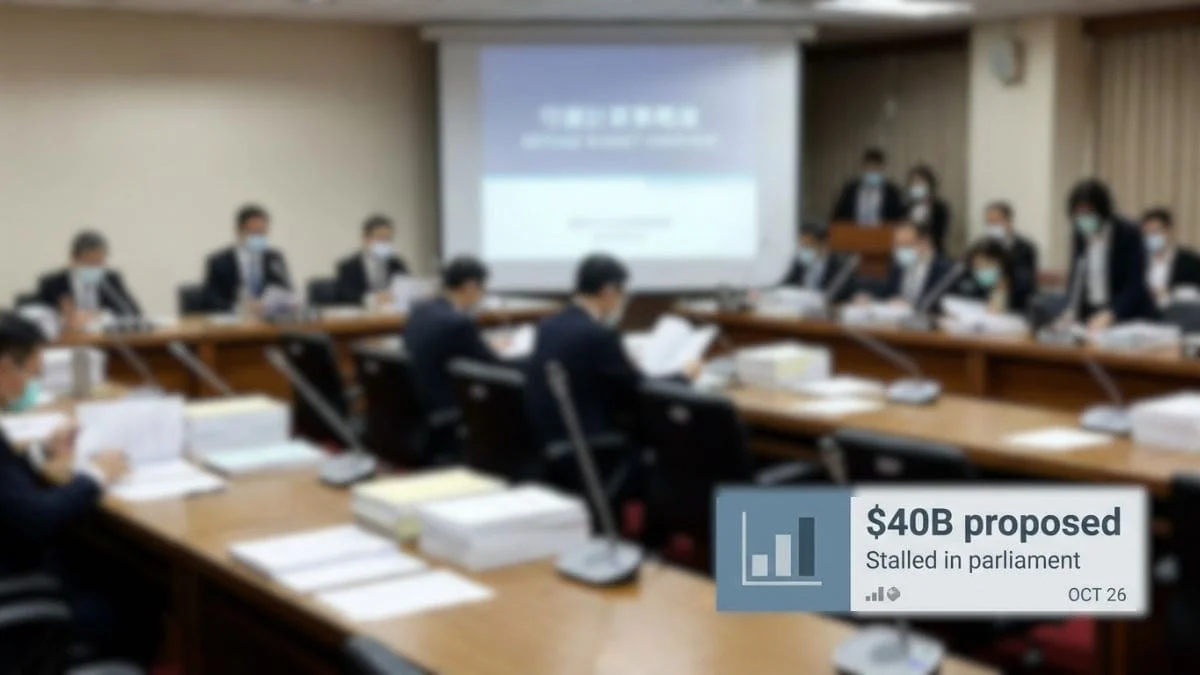
On March 30, 2026, a delegation of U.S. lawmakers met with Taiwan’s President Lai Ching-te in Taipei and supported Taiwan’s government’s efforts to increase Taiwan’s military spending to $40 billion, a proposed Taiwan defense budget currently stalled in the opposition-controlled parliament.
A bipartisan group of four senators, including Democrats Jeanne Shaheen and Jacky Rosen, and Republicans John Curtis and Thom Tillis, visited Taiwan not only to bolster U.S. alliances but also to counter China’s influence in the region, before the May 2026 summit.
However, during his May 2026 visit to China, President Donald Trump warned Taiwan against declaring formal independence, saying that he was not looking to have somebody go independent. “I don’t want to travel 9,500 miles to fight a war.
He later remarked on his return from China that when Chinese President Xi Jinping asked if the U.S. would defend Taiwan, he replied, “I don’t talk about that”.
His remarks came after Xi warned that the Taiwan issue was China’s ‘red line’, which could push the two superpowers into a direct clash. Later, he put a proposed Taiwan defense deal into abeyance, saying he was holding the package to use as a bargaining chip in broader trade and geopolitical negotiations with China.
Why has Starlux Airlines expanded Taiwan–Japan connectivity?
On March 30, 2026, Taiwan’s Starlux Airlines announced plans to expand routes from Taichung to Tokyo and Kumamoto, a city where the world’s largest AI chip manufacturer – Taiwan Semiconductor Manufacturing Company (TSMC) has located its multi-billion-dollar fabrication plant. This direct flight will act as a dedicated “semiconductor shuttle,” transporting TSMC executives, specialized engineers, and supply-chain personnel rapidly between Taipei/Kaohsiung and Kumamoto.
Semiconductor fabrication requires an incredibly complex and highly sensitive supply chain, and direct flights between Taiwan and Kumamoto will help manage that supply chain and enable rapid transfers of specialized equipment, testing tools, and materials.
This direct link would also encourage soft diplomacy between the two countries, which the analysts believe would not trigger the intense diplomatic blowback from Beijing.
Beijing sanctions Japanese lawmaker Keiji Furuya over Taiwan visits
On the same date, China imposed a sanction on a conservative Japanese lawmaker, Keiji Furuya, a close ally of Prime Minister Sanae Takaichi, and accused him of “colluding with” separatists in Taiwan. However, Japan termed it an unacceptable and regrettable step, demanding that it be retracted immediately.
Furuya heads a bipartisan Japan-Taiwan lawmakers’ consultation council and regularly visits Taiwan. In his most recent visit to Taipei, he held talks with Taiwanese President Lai Ching-te in mid-March. Furuya’s sanctioning also signals Beijing’s discomfort with the deepening Taiwan-Japan semiconductor corridor, which the Starlux Airlines expansion is physically reinforcing.
These recent developments indicate a chessboard is already set, accelerating a multi-front geopolitical contest over Taiwan’s future.
Beijing’s simultaneous actions, sanctioning a Japanese lawmaker, providing a sponsored visit to Taiwan’s opposition to China, strongly endorsed the one-China narrative, fragmenting the US-Taiwan-Japan coalition, reflected a coordinated strategy leading up to the May 2026 summit.
Now that the summit has concluded and the US has placed the defense deal in abeyance, the chessboard has become more complex. Washington continues to channel its response cautiously, while Japan strengthens its semiconductor corridor with Taiwan despite Chinese economic pressure.
All these developments prove that the Taiwan defense package remains the ultimate battleground of the global chip war.
Whatever underlying deals were struck between Trump and Xi in Beijing, one reality remains unchanged: the world’s AI future still runs through Taiwan, and no superpower can afford to ignore this island.
Read more analysis in our Great Power Economics section.