How the US and China Semiconductor War Is Reshaping the Infrastructure of Egypt

⏱️ 4 Mins Read
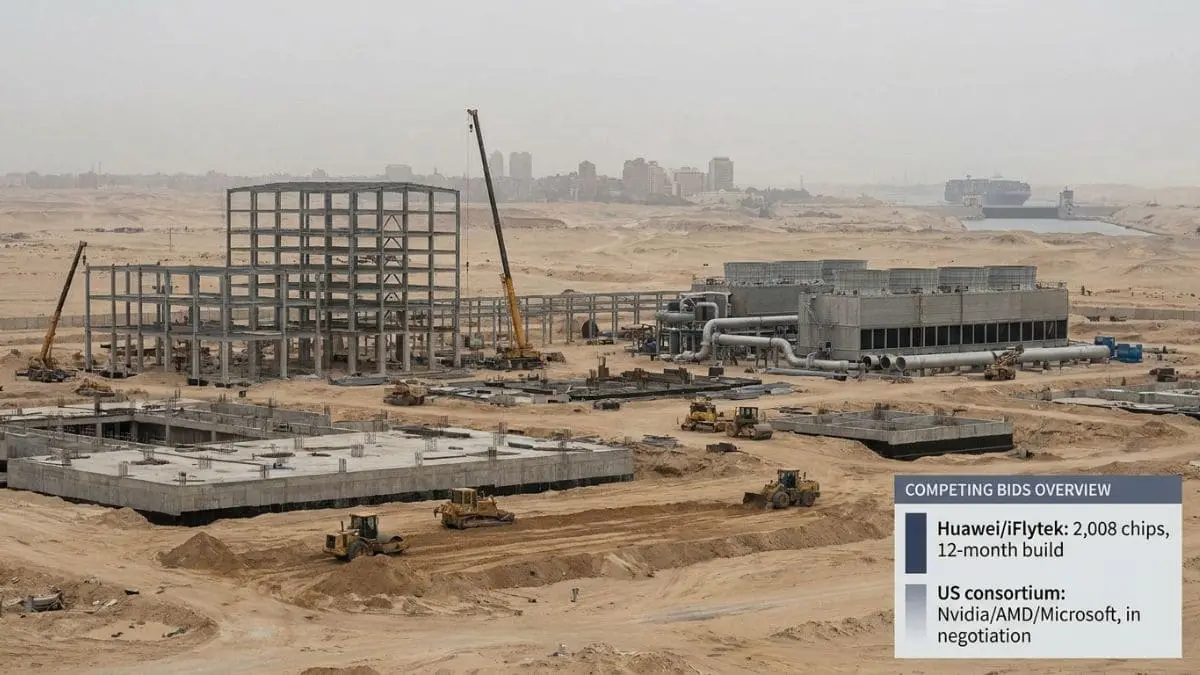
Chinese technology giant Huawei has submitted a formal proposal to the Egyptian government to build an AI Infrastructure of Egypt, utilizing 2,008 of its proprietary Ascend processors.
The US State Department is scrambling to assemble a counter-bid by approaching Nvidia, AMD, and Microsoft to form an American consortium.
While Chinese tech giants market sanction-proof infrastructure to emerging economies, Beijing’s own domestic tech sector continues to rely on smuggled Nvidia silicon to train frontier models.
A ‘non-American’ or ‘Non-Chinese’ tech stack is nothing but a marketing gimmick; the truth of the matter is that an absolutely sovereign AI is an illusion because the entire global hardware supply chain is fastened to the choke points.
The US depends on Taiwan’s chip manufacturing ecosystem to produce Nvidia’s cutting-edge chips; China relies heavily on Nvidia-smuggled chips to run AI infrastructure, while the rest of the world has no option but to rely solely on American or Chinese AI solutions or a mix of both.
The great power competition is now playing out in Cairo. This will transform the Suez Canal’s physical trade corridors into a high-stakes arena for sovereign computing. The future for science and technology in Egypt is directly linked with the shifting defense architecture of the Middle East.
A New Digital Architecture for Cairo
How is the US-China semiconductor war affecting Egypt’s infrastructure?
The United States and China are directly competing to control the digital infrastructure of Egypt. Huawei has proposed deploying 2,008 proprietary Ascend processors for state surveillance and sovereign computing. In response, Washington is mobilizing an American tech consortium, featuring Nvidia, AMD, and Microsoft, to prevent Beijing from establishing an exclusive technological foothold in North Africa.
What Is the Future of Science and Technology In Egypt?
Under its national development strategy, Cairo aims for artificial intelligence to contribute 7.7% of its total GDP by 2030. To drive this expansion in science and technology in Egypt, the state is balancing low-cost Chinese infrastructure with American diplomatic partnerships, leveraging the geopolitical rivalry to extract maximum investment for its domestic digital grid.
This balancing act mirrors the sovereign AI dilemma facing every emerging economy where the choice of infrastructure provider is simultaneously a geopolitical alignment decision.
Huawei’s proposal offers 1,408 high-end Ascend 950-series processors to anchor a national AI training cloud, supported by 600 Ascend inference chips to process operational workloads.
Outlining an aggressive 12-month deployment schedule, Huawei is not only pitching server racks, but also offering an entire sovereign stack designed to operate free from Western intellectual property and trade sanctions.
Hardware Gaps VS Ecosystem Control
Who Is Winning the Chip War In Emerging Markets?
While the US dominates hardware design through Nvidia and Taiwan’s manufacturing ecosystem, China is winning the race in emerging markets, capturing strategic ground by packaging lower-cost hardware with open-source software and domestic security tools, providing offering a functional alternative to US-controlled platforms to developing nations.
The strategic value of the Egyptian project for Beijing cannot be ruled out. A success in getting the contract would register the first major overseas export of Huawei’s Ascend accelerators, validating a supply chain rebuilt after years of US sanctions.
However, the deal will also extend far beyond commercial compute. In partnership with the US-sanctioned firm iFlytek, Huawei’s package integrates vehicle and facial-recognition systems wired directly into Egypt’s civil registry and national population database. By anchoring domestic security in Chinese hardware, Cairo would become structurally dependent on Beijing’s firmware, maintenance, and technical standards.
The Geopolitics of Technology: Competing AI Infrastructure Bids in Egypt
| Strategic Element | Huawei & iFlytek Proposal (China) | US Consortium Response (Nvidia, AMD, Microsoft) |
| Hardware Volume | 2,008 processors (1,408 Ascend 950-series for training; 600 for inference). | High-end US AI accelerators; specific hardware allocations and architecture unconfirmed. |
| Application & Scope | State and public-sector workloads; include full-scale facial and vehicle recognition tied to national databases. | Commercial enterprise and sovereign computing; potential policy restrictions on surveillance applications. |
| Geopolitical Strategy | Deploy the first overseas Ascend cluster to demonstrate a sanction-proof alternative to Western tech. | Block Chinese digital expansion in Africa and preserve Western standards across regional data networks. |
| Execution Speed | Turnkey 12-month construction and deployment schedule. | Proposal currently in exploratory assembly by the US State Department. |
Maritime Choke Points and the Makkah Pact Friction
The timing of this infrastructure battle is inseparable from broader security realignments. Chinese President Xi Jinping’s state visit to Cairo underscores Beijing’s intent to link Egypt’s digital backbone with its physical investments across the Suez Canal Economic Zone (SCZone), securing the primary trade artery between Asia and Europe.
Simultaneously, a new regional security framework has emerged with the signing of the Makkah Pact between Saudi Arabia, Turkey, and Pakistan. Ankara and Islamabad are actively discussing the expansion of the pact, evaluating Egypt and Iran as critical regional players for securing maritime corridors.
This is where digital infrastructure conflicts with physical defense. If Egypt integrates Chinese military-grade AI and surveillance architecture into its sovereign institutions, it introduces a severe interoperability conflict.
The two primary signatories (Turkey and Saudi Arabia) of the Makkah Pact remain deeply intertwined with Western defense platforms, US-sourced avionics, and NATO-standard communications.
Embedding Huawei and iFlytek systems into Cairo’s command structures creates an immediate counterintelligence barrier, potentially locking Egypt out of coordinated security frameworks that rely on Western-aligned data networks.
Cairo’s calculated engagement with Huawei will be a classic dual-containment strategy. By entertaining Beijing’s integrated surveillance bid, Egypt is utilizing Chinese leverage to force Washington’s hand, demanding subsidized American silicon without ideological strings attached.
Whether Cairo ultimately accepts Huawei’s hardware or turns to the American consortium will determine more than just the speed of its data centers; it will signal whether North Africa’s primary transit power falls behind Washington’s technological perimeter or embeds itself behind the expanding Digital Wall of China.
Read more analysis in our Great Power Economics section.