Why the NEOM City Master Plan Collapsed: The 2026 Audit

⏱️ 3 Mins Read
Move past the polished marketing renders of the Saudi smart city to address the capital, physical, and engineering collision that forced Riyadh to triage the development. The sheer financial realities of NEOM city master plan have collided with a global AI compute boom, forcing a massive strategic turning point.
Is NEOM’s The Line Cancelled?
NEOM Status Summary: Those searching to find out whether NEOM The Line cancelled or not should know the project is not officially abolished, but the NEOM city master plan has been downscaled.
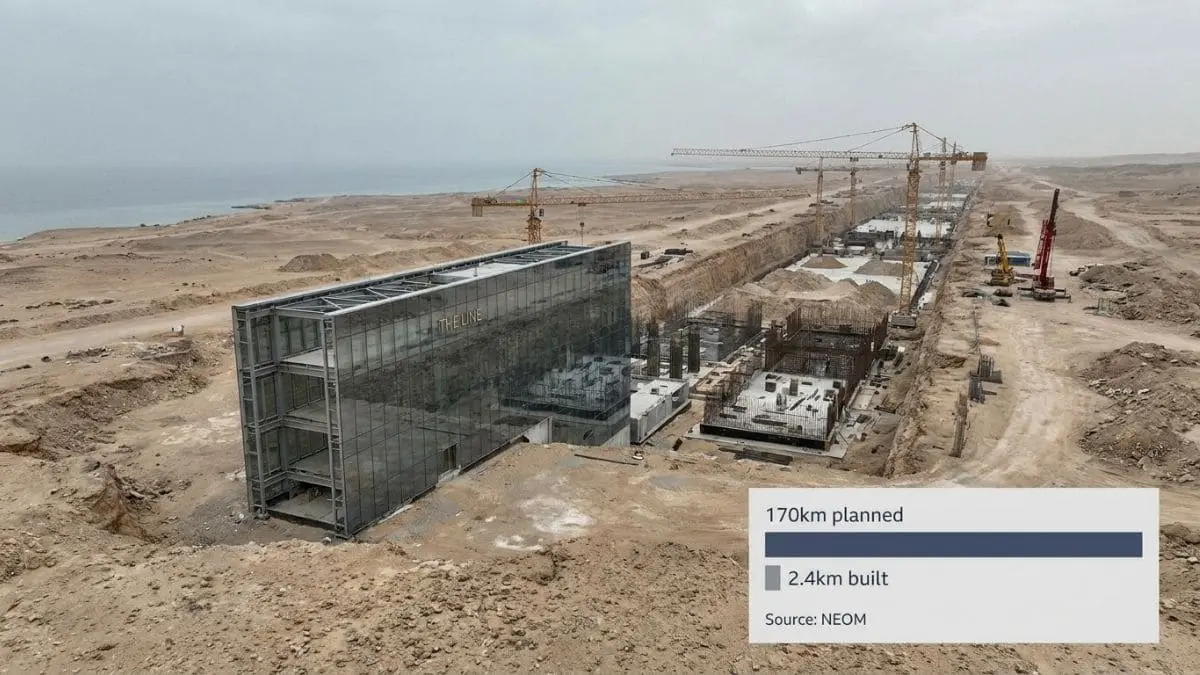
The initial designs had a 170-kilometer mirrored linear city for 9 million residents. The phase-1 construction is limited to a 2.4-kilometer coastal segment serving 300,000 residents. The surplus foundations and extensive trenches are currently being evaluated for conversion into sovereign AI data centers. These are critical NEOM city facts every investor must understand.
Saudi Arabia Wall City Construction: Why the Linear Design Failed
International engineering teams hit severe physical barriers trying to execute the linear city NEOM project the line Saudi Arabia. The thermodynamic challenges of building in desert environments, combined with extreme lateral wind loads on a 500-meter continuous vertical facade, made structural engineering nearly impossible. Furthermore, a linear layout forces severe single-point-of-failure bottlenecks for internal transit and logistics.
A distinct mutual delusion formed between autocratic project directives and international NEOM city architects and consultancies. Top-tier Western engineering contractors billed millions in fees for structurally implausible concepts, like suspending an upside-down 30-story building from a bridge hundreds of meters in the air, simply because it was heavily suppressed.
Evaluating the NEOM City Master Plan: Vision vs. Ground Status
To provide an accurate NEOM City progress update, we have to compare the original marketing promises with the reality of 2026 to understand how this multi-billion-dollar project is shifting from utopian real estate to pragmatic industrial utility.
| NEOM Development Region | Original Master Plan Scope | 2026 Ground Reality | Current Operational Status |
| The Line | 170 km linear city; 9M population; $500B initial estimate | Scaled to 2.4 km coastal sector; 300k capacity | Downsized / Foundations Repurposed |
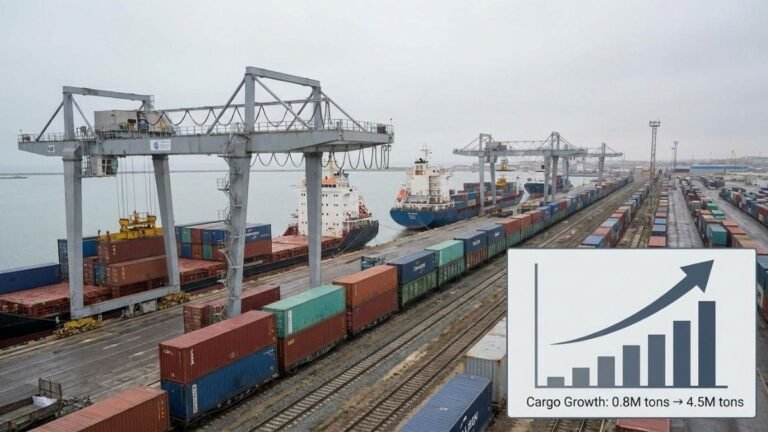
| Oxagon (Industrial Port) | Floating automated industrial city & port | Active coastal port buildout; green hydrogen hub | Prioritized / Active |
| Trojena (Ski Resort) | Mountain ski resort hosting 2029 Asian Winter Games | Earthworks underway; severe engineering/water hurdles | Scaled Back / Critical Path |
| Sindalah (Yacht Club) | Ultra-luxury island tourism hub | Built infrastructure; delayed commercial ramp-up | Completed / Underperforming |
| AI Compute Infrastructure | Unplanned in original architectural renders | Repurposing coastal civil footprints into server clusters | Rapidly Expanding |
Understanding the NEOM City Project Cost and Financial Triage
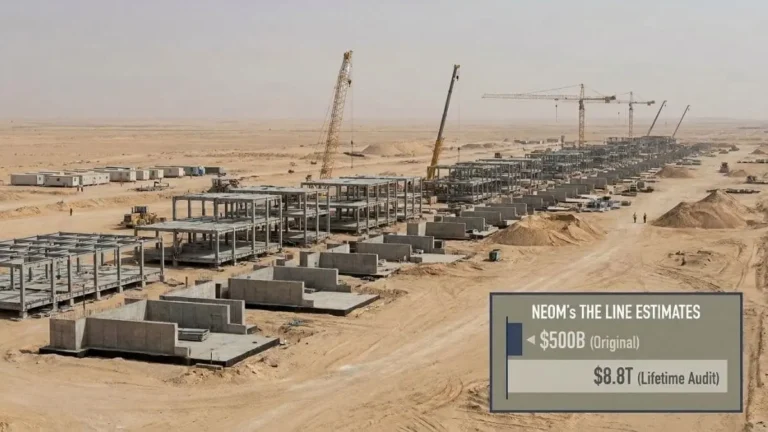
Internal audits recently priced the lifetime cost of the full 170-kilometer buildout at $8.8 trillion, nearly eight times Saudi Arabia’s annual GDP. This astronomical NEOM city project cost forced an immediate financial triage.
The NEOM investment fund and the broader Public Investment Fund (PIF) absorbed an estimated $50 billion in preliminary earthworks, roads, power systems, concrete batch plants, and water infrastructure.
Furthermore, significant capital was being spent terminating non-viable contractor agreements and quarantining legacy liabilities. Ultimately, the lack of private foreign direct investment from NEOM city investors meant the state had to shoulder the massive capital expenditure alone, prompting the aggressive downscaling.
From Megacity to Compute Hub: Repurposing the Desert Footprint
Riyadh is aggressively striving to recover its $50 billion preliminary spend. The kingdom is putting all its efforts into utilizing its green hydrogen plant, vast solar arrays, operational concrete batch plants, and deep-water coastal access to construct sovereign AI data centers.
However, establishing data centers and operating them in a desert present profound engineering challenges. Resolving extreme ambient heat requires either energy-intensive water desalination or the use of Red Sea closed-loop heat exchangers to cool the processor cores.
Despite these thermodynamic hurdles, transitioning the foundational footprint into digital infrastructure aligns directly with the kingdom’s broader sovereign technology ambitions.
NEOM’s trajectory is not a story of total failure. It is ultimately making a necessary transition from unfeasible architectural vanity projects to pragmatic sovereign industrial and digital infrastructure. For a complete macroeconomic context on how this capital prioritization affects the broader kingdom, see our analysis on Saudi Vision 2030 economic progress and triage.
Read more analysis in our Middle Power Trap section.