United Arab Emirates Exports And Pakistan’s Transshipment Dream?

⏱️ 6 Mins Read
The United Arab Emirates’ exports through a massive West-East pipeline, expected to be fully functional by 2027, could change everything for Pakistan, which has exactly 18 months to make this windfall permanent.
Following the closure of the world’s most important maritime chokepoint (Strait of Hormuz), protection and indemnity insurance on vessels was canceled, and all top shipping lines suspended all Gulf routing, which not only put a full stop on nearly 20 percent of the world’s oil trade, but also billions of dollars in containerized cargo with nowhere to go.
Then something happened that surprised almost everyone, perhaps most of all, Pakistan itself, as the world’s shipping industry turned toward Pakistan.
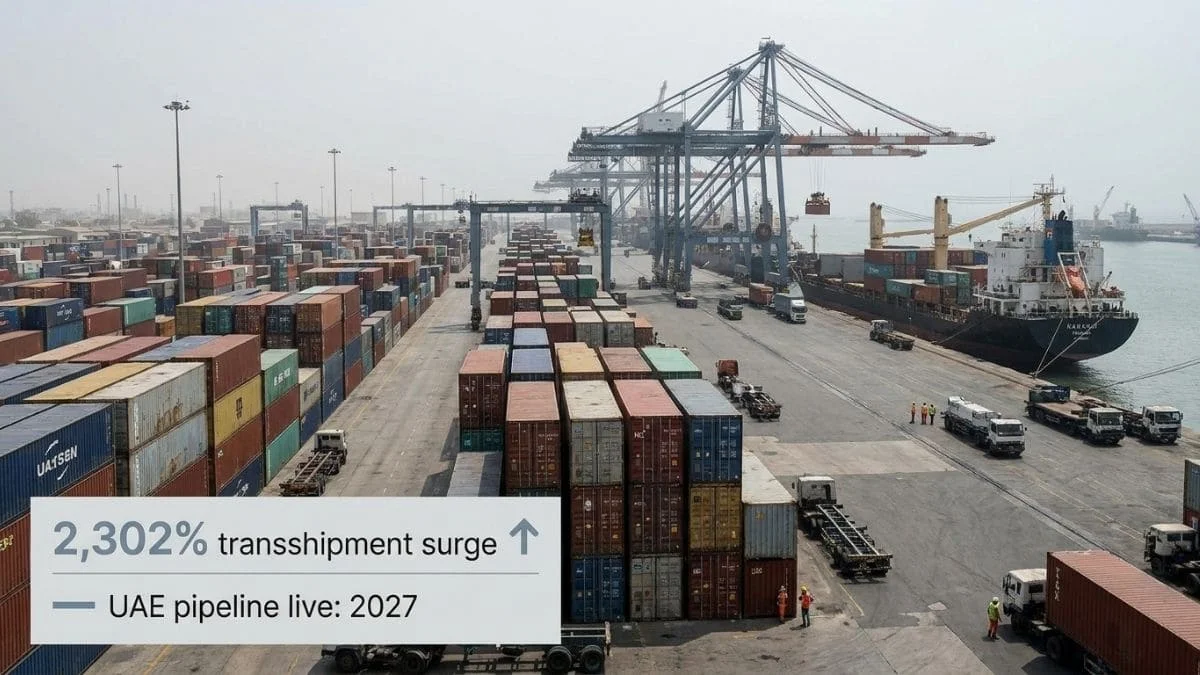
By March 24, 2026, Karachi Port had processed more transshipment containers than it had handled in the entire previous year. Gwadar, a port that historically received fewer than 20 ships annually, was processing that same volume in days. Port Qasim recorded a 2,302 percent surge in transshipment compared to February levels. Daily cargo handling at Karachi reached 168,850 tons on March 31, nearly triple the 57,198 tons recorded on the same day in 2025. Pakistan had not lobbied for this windfall, but it quickly capitalized on it.
However, the UAE is now writing a different story: a pipeline at its center and a 2027 deadline that Pakistan’s maritime ministry cannot afford to misread.
Why is the Strait of Hormuz Important for United Arab Emirates Exports?
To understand the competitive threat facing Pakistan’s transshipment ambitions, we must first examine why is the strait of hormuz important to the broader geopolitical landscape.
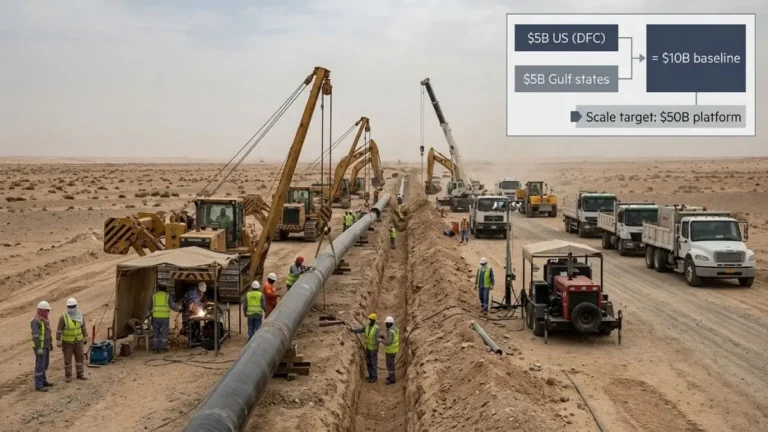
The UAE is fast-tracking a new West-East crude oil pipeline, or the Habshan–Fujairah expansion, to bypass Hormuz, which is expected to be fully operational by 2027, doubling export capacity to over 3 million barrels per day.
ADNOC CEO Sultan Ahmed Al Jaber, speaking at the Atlantic Council on May 20, said: “Right now, too much of the world’s energy still moves through too few chokepoints. Energy security is no longer just about your ability to continue producing energy, but also about routes, access, storage, and redundancy.”
Washington is now extending the same redundancy logic to a regional scale, proposing a $10 billion joint investment fund with Arab allies to permanently alter the Middle East’s energy architecture beyond what any single pipeline can achieve.
For a nation analyzing how the UAE makes money, the answer fundamentally relies on uninterrupted energy flows. The UAE was producing slightly above 3 million barrels per day before the conflict but has seen effective output constrained to between 1.8 and 2.1 million barrels per day due to wartime disruptions.
This strategic infrastructure play stems directly from great power economic competition. By securing United Arab Emirates exports through a terrestrial bypass, Abu Dhabi is insulating its sovereign wealth from maritime chokepoints.
The Dubai Canal Myth vs. Pipeline Realities
Public discourse often asks why the Gulf states do not simply dig a ‘Dubai Canal’ to bypass Hormuz entirely for massive container ships. The answer lies in hard geology. The eastern coast of the UAE and Oman is guarded by the Al Hajar mountain range, with peaks rising over 1,000 meters (3,200 feet) above sea level.
Building a lock system over these mountains, far exceeding the Panama Canal’s maximum 26-meter elevation, is an engineering and financial impossibility. Therefore, a pipeline is not just a convenient option, but a structural necessity to bypass the strait.
Pipeline Vulnerability: Why It Beats Maritime Shipping
Risk analysts frequently debate the vulnerability of this new infrastructure. While an overland pipeline is a stationary target compared to a moving mega-tanker, the logistics of repair heavily favor terrestrial infrastructure.
A targeted strike on a pipeline pump station does not cost hundreds of millions of dollars in lost cargo, nor does it take years to replace like a sunken vessel. Pipeline pressure can be reduced, sections can be rapidly repaired, and the flow of capital is restored in days, not months.
What the pipeline does is something more consequential for Pakistan: it restores the UAE’s oil revenue at full operational capacity, and that revenue flows directly into the financial ecosystem that funds everything, including DP World’s $3 billion capital expenditure budget for 2026. The pipeline is the engine. The container recovery is the consequence.
What Is Pakistan’s Strategy of Transshipment? And Why They Did Right
Pakistan did not simply reap the passive benefits of geopolitical tension; it accelerated its regulatory machinery.
The same geopolitical disruption that grounded airlines and redirected passenger traffic through Gulf hubs is now doing the same for shipping, creating a window for Pakistan that may close faster than its infrastructure can scale.
The government revised transshipment regulations to allow cargo handling at both seaports and airports, giving international logistics operators the operational flexibility they need.
- Pakistan Customs brought international shipping lines under the State Bank’s official exchange rate regime in January 2026, ending years of inflated discretionary billing.
- Port dues and berthing charges fell in the weeks after the Hormuz closure.
- The federal government approved new cargo categories for transshipment in early April, including bulk cargo, vehicles via Ro-Ro vessels, and LCL shipments.
- The Transit of Goods Order 2026 formally legalized third-country cargo consigned to Iran through Pakistani ports and land corridors.
These are not promises or plans but assets that will exist long after Hormuz reopens. Pakistan’s National Shipping Corporation plans to expand its fleet to 30 vessels by mid-2026. But the competition is also real.
The UAE’s Response: Faster, Better-Funded, and Already Underway
Pakistan’s celebratory commentary since March 2026 has missed something important: the UAE did not passively accept its temporary displacement. It responded almost immediately, with the institutional coordination and financial firepower that established hub economies deploy when their commercial position is threatened.
DP World confirmed the port remained fully operational throughout the crisis period and committed $3 billion in capital expenditure for 2026 to expand logistics capabilities.
The five-node UAE maritime system, including Jebel Ali, Khor Fakkan, Fujairah, Abu Dhabi’s Khalifa Port, and Sharjah, functioned as a coordinated national response rather than a collection of competing terminals.
And now, with the West-East Pipeline’s 2027 completion, the UAE adds the final piece: permanent, uninterrupted oil export revenue flowing through Fujairah regardless of what Iran does or does not do with the Strait of Hormuz.
How Oil Revenue Translates Into Shipping Line Confidence
Shipping lines do not make long-term routing decisions based solely on geography or port tariffs. They base them on a composite assessment of institutional reliability, regulatory predictability, the financial stability of port operators, infrastructure investment trajectory, and geopolitical risk profile. The UAE scores strongly on every single one of these dimensions. Pakistan, despite its genuine geographic and infrastructure advantages, scores inconsistently on most of them.
When the West-East pipeline reaches operational capacity in 2027, it will not directly add a single TEU to Fujairah’s container handling. What it will do is eliminate the single largest uncertainty that shipping line executives currently factor into their risk assessment of the UAE market: the question of whether Abu Dhabi’s oil revenue, and therefore its sovereign financial capacity to invest in port infrastructure, free zone competitiveness, and logistics coordination, is permanently vulnerable to Iranian disruption.
With two bypass pipelines operational, the answer becomes no. The UAE’s oil revenue is structurally protected. That assurance is worth more to top shipping lines’ routing decisions than any port tariff reduction Pakistan can offer in the near term.
Pakistan’s Structural Advantage: The One Arena the UAE Pipeline Cannot Touch
Despite competitive pressure from the UAE, Pakistan has one structural advantage no pipeline can directly threaten: the Central Asian corridor.
Kazakhstan, Uzbekistan, Tajikistan, Turkmenistan, and Afghanistan collectively represent hundreds of millions of people and vast natural resource wealth with no direct maritime access. For these nations, Gwadar, backed by CPEC’s overland infrastructure, offers something that Fujairah or Colombo simply cannot match: a geographically logical, cost-competitive southern sea corridor that connects them to global markets.
CPEC Phase 2, now formally underway, shifts focus toward business-to-business industrial partnerships. These are routes and relationships that function regardless of whether the Strait of Hormuz is open or closed. No amount of oil revenue flowing through Fujairah makes Fujairah a better gateway for Uzbek commodity exports than Gwadar. Geography is definitively in Pakistan’s favor.
The Vulnerabilities Pakistan Must Confront Honestly
Port congestion emerged almost immediately after the March surge began. Port charges, despite reductions, are still not demonstrably competitive against Colombo, Salalah, or Mundra.
Round-the-clock operations and full digital facilitation remain work in progress, not established standards. Integration with the Pakistan Single Window is partial. Governance of Karachi Port Trust and Port Qasim Authority carries political dimensions that sophisticated commercial operators recognize. Furthermore, the Iran transit corridor carries sanctions exposure implications that no Western shipping line can entirely discount.
Pakistan’s Linear Shipping Connectivity Index ranking of 35th globally, compared with the UAE’s 16th, reflects a credibility gap built over decades of consistent hub performance.
What Pakistan Must Do Before 2027: A Policy Agenda
- Lock in Service Agreements: The single most urgent priority is locking in long-term shipping line service agreements before the UAE’s port ecosystem reaches full operational recovery.
- Port Tariff Reform: Tariffs must be transparent, benchmarked, and publicly committed alongside 24/7 customs operations.
- Central Asian Prioritization: Formal transit agreements with Kazakhstan, Uzbekistan, and Tajikistan are needed, alongside aggressive marketing to Chinese and European operators.
- Sanctions Clarity: Proactive engagement with Washington is required to clarify the scope of the Iran transit corridor to maintain the broadest possible pool of international operators.
The difference between the reality and the dream of becoming a permanent transshipment hub is the distance between where Pakistan’s port governance currently stands and where it needs to be in the next 18 months when the UAE’s pipeline comes online.
The pipeline will not shatter Pakistan’s dream. Only Pakistan’s own institutional pace can do that.
Read more analysis in our Great Power Economics section.