What is Trade Bazooka? The EU Anti Coercion Instrument

⏱️ 2 Mins Read
For over a year, the European Union (EU) has absorbed economic and geopolitical pressure from both Washington and Beijing. Why is the EU trade bazooka not deployed yet? This is the first question that comes to mind when reviewing the US-EU trade deal and the China-EU trade relationship.
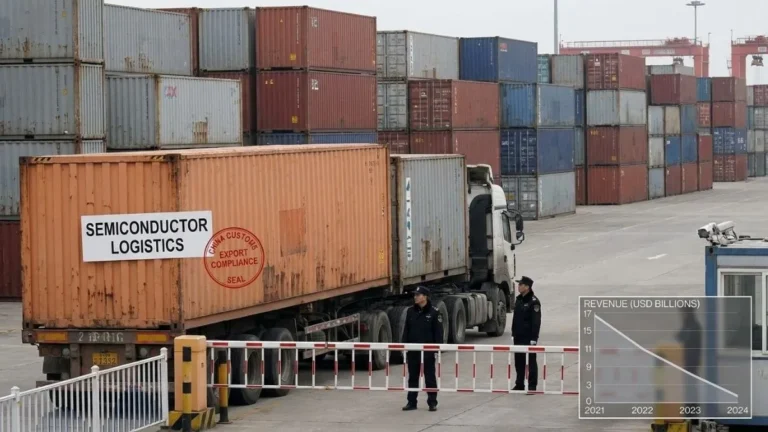
From President Donald Trump’s tariff impositions and territorial ambitions regarding Greenland to China’s rare earth embargoes and semiconductor export restrictions, the EU trade bazooka has remained silent.
What is Trade Bazooka? The EU Anti Coercion Instrument Explained
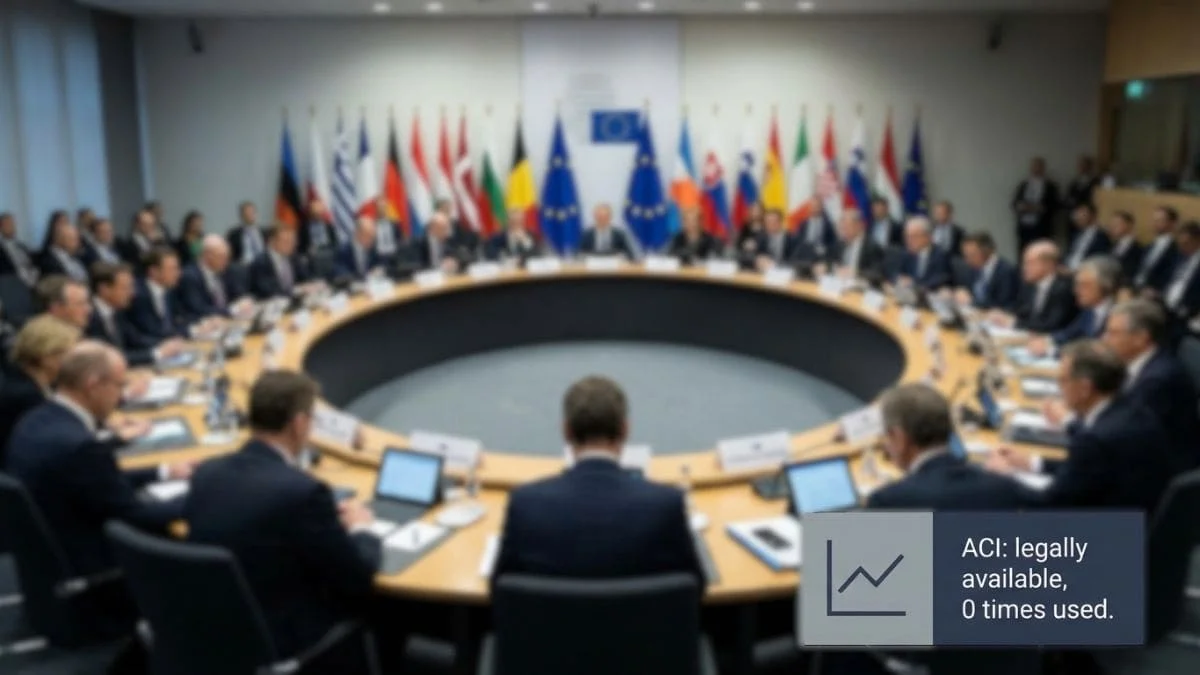
The trade bazooka is an informal term for the EU Anti Coercion Instrument (ACI). The ACI is a defensive economic mechanism that allows the European Union to impose harsh retaliatory tariffs, trade restrictions, and market access bans against any non-EU country attempting to economically blackmail or build political pressure on an EU member state.
Despite this strong legal framework, Europe’s paralysis is not happening in a vacuum; it is a direct consequence of the great power economic competition between the US and China, which is forcing every major economy to choose sides or pay the price of neutrality, restraining companies from investing in Europe. Investment growth in the European Union in 2025 remained at 0.6%.
Multinational companies in Europe, to avoid retaliation from Beijing or Washington, are investing only what is strictly necessary in China to comply with local regulations, while simultaneously decoupling their global R&D operations.
According to the IMF, “Institutional investors are increasingly pricing in European political paralysis as a structural risk. Sovereign risk premiums for advanced economies typically rise by 30-45 basis points during geopolitical shocks.
In Europe, the inability to act as a unified security guarantor has led to a discount on European assets as investors hedge against the lack of a credible EU-level response to external coercion.
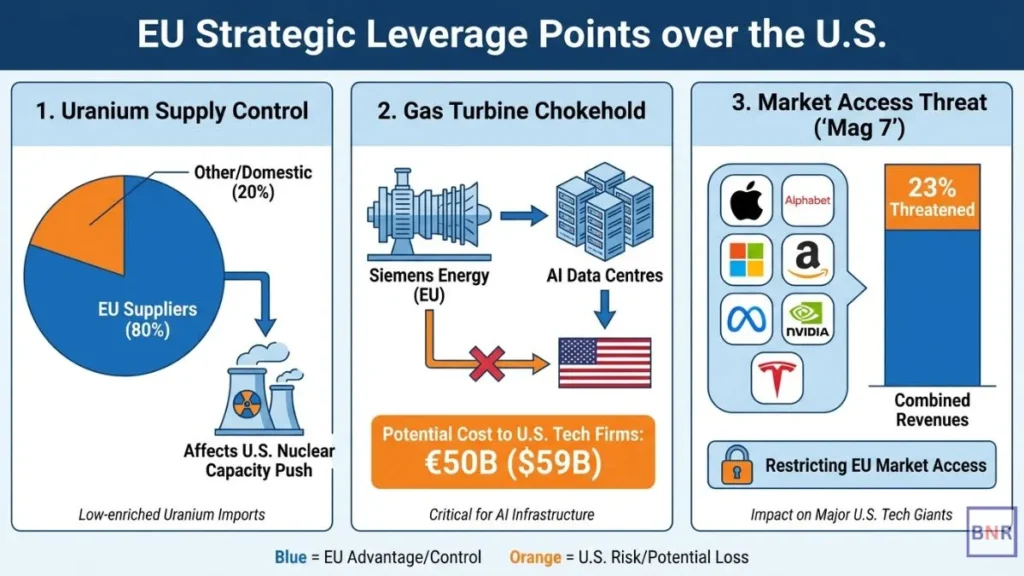
Researchers from a European think tank have identified several largely untapped high-pressure points that could yield significant economic benefits for the EU over the US and China.
The key high-pressure points highlighted by the researchers to tap such benefits are:
• European suppliers control 80% of U.S. low-enriched uranium imports, giving Europe an advantage over Washington’s push to quadruple nuclear energy capacity.
• Siemens Energy’s dominance in gas turbines, critical for AI data centers, is another chokehold; redirecting supply to European buyers could cost U.S. tech firms an estimated €50B ($59B).
• Restricting European Union market access for the “Magnificent Seven” (Apple, Alphabet, Microsoft, Amazon, Meta, NVIDIA, Tesla) could threaten up to 23% of their combined revenues.
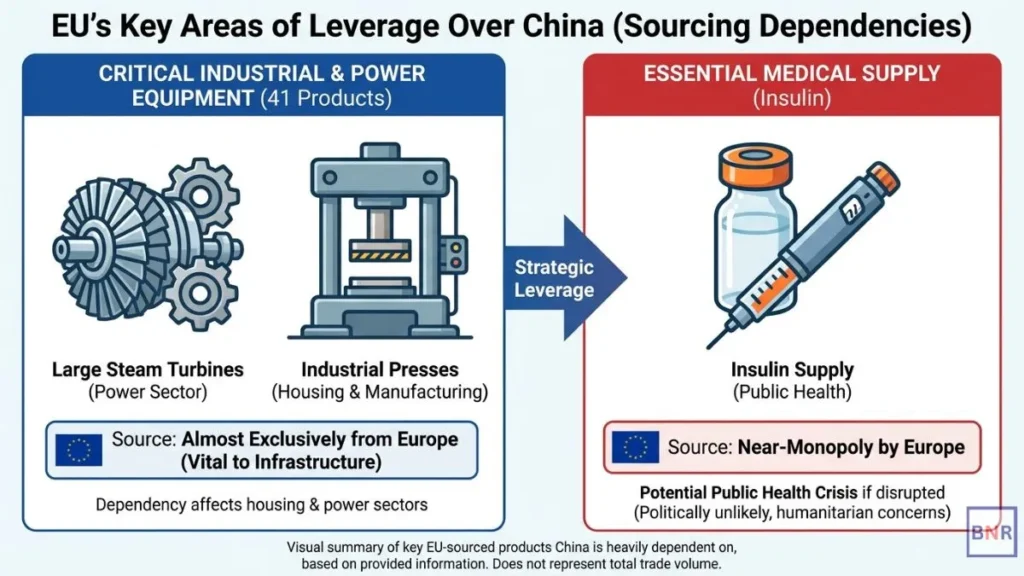
• Europe holds significant leverage over China too; 41 products China sources almost exclusively from Europe, including large steam turbines and industrial presses vital to its housing and power sectors.
• Europe also holds a near-monopoly on insulin supply to China, a dependency that could trigger a public health crisis if weaponized, though most analysts consider such a move politically unthinkable given humanitarian implications.
These leverage points exist precisely because great power competition has created concentrated dependencies, the same dynamic that has made bromine, semiconductors, and rare earths into geopolitical weapons overnight.
Most analysts believe the current US tariffs on European Union goods, ranging from 15% to 25%, including levies on dairy products and luxury goods, would trigger the ACI.
However, the instrument remains unused, and the delay is political. The cost of that is now visible in Germany’s auto sector, where Brussels’ failure to deploy structural industrial policy rather than impose border tariffs has left Volkswagen preparing to cut 100,000 jobs.
The EU does not use the ACI, but it actually counters trade imbalances or state interventions through traditional trade defense instruments – anti-subsidy and anti-dumping duties. Recent targets include Chinese electric vehicles, solar panels, and agricultural imports.
However, Chinese hybrid car brands nearly doubled their market share in the EU, raising their combined total to around 6% following a massive shift in consumer preferences.
However, European industries, particularly German manufacturers, are currently pressing the EU to abandon these narrow measures, as targeting individual products is too slow to counter the scale of Chinese state subsidies across entire product groups.
The pressure is now extending beyond the EU’s borders, with Brussels leveraging its Made in Europe industrial strategy to force the UK into tariff alignment, creating a trans-Channel regulatory battle that British consumers and automakers are caught in the middle of.
Read more analysis in our Great Power Economics section.