The Aviation Weapon: How China Plays Boeing Competitors for Leverage

⏱️ 2 Mins Read
Washington has been depending on its aerospace sector for decades to manage its trade imbalances with Beijing. Now, the dynamics have fundamentally shifted.
Today, Chinese multi-billion-dollar aviation orders are no longer just corporate transactions. These orders are the ultimate geopolitical weapon wielded by the Chinese state to extract diplomatic concessions by pitting Boeing competitors against American interests.
Why is the Latest China Airbus Deal a Strategic Weapon?
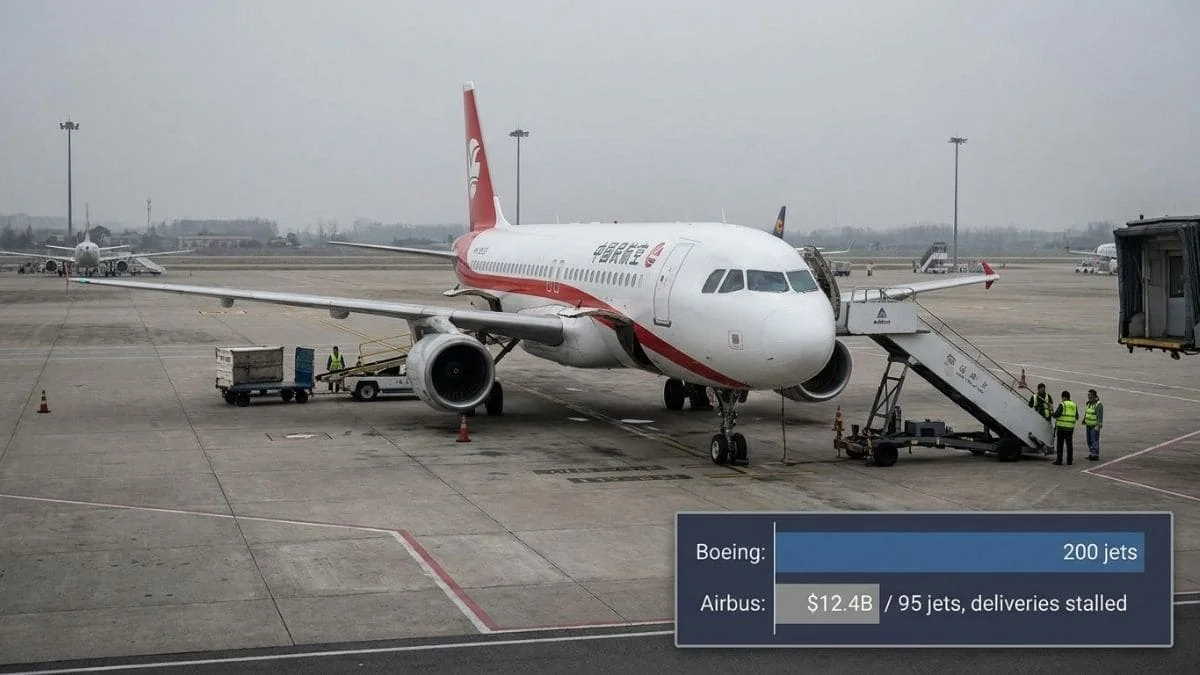
Chinese airlines recently ordered 95 Airbus jets, including 15 A350 widebodies and 80 A320neo-family narrowbodies, with a list price of $17.8 billion, of which $12.4 billion is for Air China and Shenzhen Airlines. While this appears to be a standard fleet expansion, experts consider it a calculated diplomatic maneuver.
Earlier, Beijing did a strict 50/50 market split between Airbus and Boeing to avoid over-reliance on a single Western supplier.
President Trump announced after his state visit to China in May 2026 that China had agreed to purchase 200 Boeing aircraft, a claim China also confirmed.
According to China’s Commerce Ministry, under the deal, the US will provide China with supply guarantees for aircraft engine parts and components.
Beijing used a token order of Boeing aircraft, a fraction of what American markets expected, to secure the vital Western engine components needed to keep its domestic COMAC C919 program alive.
Now, China has fundamentally fractured the duopoly, tilting the market heavily in Airbus’s favor, following the grounding of the 737 MAX and inconclusive talks over Chinese demands regarding long-term maintenance guarantees and engine part supplies.
By directing massive capital toward European aerospace, China successfully plays Brussels against Washington, turning market access into a geopolitical reward system.
The COMAC C919 Reality and European Blackmail
The ultimate long-term goal of Chinese aviation is to achieve freedom through its domestic narrow-body airliner, the COMAC C919. However, the reality of this aircraft limits China’s freedom:
- Western Dependency: The C919 relies on Western suppliers for roughly 40% to 60% of its components, particularly crucial avionics and engines.
- Production Bottlenecks: COMAC is currently struggling to scale up manufacturing, delivering only a tiny fraction of the planes needed to meet domestic demand. The deep reliance on Western supply chains (such as CFM LEAP engines and foreign avionics), geopolitical trade frictions, technical defects reported by airlines, and the complex transition from a prototype assembler to a high-rate mass producer are the major challenges.
- Certification Roadblocks: The aircraft lacks certification from the US FAA and Europe’s EASA, restricting it to domestic or highly limited international routes.
As the C919 struggles to meet domestic demand, Beijing has no option but to buy foreign jets. However, China is now using its massive order book to pressure regulators.
Recently, China deliberately stalled the approval of almost 20 Airbus deliveries to signal its impatience with Europe’s EASA over the delayed certification of the COMAC C919. This proves that Beijing will weaponize existing contracts against Boeing competitors to force the integration of its own technology into the global market.
The Macroeconomic Barometer
| Aerospace Manufacturer | Chinese Market Status | Geopolitical Function for Beijing |
| Boeing | Received a smaller-than-expected 200-jet order. | Used as a bargaining chip to secure US supply guarantees for critical engine components. |
| Airbus | Secured massive $12.4B orders, but facing delivery stalls. | Used to fracture the US duopoly and pressured to force European (EASA) certification of Chinese jets. |
| COMAC (C919) | Struggling with scale and reliant on up to 60% Western tech. | The ultimate long-term insurance policy to eliminate reliance on Western aerospace entirely. |
Evaluating aerospace giants strictly on their backlog is a mistake for institutional investors. The commercial aircraft market in Asia has transformed into a real-time barometer of international relations.
As long as Beijing holds the power to unleash or withhold orders, both Boeing and its European competitors will remain permanent pawns on the macroeconomic chessboard.
Read more analysis in our Great Power Economics section.