Uber Hotel Booking Why The Structural Threat to Booking.com Is Real
Image: AI-generated illustration

Uber Hotel Booking Is Here. Booking.com Should Worry

⏱️ 11 Mins Read

There is a single number that explains why Booking.com should be terrified of Uber’s entry into hotel booking, and it has nothing to do with room rates

According to Andrew Macdonald, President and Chief Operating Officer at Uber, more than 100 million people used Uber to travel to or from airports.

“People depend on us for business travel, discovery on personal trips, replacement of room service with UberEats, last-minute forgotten items, transit ticketing, micromobility, and much more. And now, for Uber One members, booking hotels on Uber becomes the best choice – and they can spend their credits in the cities they are visiting! Andrew said on X.

These Uber app users are already in travel mode. They already have a destination in mind. They already have their payment details saved and their notifications turned on.

They are, in every meaningful commercial sense, exactly the customers a hotel booking platform would pay a fortune to reach until April 29, 2026. The moment they closed the Uber app, they became Booking.com’s customers.

According to Q1FY26 financial results, the marketing expense of Booking Holdings in Q1 2026 stood at $2.07 billion, up from $1.78 billion in Q1 2025, an increase of roughly $290 million year-over-year. However, marketing spend as a percentage of gross bookings remained flat at 3.8% in both periods (Q1FY25 and Q1FY26).

CEO Glenn Fogel said the company is investing in three forward-looking areas, including the Connected Trip vision (integrating all travel services into one seamless journey), global market expansion, and Generative AI integration to improve the traveler and partner experience.

Booking Holdings invested approximately $8.2 billion in marketing in 2025, representing a significant increase from the $7.3 billion spent in 2024.

That $8.2 billion exists for one purpose: to make sure that when a traveler decides they need a hotel, the first place they go is Booking.com. However, Uber just made a significant portion of Booking Holdings’ marketing budget less effective.

Uber achieved this not by building a better product or undercutting on price, but by placing a hotel booking button inside the Uber app that 202 million people open every month across more than 70 countries and 15,000 cities.

Uber, with no new product launch, but with a customer interception at the exact moment in the travel journey, has placed Booking.com and other online travel agencies (OTAs), for the first time in their history, in a structurally different kind of competition.

What Uber Hotel Booking Actually Is

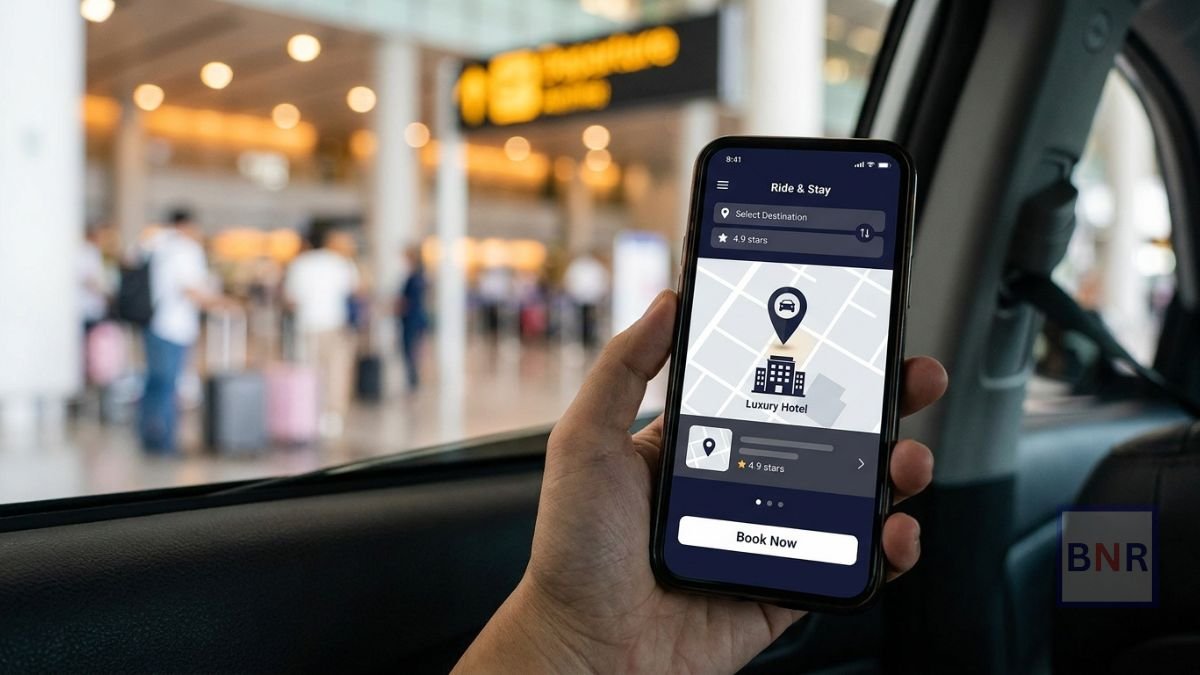
On the surface, Uber hotel booking looks simple. A new hotels section on the Uber app homescreen lets users browse available hotels on a map, explore ratings, reviews, and photos, and filter by amenities to book with confidence.

Users can refine searches through filters, including guest ratings, price, amenities, hotel class, and brand, then confirm their reservation using the default payment method already saved in their account and receive a confirmation email linked to their existing profile.

It works the way everything on Uber works: open the app, find what you want, tap to confirm, done.

But each element of this product is not a convenience feature. It is a competitive weapon aimed directly at the behavioral habits that make Booking.com’s business defensible.

The 700,000-property inventory is not a starting catalogue; it is Expedia’s entire global hotel database, deployed inside a platform Booking.com has no access to.

Uber and Expedia Group are partnering through Expedia’s Rapid API technology to offer Uber users access to a wide selection of hotels, ultimately growing to more than 700,000 properties in destinations around the globe. The same live inventory, the same real-time pricing, the same availability data that powers Expedia’s own platform, now accessible to 202 million Uber users, who may never otherwise use the Expedia app.

The saved payment details are more significant than they appear. One of the consistent friction points in travel booking is the moment a new platform asks for your credit card.

Uber has already cleared that hurdle for every single one of its users. The payment method that paid for your last airport ride is the same one that books your hotel with a single confirmation tap. That frictionless payment experience took Booking.com years to build through app downloads, account creation, and first-booking incentives. Uber inherited it from its existing mobility business at zero incremental cost.

The post-booking notifications complete the loop. Travelers receive push notifications before their hotel check-in date to book Uber rides at a discount for the duration of their trip.

After the hotel is booked, Uber sends a reminder in a confirmation email to schedule rides with Uber Reserve, with a breakdown of price details, refund policies, and any earned Uber One credits.

This means the hotel booking is not the end of the transaction; it is the beginning of an integrated trip experience that keeps every travel touchpoint inside the Uber ecosystem from departure to return. Booking.com processes a booking, and then the customer leaves. Uber processes a booking, and the customer stays.

The Partnership That Makes Booking.com’s Biggest Rival Its Own Infrastructure Provider

The business relationship at the center of Uber hotel booking deserves closer attention than most coverage has given it, because buried inside a partnership announcement is one of the most counterintuitive competitive dynamics in recent travel industry history.

Uber CEO Dara Khosrowshahi spent 12 years leading Expedia Group before joining Uber in 2017. The partnership he announced at GO-GET 2026 in New York City is built on a relationship cultivated over more than a decade at the top of the same industry now being disrupted.

“We’re all living through a moment of real cognitive overload: too many apps, too many decisions, too much noise. At the end of the day, our job is to help people reclaim their time, spending less of it managing the logistics of life and more of it actually living,” Khosrowshahi said at the event.

“By connecting our two-sided marketplace with Uber, we’re bringing Uber rides directly into the Expedia app and Expedia Group’s lodging inventory into the Uber app through our Rapid API technology. Together, we’re helping travelers spend less time planning and more time enjoying the journey,” Expedia CEO Ariane Gorin said.

“This partnership offers Uber users in the U.S. access to a wide selection of hotels, which will ultimately grow to more than 700,000 properties in destinations around the globe. Uber One members will earn 10% back in Uber One credits on all hotel bookings, plus they’ll save at least 20% on a rolling list of more than 10,000 hotels worldwide. Vacation rentals from Expedia Group brand, Vrbo, will be added later this year,” an Uber statement said.

Booking Holdings and Expedia Group together account for about 60% of all travel bookings in Europe and the United States. They are the two dominant forces in a duopoly that has controlled online travel distribution for nearly three decades.

By partnering with Uber, Expedia has effectively supplied the inventory infrastructure for a platform that will now compete for customers that both Expedia and Booking.com were previously splitting between themselves. Expedia gains a powerful new distribution channel, reaching hundreds of millions of users it could not otherwise access through its own apps.

Booking.com, meanwhile, has no such arrangement to access 202 million users through any partnership, and no equivalent transportation network of its own through which to intercept travelers upstream of the booking decision.

That asymmetry is not a short-term competitive disadvantage. It is a structural gap that grows wider every time Uber adds a new feature, expands to a new country, or deepens the loyalty flywheel that hotel booking now plugs directly into.

Read More: UAE Israel – Does Abu Dhabi’s OPEC Exit Ultimately Fund Tel Aviv?

Uber vs Booking.com Hotels: Where Each Platform Wins, and Why the Gap Is Closing Faster Than Anyone Expected

There is no honest version of this comparison that declares a single winner for every traveler in every situation. Booking.com is not a failing business, and Uber hotel booking is not a finished product. But the current state of competition, described precisely, is more threatening to Booking.com than even the most optimistic Uber statement suggests.

On inventory: Booking.com has reported a landmark year in 2025, with 1.2 billion room nights booked across its platforms. Its property catalogue spans hundreds of countries and includes not just hotels but apartments, villas, hostels, bed-and-breakfasts, and unique stays in markets that mass-market platforms rarely penetrate. Uber launches with 700,000 hotel properties concentrated in mainstream destinations, with Vrbo vacation rentals coming later this year.

For travelers booking in major cities and popular destinations, which account for the overwhelming majority of global hotel bookings by volume and value, Uber’s inventory is already sufficient. For travelers seeking niche properties in secondary markets, Booking.com still has clear inventory depth advantages that will take years to close.

On pricing: Base hotel rates across major OTAs are broadly comparable because hotels use dynamic pricing systems that distribute identical rates across multiple distribution channels simultaneously.

Uber’s hotel booking differentiator is heavily reliant on a unique, loyalty-driven architecture that poses a significant challenge to Booking.com. However, the differentiation is not entirely rewards-based, and the most structural challenge for Booking.com is more accurately described as the integration of hotel bookings into a daily-use, full-stack travel app that leverages, rather than just rewards, the user’s immediate, actionable travel behavior.

On user experience: Booking.com’s platform is a mature, deeply refined product that has been iterated for nearly three decades. Its search filters, price calendars, review systems, and cancellation policy displays are best-in-class for pure travel booking utility. For a traveler whose sole intention is to find and book a hotel, Booking.com has a more comprehensive dedicated experience.

Uber’s experience is built for a different kind of traveler intent, the person for whom hotel booking is one step in a broader trip management workflow. The goal, according to Uber’s Chief Product Officer (CPO) Sachin Kansal, is to eliminate the need to coordinate across multiple apps. “Consumers are spending too much time coordinating their lives, using multiple apps,” he said.

This is the experience design insight that Booking.com cannot easily counter. Booking.com can add features to its existing travel platform. It cannot add a ride-hailing network, a food delivery service, an airport concierge, or a room service integration to compete with what Uber already has. The category boundaries that define Booking.com’s competitive perimeter simply do not apply to Uber, which is not competing inside travel but competing above it.

Uber One Hotel Discount: Is It Worth Switching For?

For the 202 million Uber users reading this who have not yet decided whether Uber hotel booking changes their travel behavior, the answer to this question is not philosophical but mathematical.

Uber One costs $9.99 per month or $96 per year. Uber had 46 million Uber One members at the end of 2025, up 55% compared with the year prior. Members spend roughly three times more than non-members, and the membership drives 60% of gross bookings across the platform.

The actual benefits to Uber users with its partnership with Expedia:

The occasional traveler, two trips per year, $150 per night for two nights each trip: at 10% credits back on all bookings: $60 in Uber credits returned, redeemable against rides and food delivery within 24 hours of check-in. If one qualifying stay triggers the 20% discount, an additional $60 in direct savings. Hotel-related benefit alone: up to $120 per year against a $96 annual membership cost. Before a single ride discount or delivery benefit is factored in, the membership pays for itself.

The regular business traveler — eight trips per year, $200 per night for two nights each trip: at 10% credits back on all bookings: $320 in Uber credits returned. At 20% discount on qualifying stays across half those trips: $320 in direct savings. Total hotel-related benefit: up to $640 per year. The return on investment from hotel benefits alone is more than 6:1 before the membership’s ride and delivery benefits are added.

The stacking effect nobody is calculating: Uber One credits earned from hotel bookings can be used toward rides and orders. This means a traveler who books a $300 hotel stay earns $30 in credits that pay for their next Uber from the airport. That airport ride earns 6% back in additional credits. Those credits offset the next Uber Eats order at the hotel. That order earns its own credits. The compounding is not dramatic on any individual transaction, but across a year of regular travel and daily Uber use, the stacking effect creates a loyalty lock-in that standalone platforms structurally cannot replicate.

The honest caveat: the 20% discount applies to a rotating selection of 10,000 hotels, not all 700,000 in the catalogue. Vacation rentals from Vrbo will be added to Uber later this year, expanding both the inventory and the discount eligibility pool significantly. Travelers with fixed loyalty commitments to specific hotel chains may find the qualifying discount inventory limited relative to their usual booking patterns.

Even for the occasional traveller in the example above, a $120 return against a $96 membership means the math works before a single ride discount or delivery fee is counted.

The legacy hotel points are frequently subject to devaluations, whereas Uber Credits function as a straight cash equivalent within their ecosystem.

The Super App Blueprint: What Uber Is Actually Building

Uber hotel booking makes full sense only when you understand that it is not the destination. It is a milestone on the way to something much larger that the travel industry has been watching happen in Asia for a decade without believing it could happen in the West.

The move reflects a broader trend toward apps that handle many aspects of daily life, a model long established in China, where platforms like WeChat and Alipay bundle together payments, bookings, messaging, and much more.

In Southeast Asia, Grab built a billion-dollar business on exactly this logic, starting with rides and expanding into food, payments, insurance, and travel accommodation inside a single platform.

The Western tech industry watched and largely concluded that American consumer behavior was too fragmented across standalone apps for the super app model to take hold.

Uber has decided that the conclusion was wrong or that it has finally become wrong, thanks to a convergence of AI capability, loyalty program maturity, and user base scale that did not exist when the super app question was last seriously asked.

Uber completed 13.567 billion trips in 2025, generated $193.454 billion in gross bookings, and reported $52.017 billion in revenue. As of December 2025, Uber One members account for almost 50% of gross bookings on the platform. This is not a startup making a bold bet. It is a mature, profitable platform with an established loyalty base, deploying that base into adjacent markets with the precision of a company that knows exactly what its users do before, during, and after every trip.

That combination has not existed before. The threat it represents to Booking.com is real, data-supported, and structurally novel in ways that the incumbent’s considerable resources will struggle to address directly.

What Booking.com Must Do — And Why the Playbook Is Running Out

Booking.com is not a fragile business. It generated $26.9 billion in revenue in 2024, a 13% increase year-over-year, with $5.4 billion in net income. Its brand recognition is among the strongest in global travel. Its review ecosystem, built over decades, represents a trust infrastructure that cannot be replicated quickly. These are real competitive advantages, and they will not evaporate overnight.

But the threat Uber represents is different in kind from every competitive challenge Booking.com has previously navigated successfully. When Airbnb emerged, Booking.com responded by adding alternative accommodations to its platform. When Google Hotels appeared, Booking.com adapted its marketing mix to maintain visibility within Google’s search ecosystem. In each case, the competitive response was available and executable within Booking.com’s existing strategic framework.

Uber’s challenge is not available within that framework. Booking.com cannot add a ride-hailing service. It cannot embed food delivery. It cannot reward users for airport trips. It cannot intercept the customer at the transportation layer before the accommodation search begins.

The only available response is to deepen the loyalty and personalization within its own bounded ecosystem to make the Booking.com experience valuable enough that travelers choose to begin their hotel search there rather than inside the app they were already using to arrange transport.

The era in which Booking.com owned the first moment of hotel search intent has been seriously disrupted after the introduction of Uber hotel booking, which is live with 700,000+ properties, AI-powered search, and Uber One discounts that stack across every trip they take.

image
BNR Logo

Stay Ahead of the Markets with BNR

Start your day with our top story plus "The Editor is Watching", an exclusive daily analysis on markets, commodities, and currencies.

We don’t spam! Read our privacy policy for more info.

What You Missed