What Is Bromine Used For? The Supply Chain Risk

⏱️ 2 Mins Read
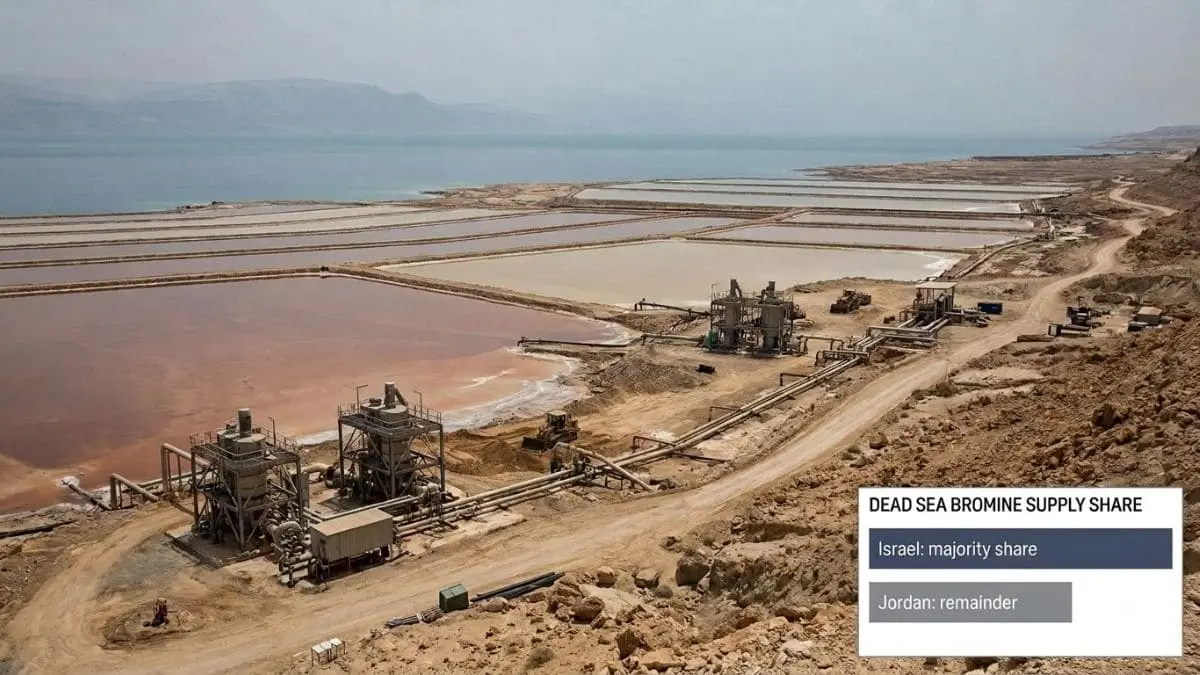
While a severe global helium crisis has constrained semiconductor manufacturing inputs, other critical elements face a very different reality. For bromine, there is no physical shortage or extraction crisis; upstream production facilities around the Dead Sea continue to operate normally.
Yet the tech supply chain frequently confronts a subtler question: what is bromine used for, and how vulnerable is its transit through a single geographic chokepoint?
While extraction remains stable, the electronics industry relies heavily on a chemical supply chain deeply concentrated in the Middle East. Understanding that reliance requires looking at where bromine goes and why procurement teams monitor its routing closely.
The supply chain disruptions have the consequence of the great power economic competition playing out across the Middle East, where military conflict is simultaneously reshaping technology supply chains, energy corridors, and shipping routes.
Just as helium has no viable substitute in semiconductor manufacturing, every circuit board installed in a smartphone, a laptop, a car dashboard, an AI server, or a gaming console relies on a chemical compound derived from bromine to prevent it from catching fire.
The Hidden Anchor: What is Bromine Used For?
Element 35 on the periodic table, bromine is a heavy, reddish-brown liquid halogen that freezes into a crystalline solid just below room temperature at $-7.2\text{°C}$. Its most commercially significant derivative in the electronics industry is tetrabromobisphenol A, or TBBPA, the most widely used brominated flame retardant.
According to the U.S. Geological Survey, the leading source of imports of bromine and bromide compounds is Israel, followed by Jordan.
Jordan is not in a direct combat zone, but it accounts for only a fraction of imports, while the vast majority of imported bromine and bromide compounds come from Israel, which sits at the center of ongoing Middle East maritime and regional security friction.
A Trillion-Dollar Industry and Its Inputs
South Korea’s industry ministry has noted that the country depends heavily on the Middle East for critical items used in semiconductor supply chains, including bromine, most of which originates from Israel.
This input matters because bromine-based compounds such as hydrogen bromide (HBr) are essential for advanced chip etching. Furthermore, TBBPA ensures that every circuit board installed in a smartphone, laptop, car dashboard, AI server, or gaming console meets fire safety standards.
Unlike helium, which can be quickly depleted, bromine has a much longer shelf life. Circuit board manufacturers typically maintain three to six months of derivative inventory, providing a reliable buffer against temporary transport delays.
Major producers like ICL and the Jordan Bromine Company continue to fulfill orders smoothly, meaning day-to-day manufacturing is not currently disrupted.
Diversification and Long-Term Sourcing
Although the United States, China, and Ukraine are all bromine producers, their combined capacity represents only a fraction of global demand. The U.S. produces significant quantities annually from brine deposits in Arkansas, and China extracts additional volumes domestically.
However, the combined supply outside Israel and Jordan cannot immediately meet global demand as a drop-in alternative. Furthermore, qualifying new suppliers for semiconductor-purity grades requires rigorous testing and certification that takes months.
Because of these qualification hurdles, tech giants and hardware manufacturers, from Samsung and SK Hynix to Apple, Nvidia, and Microsoft, maintain established supplier relationships while keeping an eye on regional logistics costs, insurance premiums, and shipping-lane efficiencies.
The Broad Picture: Managing Invisible Dependencies
Step back from the bromine supply chain, and a broader industrial pattern emerges. Modern electronics are built on hyper-efficient, just-in-time sourcing. While elements like bromine are widely extracted and production is largely stable, heavy reliance on specific geographic corridors keeps logistics and transport costs a constant variable in procurement models.
The next time you hold your phone, consider what is inside it: copper, silicon, rare earths, lithium, and a chemical compound extracted from the Dead Sea region that quietly anchors the safety and stability of the entire global electronics ecosystem.
Read more analysis in our Great Power Economics section.