Global Trade Network: A Manufacturing Scale Trap

⏱️ 3 Mins Read
Within the modern global trade network, several economies are large enough in the manufacturing sector that a great power cannot afford to ignore them, but too small in sovereign capital or security weight to negotiate the clean, well-collateralized relief the largest economies get.
This manufacturing-scale trap is one dimension of the broader great power economic competition where the US and China are systematically sorting every mid-tier economy into compliance tiers based on strategic value, not manufacturing volume.
Call it the manufacturing-scale trap. However, the evidence beneath that label is more split than a single label suggests.
Five Southeast and South Asian manufacturing economies (Vietnam, Thailand, Cambodia, Malaysia, and Bangladesh) sit at two different 2026 US tariff actions. To understand this uneven dynamic, reciprocal tariffs explained in political rhetoric must be reviewed through the lens of institutional capacity and compliance, not just aggregate export volumes.
The Mechanism of Global Trade Network
Negotiating leverage in a trade dispute depends on what a country can offer beyond the conflict, such as investment capital, a security relationship, or both.
A country’s manufacturing base can be large enough to draw serious US trade-enforcement attention and still not be large enough, in capital or strategic terms, to negotiate a deal that Taiwan or Japan gets. Scale guarantees visibility, but doesn’t guarantee a strong hand.
Four Tiers, One Policy Season
Across a single stretch of 2026 US trade actions, distinct outcomes for economies pursuing essentially the same relief:
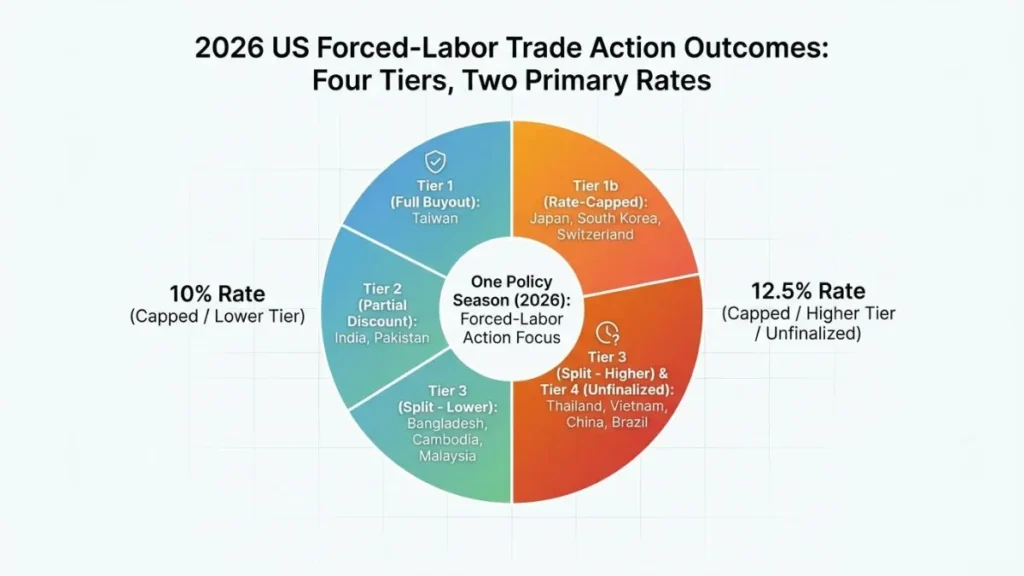
Tier 1 (Full Buyout): Taiwan signed a trade agreement on January 15, 2026, pairing a $250 billion direct investment commitment (plus a further $250 billion in credit) with a tariff cut from 20% to 15%. In the July 2026 forced-labor action specifically, Taiwan’s total rate is capped at 10%.
Tier 1b (Rate-Capped, Not Exempted): Japan, despite a $550 billion investment package, faces a forced-labor tariff at 12.5%, alongside South Korea and Switzerland.
Tier 2 (Partial, Uncollateralized Discount): India and Pakistan forced-labor action rate capped at 10%, the lowest tier available. Both countries get a concession rate because of recent diplomacy maneuvers.
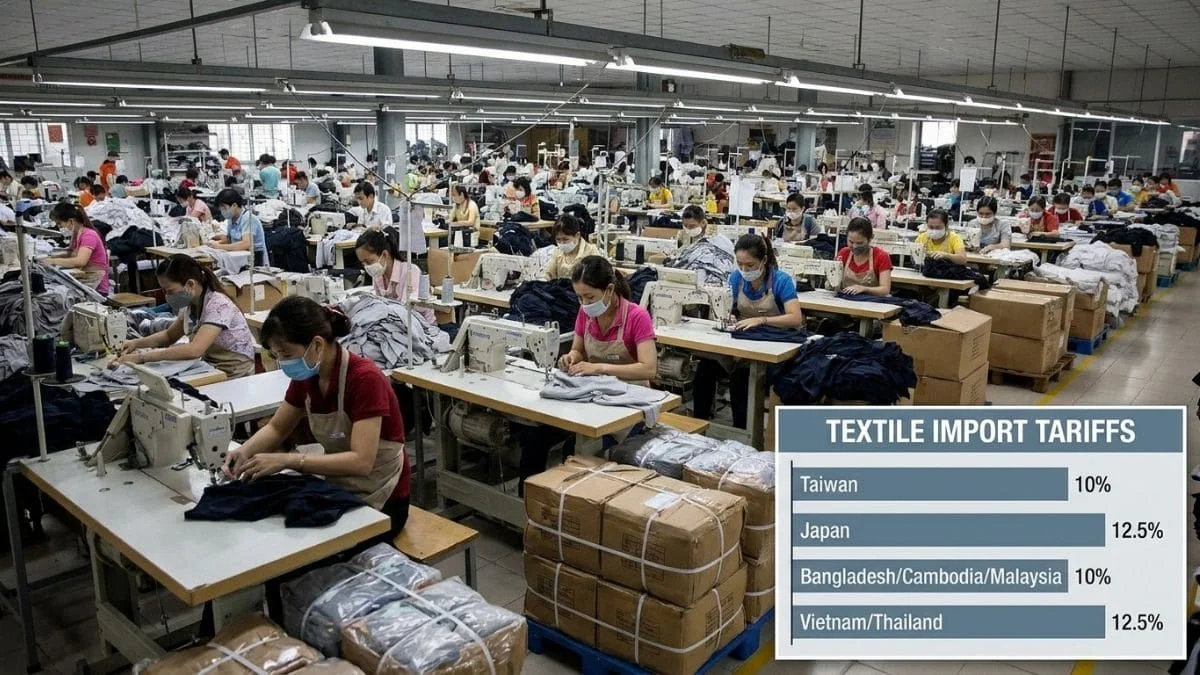
Tier 3 (Split Outcomes Among the Five): Within the forced-labor tariff specifically, the five economies split. Bangladesh, Cambodia, and Malaysia are placed in the lower 10% flat-rate group. However, Thailand and Vietnam are placed in the higher 12.5% flat-rate group, alongside China and Brazil.
It’s critical not to combine the forced-labor rates with the earlier reciprocal trade deals. Under those reciprocal trade deals, Cambodia’s rate fell from 49% to 19%, Malaysia’s from 25% to 19%, and Bangladesh’s from 20% to 19%. Malaysia committed to $70 billion in US capital investment. The catch? Cambodia and Malaysia’s agreements require them to adopt US tariffs on third countries. These clauses are widely analyzed as tools to block Chinese manufacturers from routing components and finished goods through Southeast Asia to bypass direct US duties.
Tier 4 (Unfinalized Frameworks): Vietnam and Thailand, which are still at the framework stage since October 2025 because they are locked in disputes over transshipment rules that Indonesia and Malaysia agreed to comply with, causing a higher 12.5% tier.
Are the 2026 US Tariffs Legal? The SCOTUS Confusion
Public discussions reveal ambiguity about the legality of these actions, with many asking whether the Supreme Court (SCOTUS) has already barred such measures.
While past judicial rulings forced the repayment of specific, improperly levied localized duties, the 2026 trade enforcements operate under entirely distinct statutory frameworks. Section 301 of the Trade Act of 1974 grants broad authority to address foreign unfair trade practices.
However, the Supreme Court could strike down these new forced-labor tariffs, as legal experts view Section 301 as permitting action against particular foreign acts, policies, or practices only after the US Trade Representative (USTR) makes the findings and Congress requires and selects an action designed to eliminate the identified practice. The Liberty Justice Center has filed a petition in the US Court of International Trade challenging the administration’s replacement tariffs imposed under Section 301 of the Trade Act of 1974, arguing the executive branch exceeded its statutory authority. The case is pending.
Why Mid-Tier Economies Don’t Fight Back?
For mid-tier economies, their exports depend largely on access to US consumers; launching a tariff war would accelerate the geographic substitution they fear.
Canada’s experience demonstrates the suicide option after enacting retaliatory 25% duties on US autos, steel, aluminum, and consumer products. Canada triggered a US counter-response of 50% tariffs on Canadian goods effective August 19, 2026. For mid-tier economies without Canada’s geographic integration with the US economy, that outcome would be structurally catastrophic.
Why Size Cuts Both Ways
Vietnam, Thailand, Cambodia, Malaysia, and Bangladesh are large global manufacturing players that Washington cannot exempt without undermining their enforcement credibility elsewhere.
Yet, even Japan’s $550 billion investment only bought a rate cap, not an exemption. Three of the Southeast Asian economies got the lowest tier without an investment package, suggesting enforcement compliance, not capital, was the operative variable. The remaining two (Vietnam, Thailand) remain stuck in unfinalized frameworks which attracted high slab.
The Open Question
Whether these sovereignty-costly deals and stalled frameworks represent a durable structural position or a temporary lack of leverage is worth returning to. Vietnam’s growing role in electronics assembly, as global supply chains diversify away from China, is the most plausible candidate for a shift in negotiating position.
Until that happens, the pattern holds: manufacturing scale without capital or strategic weight behind it buys a seat at the table, but not control over what’s served.
Read more analysis in our Great Power Economics section.