France Nuclear Sharing: The Germany-France Deterrence Reality

⏱️ 4 Mins Read
Nuclear deterrence in Europe is being radically redrawn, and France nuclear sharing is no longer just a myth. Following Russia’s full-scale invasion of Ukraine and growing doubts over the US commitment to European defense under President Donald Trump’s administration, European capitals are undergoing an urgent strategic rethink.
The most visible European consequence of the great-power economic competition between the US and its allies is that Trump is systematically repricing the cost of American security guarantees to force a realignment of burden-sharing.
On July 17, 2026, Chancellor Friedrich Merz, along with President Emmanuel Macron, announced that German forces will take part in a French nuclear exercise this year.
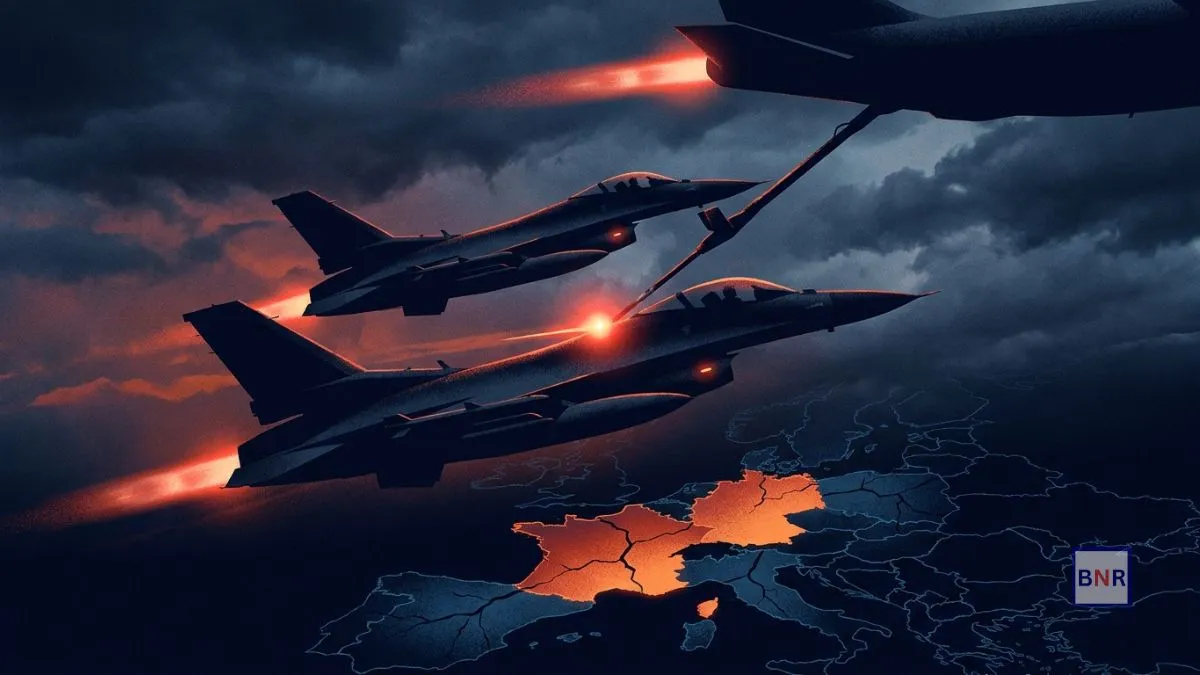
It is the first time in history that Berlin has agreed to such cooperation with Paris. As a symbolic kickoff to this cooperation, French Rafale and German Eurofighter jets conducted a joint in-flight refueling drill, as Rafales are certified to carry French nuclear weapons.
Does Germany Buy Nuclear Power from France?
To understand this military alignment, one must first look at the energy infrastructure that binds the two nations. Does Germany buy nuclear power from France? Yes. After the Fukushima crisis, Germany panicked and decided to phase out its own nuclear power generation.
As a result, Germany significantly increased its electricity imports from France, which generates electricity from France nuclear energy.
How Many Nuclear Power Plants Are in France vs. Nuclear Weapons?
France operates a robust civilian nuclear grid, but its military deterrence is based on strict sufficiency, possessing approximately 370 nuclear warheads.
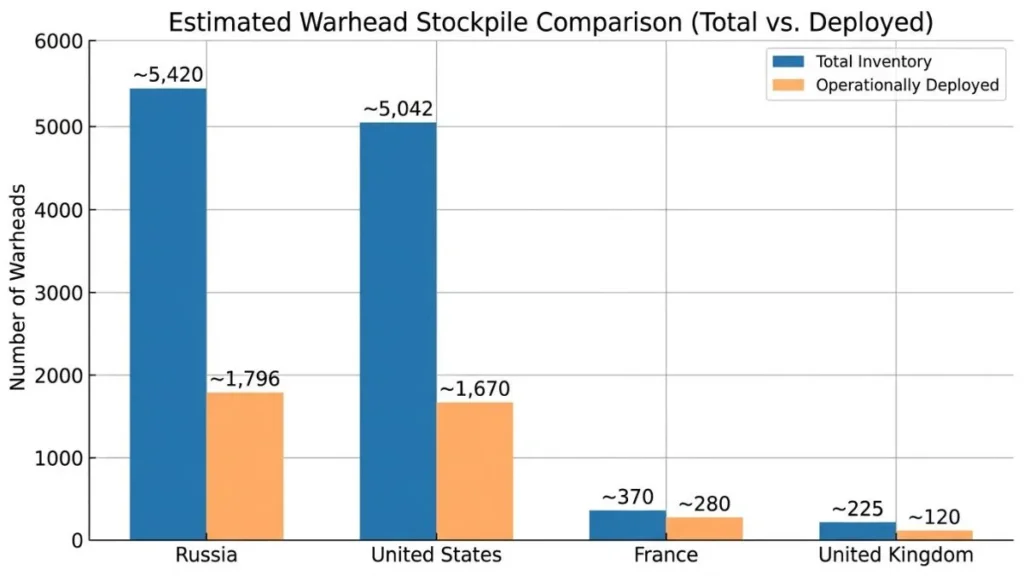
France’s arsenal includes air-launched ASMP-A missiles carried by Rafale jets and submarine-launched ballistic missiles (M51). At any given moment, at least one of France’s four nuclear-powered ballistic missile submarines is on patrol.
The Shift to Forward Deterrence
This is not about one acquiring a bomb from another. French President Emmanuel Macron has laid out a new doctrine of forward deterrence.
- This doctrine provides for the temporary deployments of elements of France’s strategic air forces to allied countries.
- It allows European partners to take part in exercises or deploy their conventional armies on support missions.
- France has conducted in-depth strategic talks with eight countries: Germany, Poland, the UK, Belgium, the Netherlands, Denmark, Sweden, and Greece.
However, Macron emphasized that the key aspects of French deterrence, namely, absolute autonomy for France and no shared decision-making, will remain the same. Only the French President can authorize a nuclear strike.
Can Germany Legally Have Nuclear Weapons? The 1990 Treaty
Germany cannot lawfully build its own independent nuclear weapons without renegotiating a treaty and having a go-ahead from all five signatories, including Russia.
- When East and West Germany reunified, the Two Plus Four Treaty was signed in 1990 by both German states, the US, UK, France, and the Soviet Union.
- Under Article 3 of this treaty, a united Germany cannot manufacture, possess, or control nuclear, biological, or chemical weapons.
- This is further tied to Germany’s obligations under the Non-Proliferation Treaty (NPT).
- Furthermore, developing an independent nuclear arsenal is extremely expensive, costing tens of billions of dollars, and would require advanced delivery systems like ballistic missiles, not just gravity bombs.
Therefore, the joint statement from the French and German governments carefully emphasized that the new nuclear steering group complements, rather than replaces, NATO’s nuclear-sharing arrangements.
US Election Impact on NATO Nuclear Umbrella
Doubts over the American umbrella are currently not hypothetical. Since resuming his office, President Trump has repeatedly lambasted NATO burden-sharing. Doubts over the American umbrella are currently not hypothetical. Since returning to the White House, President Trump has repeatedly lambasted NATO burden-sharing.
In 2026, the US reduced its troops in Europe, including withdrawing 5,000 troops from Germany following Chancellor Merz’s unfavorable remarks about US strikes on Iran. Defense Secretary Pete Hegseth stated on June 18, 2026, that strategic realities prevent the United States from focusing primarily on Europe’s security. This has reinforced the perception in European capitals that Washington’s commitment is being actively renegotiated.
French Political Instability and the 2027 Horizon
The entire architecture of this new European deterrence rests on the political survival of its current leaders. Macron cannot run again in the 2027 presidential election due to term limits.
The far-right National Rally (Rassemblement National), led by Marine Le Pen and Jordan Bardella, currently polls as a strong contender for 2027. Bardella has openly rejected any geographic distribution of French nuclear forces outside French territory or any dilution of sovereign control over the arsenal. If the National Rally wins in 2027, the most likely outcome is a rollback of this newly Europeanized cooperation.
Strategic Comparison: NATO Sharing vs. French Forward Deterrence
The structural differences between these two nuclear umbrellas are the operational reality:
| Strategic Component | US / NATO Nuclear Sharing | France “Forward Deterrence” |
| Command & Control | Host nations can deliver US warheads stored on their soil under specific NATO arrangements. | Absolute autonomy for France; no shared decision-making allowed. |
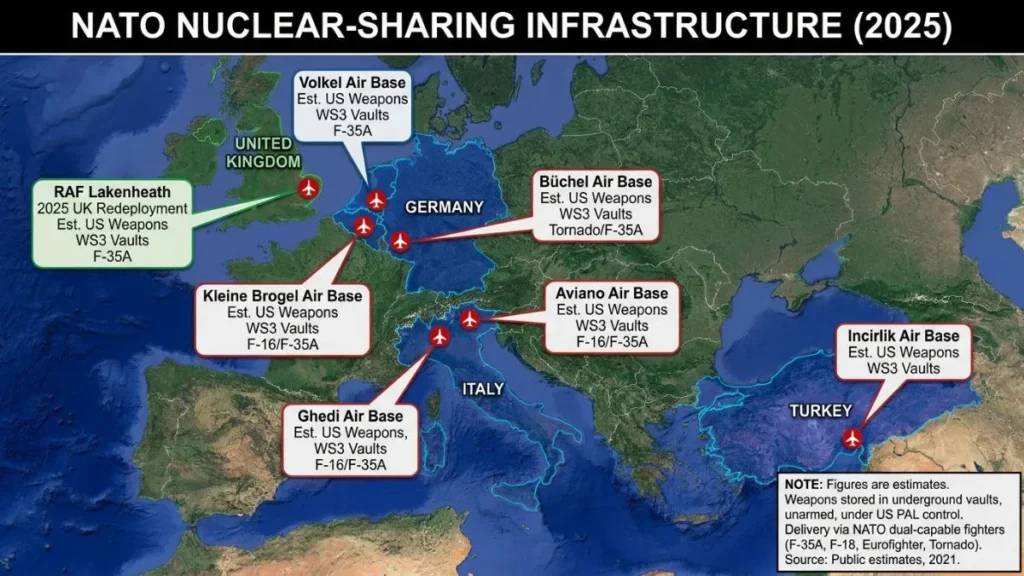
| Deployment Strategy | US B61 tactical bombs are actively deployed across five NATO states. | Temporary deployments of elements of French strategic air forces to allied countries. |
| Arsenal Size | Backed by the massive stockpile of the United States military. | Based on strict sufficiency; approximately 300 to 370 nuclear warheads. |
| Participating Nations | Germany, Belgium, Netherlands, Italy, and Turkey. | In-depth talks with Germany, Poland, the UK, Belgium, the Netherlands, Denmark, Sweden, and Greece. |
For the Kremlin, Germany France nuclear sharing is a strategic complication. It signals that even under sustained American pressure to reduce troop levels, Europe’s core is moving toward deeper nuclear coordination.
The same European reluctance to act unilaterally that kept its trade bazooka unfired against Washington and Beijing is now being overcome in the security domain, driven by the same American unpredictability that Brussels has so far failed to answer economically.
Germany, the most nuclear-averse NATO power, is now willing to train its forces alongside French nuclear-capable aircraft publicly.
For NATO, the arrangement is being carefully framed as preservative rather than competitive with the nuclear-sharing program. A treaty-bound Germany cannot become a nuclear power itself. France’s arsenal, even after expansion, will remain a fraction of American or Russian stockpiles.
But the entire architecture rests on the leaders’ political survival. These frameworks would need to prove themselves in a genuine crisis if the Rassemblement National wins the 2027 elections.
Read more analysis in our Great Power Economics section.