The US-Mexico Trade Relationship: A Dependency Trap

⏱️ Mins Read
Look at the trade numbers for April 2026: $86 billion in total exchange, of which $50.69 billion represented Mexico’s exports to the US. Framing it as Mexican economic power is a conceptual blunder because it shows deep structural dependency.
When evaluating the US-Mexico trade relationship, mistaking trade volume for sovereign leverage is a middle power trap, as activity without ownership, and dependency mistaken for strength.
What Does the United States Import From Mexico?
Anyone arguing the US holds all the cards needs to explain how American companies replace $50.69 billion in monthly imports without absorbing significant cost inflation and production delays.
When asking what imports does the US get from Mexico, the data moves far beyond peripheral goods. Mexico serves as embedded infrastructure for American manufacturing:
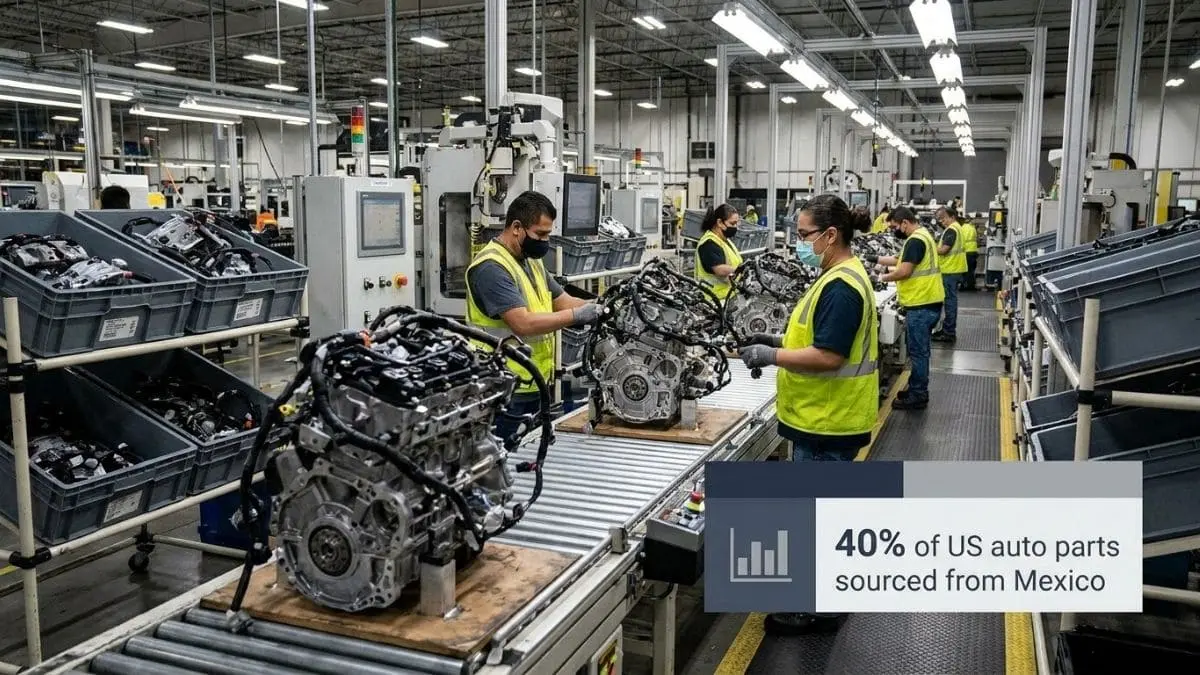
- Automotive Supply Chain: Roughly 40% of the parts for vehicles assembled in the United States are imported from Mexico.
- High-Tech Components: Medical devices, electronics, and aerospace components rely heavily on Mexican assembly facilities.
- Consumer Goods: A vast array of consumer appliances are manufactured across the border.
The US auto sector would not go dark without Mexico. But it would become significantly less competitive globally. It would face pressure from Chinese EVs in international markets, which would be a strategic wound.
The China Backdoor and Foreign Trade Policy
Mexico’s rise to the top of the US trade rankings did not happen in isolation. It happened as China fell from decades of dominance to a position behind Mexico, Canada, and Taiwan. This is foreign trade policy made visible in macroeconomic data.
Strategic decoupling from China required a manufacturing alternative at scale, and Mexico was the answer. However, Chinese manufacturers diagnosed the decoupling strategy before US regulators fully did.
Through shell operations, partial assembly lines, and certificate-of-origin manipulation, Chinese companies are routing products through Mexico specifically to get benefits from USMCA’s zero-tariff access while technically complying with rules-of-origin thresholds.
Mexico is simultaneously a China-decoupling vehicle and a China backdoor, sometimes operating within the same industrial park.
What Are the Tariffs on Mexico and the USMCA Impact on Manufacturing?
The tighter rules-of-origin enforcement the US is demanding is precisely designed to close this backdoor. Under the current ambiguity, Mexico’s dual role is a weakness. It gives Washington grounds to demand tighter regulations and treat Mexico’s compliance as suspect.
If the USMCA collapses entirely and broad Mexico tariffs are reinstated, both sides face severe consequences, but the fallout is highly unbalanced:
The United States (A Bad Quarter/Year)
- US companies absorb higher input costs.
- Consumer prices rise due to supply chain friction.
- The USMCA impact on manufacturing leads to margin compression and possible production slowdowns in the auto sector.
Mexico (An Existential Crisis)
- Foreign direct investment pauses as companies wait for legal clarity.
- Export revenue growth stalls.
- The GDP model that has driven Mexico’s economic expansion loses its legal foundation.
- Unlike the US, Mexico has no domestic demand base large enough to absorb the macroeconomic shock.
The Diversification Myth vs. Negotiation Reality
Mexico and Canada can simply pivot away from the US, pointing to the recent comprehensive strategic partnership between President Claudia Sheinbaum and PM Mark Carney. The theory is that middle powers can diversify their exports and insulate themselves from US trade volatility.
The facts dictate otherwise. During the formal joint review on July 1, 2026, the United States explicitly declined to grant an automatic 16-year extension to the USMCA in its current form. This triggered annual reviews and immediate uncertainty.
If diversification were a viable near-term shield, Mexico would walk away from the table. Instead, following the July 1 decision, U.S. Trade Representative Jamieson Greer and Mexican officials immediately engaged in urgent bilateral talks. They are currently targeting interim arrangements by the end of 2026, with the fourth round of negotiations scheduled for September in Washington, D.C. Comprehensive USMCA renegotiations have been postponed to 2027.
Who Actually Holds the Leverage?
Former President Trump’s statement, “We don’t need anything from Mexico,” is negotiating theater. However, the reality of the ongoing bilateral negotiations proves that Mexico cannot simply decouple.
Canada can negotiate quietly because its leverage (energy, aluminum, integrated auto corridors) is real enough not to require signaling. Mexico negotiates loudly, and participates actively in interim bilateral talks because it needs to signal the leverage it doesn’t fully possess.
Mexico’s realistic response set is narrow. It can slow-walk concessions, build coalition pressure through WTO mechanisms, and use the political cost of US auto sector disruption as implicit leverage.
What it cannot do is credibly threaten to walk away, redirect its exports, or accept non-renewal without catastrophic economic consequence. In the trade with Mexico and the US, one side faces a painful adjustment; the other faces a structural crisis.
Read more analysis in our Middle Power Trap section.