AI Euphoria Collides with Macro Reality as Geopolitical Risks Mount: Weekly Market Review June 1, 2026

⏱️ 6 Mins Read
Weekly Market Review June 1, 2026: Markets closed the week and the month of May on a broadly bullish note, powered by artificial intelligence earnings momentum, cautious optimism over a potential US-Iran peace agreement, and a historic ninth consecutive weekly gain for the S&P 500.
Weekly Market Review June 1, 2026:
Wall Street: AI Dominance Masks Deteriorating Consumer Fundamentals
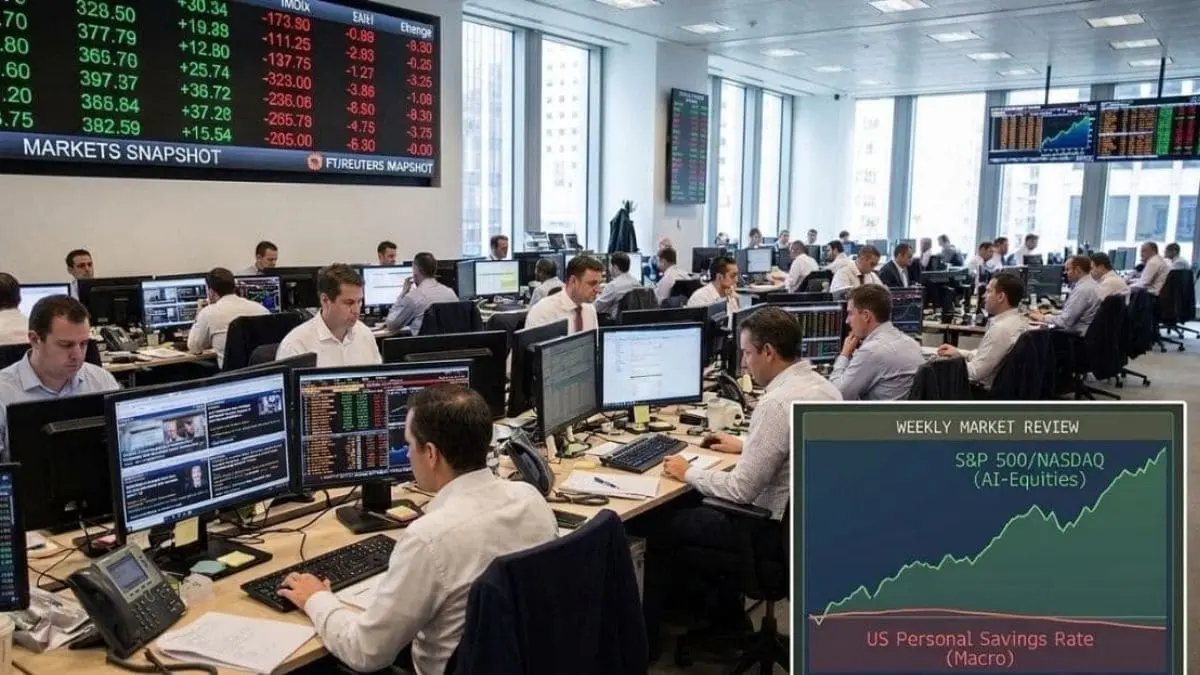
American equities closed May on a historic tear, but the divergence between tech valuations and macroeconomic reality has never been wider. The S&P 500 capped a 5.15% monthly gain, closing at 7,580 and securing its ninth consecutive positive week, the longest sustained winning streak since 2023. Tech-heavy indices led the charge, with the Nasdaq surging 8.36% for the month, while the Dow Jones Industrial Average lagged with a 2.78% advance.
The dominant catalyst for this institutional buying spree remains artificial intelligence infrastructure. Dell Technologies provided the week’s critical earnings inflection point, reporting an 88% surge in annual revenue driven entirely by AI server demand.
After upgrading its full-year AI revenue projections from $50 billion to $60 billion, Dell’s stock went up by 32.76%. This blowout quarter serves as a definitive proxy for ongoing GPU demand, establishing a firm structural floor for Nvidia, which consolidated at $213 following a peak near $235 earlier in the month. Similarly, Microsoft reclaimed its 200-day moving average to close at $441, capitalizing on fading anxieties regarding AI’s threat to traditional software business models.
However, beneath the surface of mega-cap tech valuations, the macroeconomic foundation is cracking.
- Inflation Resurgence: The Commerce Department’s April PCE price index, the Federal Reserve’s preferred inflation metric, accelerated to 3.3% annually, marking its highest level since May 2023.
- Consumer Exhaustion: Simultaneously, the personal savings rate plummeted to its lowest level since 2022, signaling that the American consumer is increasingly reliant on debt to maintain baseline spending habits.
The broader tech cohort also faces idiosyncratic, unpriced headwinds. While Apple tested premium territory at $312 without a defined AI revenue catalyst, Amazon ($271) continues to battle delays in its Project Kuiper satellite broadband rollout following a Blue Origin launchpad.
Meta remained technically robust at $630, though the market is closely monitoring internal headcount reductions enacted to subsidize its aggressive AI infrastructure buildout.
Meanwhile, Tesla ($436) caught thematic tailwinds from a separate domestic humanoid robotics announcement but remains heavily constrained by a tightening European regulatory environment and a contracting Chinese manufacturing sector.
Europe: Geopolitical Relief Rally Overshadows NATO Escalation Tail Risks
European equity markets staged a rally through May, predicated almost entirely on a single geopolitical binary: the anticipated US-Iran peace agreement. Markets have aggressively priced in a diplomatic resolution that would guarantee freedom of navigation through the Strait of Hormuz, thereby relieving the acute energy price shocks that have severely compressed European corporate margins this year.
Germany’s highly energy-sensitive industrial base was the primary beneficiary of this narrative, driving the DAX to 25,118, its highest point since February, on volume spikes that indicate heavy institutional accumulation.
The Euro Stoxx 50 confirmed this regional strength, pressing into all-time high territory at 6,051 with perfectly aligned bullish momentum. The recovery remains fragmented elsewhere; France’s CAC 40 rebounded to 8,219 but remains well below its March peaks, while Britain’s FTSE 100 dragged as the regional laggard at 10,426 due to domestic consumer fragility.
Crucially, this relief rally is blinding markets to a severe tail risk. On May 29, during an overnight assault on Ukraine, a Russian drone crashed into a residential building in eastern Romania, injuring two civilians. Because Romania is a NATO member state, this incident represents a critical escalation flashpoint.
While European indices have yet to reprice based on this breach, any formal NATO response would immediately fracture the current risk-on environment. In the interim, European defense equities found secondary structural support from the Shangri-La Dialogue in Singapore, which solidified emerging defense-industrial partnerships between the EU, Japan, and South Korea.
Asia-Pacific: Historic Japanese Highs Diverge from Chinese Structural Headwinds
The macroeconomic divide across the Pacific rim widened sharply this week, highlighting a stark contrast between structural acceleration and cyclical contraction.
Japan’s Nikkei 225 served as the region’s premier growth engine, surging to an unprecedented all-time high of 66,329.50. This institutional capital flight into Tokyo is powered by two distinct macro tailwinds: the ongoing global AI infrastructure buildout lifting semiconductor-adjacent equities, and Japan’s elevated strategic profile.
The formalization of the new Philippines-Japan Reciprocal Access Agreement at the Shangri-La Dialogue has cemented Tokyo’s position as the primary beneficiary of the accelerating US-China technology decoupling.
Conversely, China’s Hang Seng Index emerged as the week’s most severe underperformer, breaking down into deep discount territory to close at 25,320. The sell-off was triggered by macroeconomic indicators showing a worsening domestic landscape:
- Manufacturing Contraction: China’s official manufacturing PMI slipped to 49.9 in May, crossing the critical line into contraction territory and proving that the post-COVID recovery has run out of momentum. While the non-manufacturing sector managed a marginal expansion at 50.1, the industrial weakness severely threatens the forward earnings base of heavy industrial and tech components.
- Regulatory Overreach: Beijing’s tightening regulatory grip over top AI talent introduces a severe structural ceiling, handicapping its domestic tech sector in the global technology arms race. This fundamental decay has firmly triggered longer-term technical sell signals, giving the Hang Seng the highest short-conviction profile in the region.
- Elsewhere, India’s Nifty 50 (23,609) remains trapped in a bearish holding pattern, languishing well below its January peak near 25,500. Despite New Delhi’s expanding bilateral and strategic corridors with Israel and Cyprus, domestic equity markets have completely failed to monetize this geopolitical credibility, leaving the index entirely dependent on defending its critical structural support floor at 22,250.
Meanwhile, Pakistan’s KSE-100 staged a notable counter-trend recovery to 173,115. As one of the world’s most energy-import-dependent frontiers, the index found immediate balance-of-payments relief in the swift pullback of global crude prices, though its medium-term trajectory remains entirely hostage to the binary resolution of the Iran peace treaty.
Commodities: Energy Markets De-Risk on Diplomacy as Metals Watch Beijing
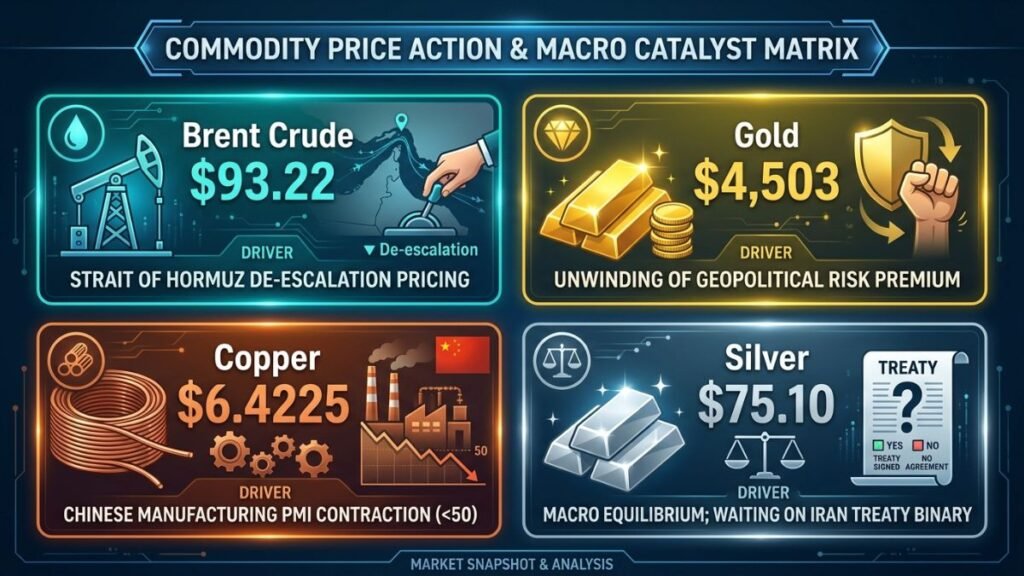
The pricing behavior across the global commodities complex confirms that institutional desks are actively unwinding geopolitical risk premiums. Brent crude, closing at $91.12, remains the definitive macro barometer. Having cratered from its conflict-driven peak above $120, oil’s descent reflects the systematic pricing-in of a diplomatic breakthrough, specifically the clause in the draft US-Iran peace agreement mandating unhindered maritime transit through the Strait of Hormuz.
While a highly targeted Ukrainian drone strike on Russia’s Saratov oil refinery on May 31 introduced brief supply anxieties, the underlying chart pattern is uncorrupted: a classic lower-high structure that will accelerate toward $80 upon a formal signature, or gap back above $100 should negotiations collapse.
Industrial and precious metals are facing distinct structural headwinds:
- Copper’s Demand Deficit: Copper retraced from its peak of $6.75 to settle at $6.4225, tracking the sub-50 Chinese manufacturing data that directly undercuts near-term industrial demand. While the long-term bull thesis regarding AI data center electrification keeps the broader trend intact above $6.25, momentum cannot resume without an aggressive fiscal stimulus package from Beijing.
- Gold’s Pivot to Bearish Momentum: Gold has entered a cyclical consolidation phase at $ 4,593, dropping sharply from its historic premium above $4,800. The unwinding of the Middle East risk premium is the dominant drag, though a firm structural floor is being maintained by the ongoing war in Eastern Europe, underscored by the recent drone incursions into NATO-territory Romania.
- Silver at Equilibrium: Silver ($75.10) remains the market’s most neutral major asset, caught in a structural crosscurrent. It is trapped between declining safe-haven demand on one side and deteriorating Chinese industrial consumption on the other, ensuring that absolute directional clarity will not emerge until the Iran diplomatic binary resolves.
Currency: The US Dollar Trapped in a Sovereign Tug-of-War
The US Dollar Index (DXY) closed at 98.95, perfectly encapsulating the broader macro gridlock. The greenback is currently pinned between two powerful, opposing forces. On the bearish side, the momentum behind the US-Iran peace agreement is fostering a potent “risk-on” global environment, prompting institutional allocators to rotate capital out of defensive cash hoards and into depressed emerging markets.
On the bullish side, the domestic macroeconomic backdrop remains stubbornly restrictive. With April PCE inflation hot at 3.8% and the aggregate personal savings rate severely depleted, the Federal Reserve has virtually zero fundamental justification to ease monetary policy. This structural reality provides an uncompromising floor for the greenback, leaving the DXY’s longer-term technical profile mixed. The upcoming diplomatic resolution is the ultimate directional unlock: a signed treaty breaks the dollar below 98, while a diplomatic failure sends it back above 100.
The Week Ahead: Five Critical Macro Catalysts
As markets transition into June, portfolio risk is heavily concentrated across five highly correlated binary events:
- The Formal Execution of the Iran Deal: This is the undisputed epicenter of macro risk. Any sudden impasse over the remaining unresolved issues will immediately spark an aggressive, violent repricing across global crude, safe-haven gold, and interest-rate-sensitive equity benchmarks.
- Beijing’s Stimulus Response: Following May’s disappointing 49.9 manufacturing PMI print, global commodities and the Hang Seng are entirely dependent on whether the Chinese Politburo delivers major fiscal or monetary intervention.
- NATO’s Sovereign Response Function: The residential drone strike in Romania has not yet received a formal diplomatic or military counter-response. Any escalation or retaliatory posture by the alliance will instantly force a severe repricing of European defense equities and safe-haven assets.
- Colombia’s Presidential Runoff Alignment: With the electorate highly fragmented and no clear first-round majority, the preliminary political positioning ahead of the June 21 runoff introduces a sharp layer of localized political risk into emerging market indices.
Federal Reserve Rhetoric Post-PCE: Given that core consumer inflation is holding at its highest level since October 2023, alongside collapsing consumer savings, any hawkish rhetoric from Fed officials explicitly taking 2026 interest rate cuts off the table will trigger an immediate valuation correction within the AI-driven tech sector.