How Visa Bought FIFA World Cup 2026 Without Buying It

How Visa Bought FIFA World Cup 2026 Without Buying It

⏱️ 5 Mins Read

How a payment company spent nearly two decades quietly turning the world’s most passionate sport, the FIFA World Cup, into its most powerful marketing weapon, and what 4.5 million ticket applicants from 216 countries reveal about the future of brand power.

A boy works on a tea farm in Kiambu, Kenya, or a teenager from Lyari, Pakistan, supports his family with a handcart. They both have different livelihoods. They have never visited a bank, nor are they aware of what digital payment means. But they know Vinícius Júnior or Neymar and are passionate about soccer.

They know the FIFA World Cup is happening, and both of them have a desire to see their favorite football stars live in the stadium. They are Visa’s most important customer, and they don’t know it yet.

This is the story of how Visa played a marketing masterstroke. Not through advertising. Not through celebrity endorsements, discount offers, or cashback rewards.

But through an exceptional marketing strategy that is far more durable and commercially effective than any marketing drive. The first-ever Visa Presale Draw for FIFA World Cup 2026, a mechanism that took 19 years to build and 10 days to execute, may quietly reshape the global payments landscape for a generation.

The Numbers That Reframe Everything

The fever of the FIFA World Cup 2026, which is less than two weeks away, has already engulfed the fans across the globe, looking forward to their team performing well in this high-voltage tournament.

Amid all this buzz, this is what has already happened before a single ball has been kicked.

FIFA received over 500 million ticket requests, or an average of 15 million requests per day, during a 33-day application window that closed in January 2026 from all 211 FIFA member countries. The probability of getting a ticket out of 500 million requests against roughly 5.8 million available tickets was 1 for every 86 requests.

However, inside that staggering demand for tickets lies a commercial event that most analysts skimmed past entirely.

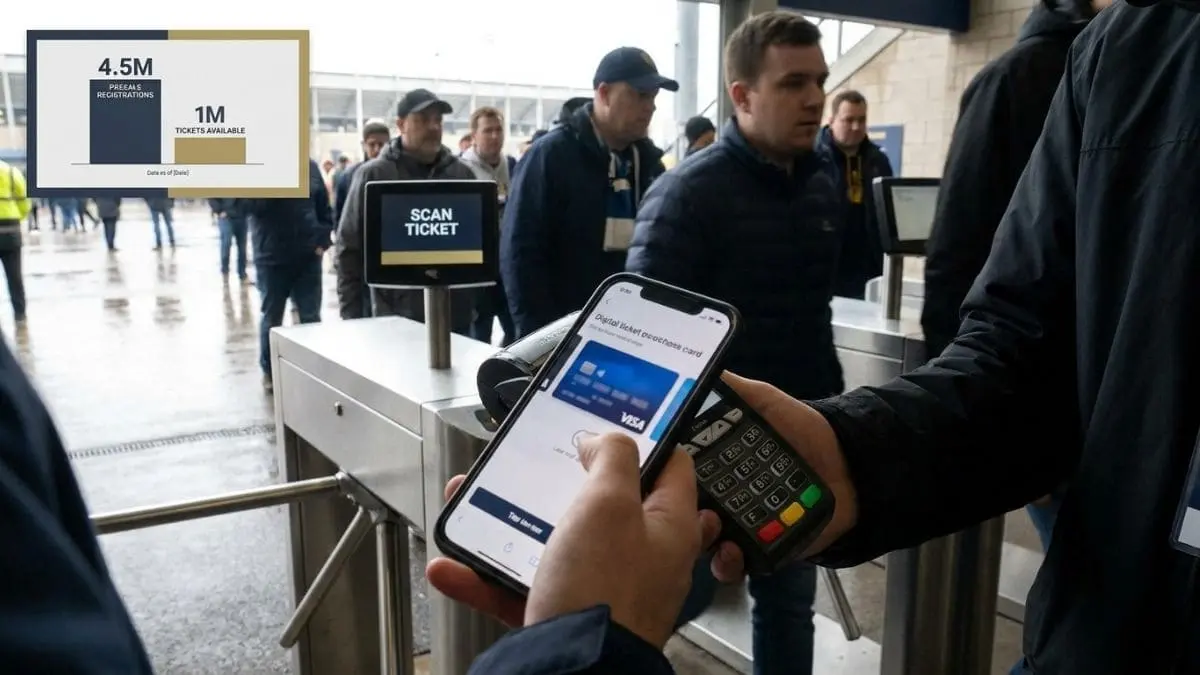
Over 4.5 million people from 216 different countries signed up for the Visa Presale Draw, which was exclusive for VISA cardholders. In the first 24 hours, 1.5 million people had already registered.

Every one of those 4.5 million people did the same thing: they entered Visa card payment credentials into a FIFA registration system, not to buy a ticket, but simply for the chance to try.

It was beyond impressions, clicks, or even conversions. It was something rarer and more valuable: a verified, high-intent consumer across 216 countries declaring their card allegiance to chase a once-in-a-lifetime experience on a global scale.

Certainly, no advertising budget in the world produces that quality of data. Visa did not buy it but built it in 19 years.

Visa FIFA World Cup Journey

Visa first became a FIFA partner in 2007, ahead of the 2010 World Cup in South Africa.

At that point, the arrangement was straightforward. Visa paid for exclusivity in the financial services category. In return, it got stadium branding, some cardholder experience activations, and the right to put its logo on the trophy, which was standard sports sponsorship, valuable but passive.

Since 2007, Visa has been instrumental in elevating the payment experience at more than 40 FIFA events in 19 years. During this period, Visa showed up, installed payment terminals, ran cardholder promotions, and quietly did something exceptional that most sponsors never bother to do. It actually improved the fan experience rather than simply interrupting it.

At the FIFA World Cup 2018, Visa had integrated contactless payment technology across all tournament stadiums with over 3,500 contactless-enabled point-of-sale terminals that drove 50 percent of all purchases inside stadiums throughout the tournament.

This was a smart move from Visa, which used its FIFA platform to introduce a payment technology behavior, i.e., tap to pay, contactless, digital wallets, to grab a global audience experiencing high emotional engagement.

Football fans don’t think about their payment method when their country scores a goal. They cheer every moment in the stadium with a glass of chilled beer, food, and a team jersey. Keeping this behavior in view, Visa made sure its infrastructure was invisible enough to be frictionless and present enough to be habitual.

Around 70% of all consumer spending at Qatar 2022 venues came from internationally issued Visa cards. The 19 years of quiet infrastructure building had produced a payment monopoly in practice without ever needing one in policy.

How Visa Went From Logo to Gatekeeper

For all previous Men’s World Cups, Visa’s ticket-related benefits were peripheral. Cardholders got priority queue access and some exclusive experiences.

The first-ever Visa Presale Draw was officially announced in Washington, D.C., where Visa Regional President Kim Lawrence described it as offering cardholders exclusive early access to apply for tickets to the most anticipated sporting event in the world.

“First-ever”, these two words carry the entire commercial weight of what Visa negotiated for 2026. After 19 years of proving its value as an operational partner, installing terminals, processing payments, generating transaction data, improving fan experience, Visa has finally converted that trust into something no payment brand had ever secured at a Men’s World Cup before: first mover advantage on the most in-demand consumer product on earth.

The first-ever Visa Presale Draw was exclusively for Visa cardholders, and no other cards were accepted during this phase.

The world’s best seats, the earliest pick of approximately one million tickets, went to Visa cardholders before the general public had any access whatsoever. By the time every other cardholder could attempt a purchase, the first wave of inventory had already been picked by 4.5 million Visa applicants.

Visa payment cards were the exclusive payment method accepted by FIFA for ticket purchases in the first phase of sales for the FIFA World Cup 2026.

5 Billion Football Fans. Not All with Visa. That Is the Point

FIFA cites 5 billion football fans around the world. Nearly 4.3 billion Visa cards are currently in global circulation.

Millions of football fans in sub-Saharan Africa, Southeast Asia, and rural South America follow the game with devotion, and they are entirely outside formal financial infrastructure.

They know every player on their national squad, every result from the last decade, and every injustice by referee decision that went against them. However, they do not know Visa’s market capitalization and its payment network because they never needed to.

But they know the World Cup final seat exists. And now, for the first time in the tournament’s history, they know that a Visa card is what gets you there first.

Visa currently holds the largest share of global credit cards, representing a dominant 37% of all credit cards in circulation worldwide.

The remaining 63 percent of global card users, plus the billions of football fans who carry no card, represent the exact population that Visa’s presale strategy is quietly speaking to, not through advertising but through aspiration.

The Behavioral Economics of Missing Out

The mechanism of behavioral economics makes this strategy commercially durable beyond a single tournament.

A passionate fan in Buenos Aires, in Lagos, or in Jakarta discovers that the best available seats to see their favorite team are gone; not because they were too slow or they could not afford them, but because they did not have the right card.

This regret does not produce anger for Visa but builds something far more commercially useful: a quiet, private resolution. “Next time, I will have that card”. Critically, these fans do not abandon their existing card but add a Visa card alongside it.

Mastercard and others do not lose customers when Visa gains one. What changes is the composition of the consumer’s wallet and, crucially, which card they reach for first when the stakes are highest. Visa card just ensured that at the world’s most emotionally charged fan moment, its card is the one with the advantage.

According to Visa’s annual report 2025, it has reported 4.9 billion payment credentials worldwide for fiscal year 2025, with $16.7 trillion in total volume and $20.05 billion in net revenue for the year.

If Visa succeeds in converting only one percent of the football fans who currently don’t have a Visa card, it would create millions of new accounts that would generate substantial revenue only through transaction fees, which would be more than a consumer’s spending over decades.

What It Means for the Unbanked Fan

Return to that boy in Kenya or a teenager in Pakistan. They are the ones who know Neymar but not Visa. They have never needed a payment card and possibly won’t for years.

They will be watching FIFA World Cup 2026 matches on someone’s cell phone or a television installed in a barber shop or café.

What they watch, other than a match itself, are the fans celebrating the performance of their team in the stadium, the ones who grabbed the opportunity to live their dream moment because they had the right card.

Ten years from now, these young boys from Kenya and Pakistan will have grown up and will have a better lifestyle.

When they walk into a bank to open their first account, the clerk asks which card they would like. Somewhere in the back of their mind, quiet, wordless, barely conscious is the memory of what having the right card could mean.

That is the return on investment that no quarterly earnings call will ever capture. And it is exactly what Visa spent 19 years building toward. The beautiful game just became Visa’s wisest business decision.

Read More: Uber Hotel Booking Is Here

image
BNR Logo

Stay Ahead of the Markets with BNR

Start your day with our top story plus "The Editor is Watching", an exclusive daily analysis on markets, commodities, and currencies.

We don’t spam! Read our privacy policy for more info.

What You Missed