TITR: Is the Middle Corridor Commercially Viable?

⏱️ 3 Mins Read
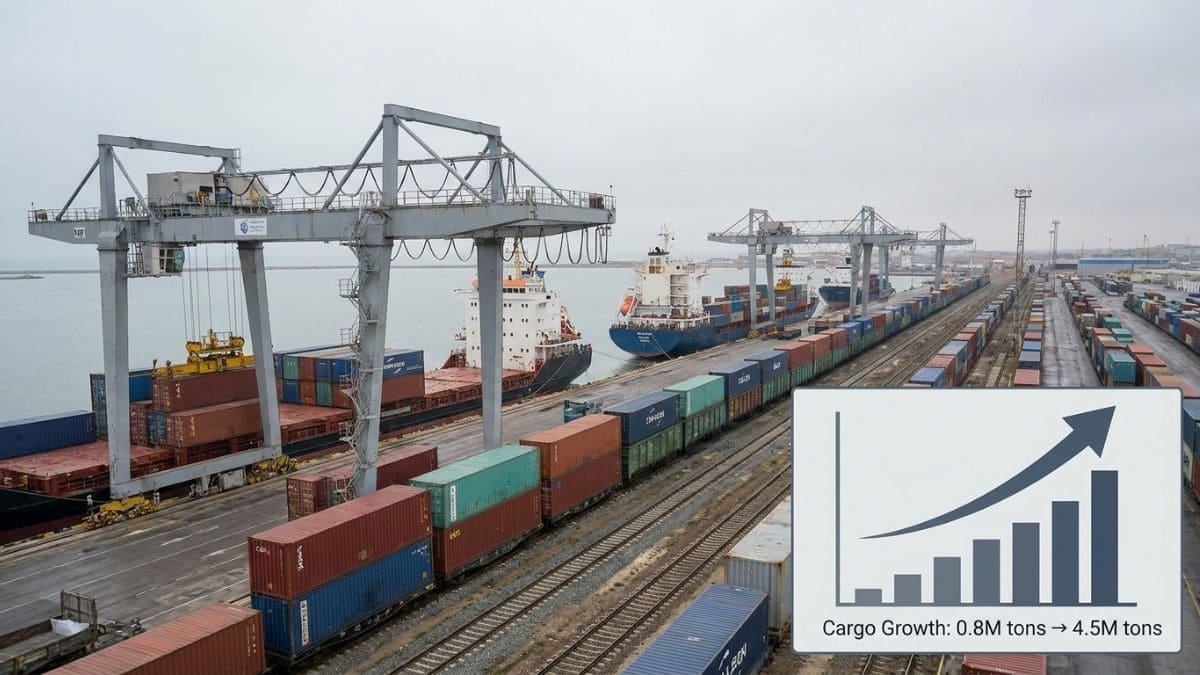
The Trans-Caspian International Transport Route (TITR) is becoming a commercially competitive alternative to Eurasian land bridges, expanding cargo volume from 0.8 million tons to 4.5 million tons and targeting 300,000 twenty-foot equivalent units (TEUs) by 2029.
This expansion is the commercial outcome of a strategic race among Kazakhstan, Azerbaijan, and Uzbekistan, each betting to convert geopolitical disruption into lasting sovereign advantage by controlling the corridor’s key nodes.
The corridor initially expanded as an emergency bypass around the sanctioned Russian rail network and the sea routes targeted by the Houthis in the Red Sea.
The data presented at the 7th Caspian Business Forum in New York confirms that the route’s long-term survival now depends strictly on freight tariffs, transit speed, and administrative synchronization.
Why is the TRIPP considered internationally significant when a Middle Corridor through Georgia already exists?
The Trump Route for International Peace and Prosperity (TRIPP) does not replace the existing Georgian railway via Baku-Tbilisi-Kars; it establishes a complementary southern branch through Armenia that connects mainland Azerbaijan to its Nakhchivan exclave. This secondary alignment shortens access to European markets by roughly 1,000 kilometers, driving regional integration and introducing vital redundancy into the wider transport corridor.
To institutionalize this secondary leg, the finalized framework agreements signed in mid-2026 officially granted the TRIPP Development Company (TDC) an initial 49-year land use right, with the option to restructure terms after that period. TRIPP’s ownership is split between the US (74%) and Armenia (26%).
The US International Development Finance Corporation (DFC) will hold a proposed controlling stake through a US-owned subsidiary. Integrating this leg into the wider system provides alternative routing without displacing Georgia’s existing transit infrastructure. So far, construction on TRIPP has been pushed back and is not expected to start in Armenia until at least 2027
The Financial Mechanisms Driving Commercial Viability
Making the TITR an economically viable artery requires addressing structural capital allocation, not overall capital availability. Multilateral institutions and government-backed enterprise funds are deploying targeted financial mechanisms to mitigate cross-border operational risk.
| Financial Mechanism / Project | Capital Commitment | Operational Target |
| EU Global Gateway | €12 Billion | Mobilizes public and private capital to focus broadly on tripling trade volumes, diversifying routes, and cutting transit times by 2030. |
| Trans-Caspian Enterprise Fund | $400 Million+ | US government-backed vehicle designed to establish the bankability of high-potential mid-market logistics projects and catalyze institutional co-investment. |
| Trans-Caspian Subsea Fiber-Optic Cable | Bilateral Infrastructure | Undersea telecom line laid across the Caspian seabed between Kazakhstan and Azerbaijan. This will help to synchronize freight customs and digital cargo management. |
For Central Asian economies, this corridor has moved past third-party transit services. Kazakhstan is utilizing the route to directly export sovereign energy, petrochemicals, and critical minerals into European markets while decoupling its logistics from traditional single-country transit monopolies.
What are the current major issues facing Central Asia?
Central Asia faces structural environmental and geopolitical vulnerabilities. Internal socio-economic pressures and resource constraints pose greater risks than state-to-state conflict.
Water allocation is the region’s most important issue. Afghanistan’s ongoing construction of the Qosh Tepa Canal threatens to divert up to 20% of the Amu Darya River’s water flow before it reaches downstream states.
Uzbekistan and Turkmenistan have relied heavily on this water for their water-intensive cotton monocultures since the Soviet era. As Afghanistan is not part of regional water-sharing agreements, this diversion, compounded by climate-driven glacier melt and outdated irrigation infrastructure, presents a severe threat to agricultural output and regional stability.
With high population growth and youth unemployment, Tajikistan and Kyrgyzstan depend heavily on labor migration and remittances, predominantly from Russia. Any disruption to these remittance flows directly threatens domestic stability.
The push to develop the Trans-Caspian International Transport Route (The Middle Corridor) to bypass Russian-sanctioned territory has exposed severe infrastructure and logistics bottlenecks. At the same time, regional states face the constant threat of secondary Western sanctions while attempting to attract diversified foreign investment to modernize their economies. Meanwhile, the presence of various militant groups in Afghanistan requires airtight border security.
Addressing the Multi-Modal Bottleneck and Long-Term Reliability
External disruptions from Russian sanctions and Houthi maritime attacks generated immediate demand for the Caspian bypass, but relying on permanent conflict elsewhere is commercially unsustainable.
The corridor’s multi-phase operation is a major issue: cargo is first offloaded from trains to Caspian Sea vessels at ports like Aktau or Kuryk, then shipped to Azerbaijan’s Port of Alat and finally reloaded onto rail wagons, creating high handling fees, port dwell time, and equipment-malfunction shocks.
The European Bank for Reconstruction and Development (EBRD) believes connectivity measures such as digitizing cross-border customs documentation, establishing unified transit tariffs, and automating border clearance are required to slash transit times and to close this efficiency gap.
To prevent cargo from returning to traditional northern corridors as geopolitical conditions ease, these administrative reforms must be institutionalized.
The integration of Western financing, bilateral digital links, and coordinated customs procedures represents the Middle Corridor’s shift from a temporary geopolitical detour into an enduring Eurasian trade route.
Read more analysis in our Great Power Economics section.