
Regional Integration: The Middle Corridor Double-Bypass Race

⏱️ 18 Mins Read
Russia’s 2022 invasion of Ukraine crippled the Trans-Siberian railway network, instantly turning a dominant overland trade route into a massive liability. But the true catalyst for the Middle Corridor’s current explosion came from the South.
With US-Iran tensions functionally blocking southern overland routes through Tehran, and Houthi attacks in the Red Sea forcing global maritime shipping into costly detours around Africa, European buyers and Chinese exporters were cornered. They needed a “double-bypass,” a route completely insulated from both the Russian warzone in the North and the Middle Eastern conflict in the South.
That search for a double-bypass is one consequence of the great-power economic competition among the US, Russia, and China, which is accelerating a massive wave of regional integration across Eurasia and simultaneously reshaping energy corridors, technology supply chains, and financial architecture across the globe.
The Middle Corridor and the Drive for Regional Integration
To answer what is the middle corridor: formally known as the Trans-Caspian International Transport Route (TITR), it is a 4,250-kilometer multimodal trade corridor linking western China to Eastern Europe via Kazakhstan, the Caspian Sea, Azerbaijan, Georgia, and Turkey.
This transit corridor, nearly 2,500km shorter than the Northern Corridor, was largely ignored for years. Geopolitical shocks have sent logistics companies scrambling to use this sprawling route as an alternative to the Russian-dominated Northern Corridor.
The European Union is investing heavily in these midasia routes because geopolitical and security risks in both the northern and southern transit corridors have escalated dramatically due to Russia and the Houthis.
Before February 2022, the route handled roughly 500,000 tons of cargo annually. It now moves 4.5 million tons, pushing Kazakhstan to target 15 million tons by 2030.
The European Union has responded with institutional weight. The EU and its partners have committed €10 billion toward sustainable transport connectivity in the region through the Global Gateway initiative, with the EBRD and European Investment Bank financing projects across Kazakhstan, Kyrgyzstan, and Uzbekistan.
In February 2026, the World Bank also approved an $846 million guarantee to mobilize $1.41 billion in long-term commercial financing specifically for Kazakhstan’s section of the corridor. The Middle Corridor met the demand; now money is moving.
Beneath these developments, three competing nations are running the exact same race. Each nation is converting its strongest asset in ways that simultaneously accelerate its biggest structural liability.
Kazakhstan has the most capital but is overextended. Azerbaijan has the most momentum but is running on a depleting clock. Uzbekistan has the strongest strategic architecture but cannot fully control its own transit destiny.
The winner of this race will not be the most ambitious. It will be the state that hits its ceiling last.
Kazakhstan: The Overextended Frontrunner
Kazakhstan has the capital, but lacks the institutional bandwidth to execute its ambitions. As the physical backbone of the Middle Corridor, the country handles more than 80% of all land-based cargo transported between China and Europe. Its sovereign wealth fund provides massive fiscal headroom, accounting for roughly 60% of Central Asia’s GDP.
However, capital cannot buy infinite focus. Over the past 15 years, Kazakhstan has poured $35 billion into its rail sector. However, the rail sector still faces challenges of import dependency in transport equipment.
Modernization and electrification are urgently needed to reduce emissions and improve efficiency. Yet, the state is suffering from severe diplomatic overextension. In a single reporting period, Kazakhstan aggressively pursued initiatives with Montenegro, the Balkans, Iran, and Spain, while simultaneously offering to host Afghan-Pakistani peace talks.
This is a foreign policy apparatus running on announcement velocity rather than execution depth. When a state attempts to be everywhere at once while managing a deeply structural, heavily sanctioned rail partnership with Russia, follow-through collapses.
Crucially, Kazakhstan’s headline-grabbing surge to 4.5 million tons of cargo is not purely a testament to its strategic brilliance; it is heavily driven by Red Sea overflow. Logistics companies are forced to use Kazakh rail because maritime shipping is paralyzed by Houthis. Kazakhstan is the frontrunner, but it is entirely exposed to the gap between its stated ambitions and its actual capacity to deliver once maritime routes stabilize.
The Sanctions Contradiction
Kazakhstan’s largest infrastructure asset and its largest strategic liability is the same object: the Russian border. Kazakhstan’s largest infrastructure asset and its largest strategic liability are the same object: the Russian border.
The 2024 Strategic Partnership Agreement between KTZ and Russian Railways (RZD) formalized what was already the case: Kazakhstan’s rail network is deeply integrated with Russia.
Under that agreement, train throughput between the two systems rose by 30%, from 65 to 85 train pairs per day by mid-2025. The two operators agreed to accelerate automation of China-Europe rail transit and introduce a unified digital logistics system.
Kazakhstan is simultaneously telling Brussels it is building an alternative to Russia and telling Moscow it is expanding joint rail capacity. Both statements are true. That is exactly the problem.
The same contradiction is visible in shipping, where Iran’s Hormuz closure forced regional powers to simultaneously deepen alternative route infrastructure while maintaining economic relationships with the very actor creating the disruption.
The Diplomatic Overextension
Beyond the infrastructure contradiction, a second liability that receives almost no analytical attention: Kazakhstan’s foreign policy bandwidth is deployed across too many simultaneous initiatives to generate concentrated return on any single one.
The recent news cycle tells the story more clearly than any official statement. Within the same reporting period, Kazakhstan signed a joint declaration with Montenegro on trade and logistics diversification, announced a new European strategy focused on Balkan engagement, advanced joint port development plans with Iran, offered to host Pakistan-Afghanistan peace talks, deepened corridor negotiations with Spain, and continued its Middle Corridor expansion with EU officials.
Each initiative is individually defensible. Collectively, they describe a foreign policy apparatus running on announcement velocity rather than execution depth.
Diplomatic bandwidth is a finite resource. Foreign ministry capacity, state investment agency attention, and executive-level relationship management do not scale infinitely.
When a country with a single dominant export sector attempts to simultaneously cultivate Montenegro, the Balkans, Iran, Spain, Afghanistan-Pakistan mediation, and the EU institutional relationship while also managing a deep structural partnership with Russia and a growing infrastructure relationship with China, something gets underfunded. Based on the evidence, follow-through is underfunded.
The Caspian Sea level presents an additional physical risk that no diplomatic initiative can resolve. A Carnegie Endowment analysis published in 2026 warns that a projected sea-level drop of up to 6.5 meters could leave Kazakhstan’s Aktau and Kuryk ports landlocked by 2045, potentially forcing a costly transition to offshore deep-water terminals.
For a country betting its corridor strategy on Caspian transit capacity, this capital planning constraint is already underpriced in the infrastructure investment calculus.
Furthermore, there is a massive logistical hurdle that institutional readers frequently highlight: to ship goods from China to Europe without touching Russian soil, trains must do the highly inefficient task of being completely unloaded and packed onto ferries to cross the Caspian Sea.
Azerbaijan: The Fastest Mover with the Narrowest Window
Azerbaijan is currently winning the execution race. For a country of 10.45 million people, its strategic positioning across multiple domains is remarkable in breadth and, more unusually, in delivery.
To understand why Azerbaijan is winning, and why that victory may be temporary, you must look directly at its energy constraints.
Hydrocarbon revenues contributed 48.1% of Azerbaijan’s state budget revenues in 2025. Oil production at the Azeri-Chirag-Gunashli block has been in structural decline since 2010, falling approximately 45.5% over 15 years.
In the first half of 2025, oil GDP contracted by 2% year-on-year. The IMF projects GDP growth of 2.1% in 2026 and roughly 2.5% for 2027.
Azerbaijan’s oil reserves stand at approximately 7 billion barrels; its natural gas at 2.5 trillion cubic meters. These are not small numbers, but they are finite ones with a visible depletion trajectory.
Baku reads this math clearly. The strategic response, converting hydrocarbon revenue into geopolitical positioning before the energy advantage expires, is coherent, urgent, and already producing results.
The Connectivity Sprint
Azerbaijan has, in a compressed timeframe, transformed from an energy exporter into something more architecturally interesting: a connectivity state. The evidence across the news cycle is dense.
The Port of Alat is undergoing expansion to handle the growing volumes of Caspian transit. The Baku-Tbilisi-Kars (BTK) railway, upgraded in 2024 to an annual capacity of 5 million tons, provides Central Asian exporters with a sanctioned-Russia bypass that no other operator can offer at a comparable scale. What fuels this specific connectivity sprint is the southern maritime disruption: Azerbaijan’s BTK upgrade is hyper-profitable precisely because European markets are currently cut off from the Suez Canal, forcing volumes through Baku.
Azerbaijan holds the largest merchant fleet in the Caspian Sea, with 52 cargo ships and a shipyard capable of producing all vessel types required for Caspian operations.
Azerbaijan has become an internet transit hub through a new deal with Armenia’s telecom operator. Israeli experts are publicly positioning Azerbaijan as a gateway for Israeli technology into Central Asia. Non-oil exports grew 8.1% to $3.6 billion in 2025.
Gas exports are flowing to both Serbia and Germany. The Southern Gas Corridor, which Azerbaijan built and controls, has provided Europe with an alternative pipeline supply since 2021. While the actual gas volumes exported to Germany in early 2026 were modest, the strategic value of being in the supply chain at all, a country whose gas flows when Russian flows are sanctioned, is disproportionate to the volumes.
The Contradiction Hidden in Plain Sight
However, the execution story becomes complicated here. The same Azerbaijani state that is positioning itself as Europe’s alternative to Russian energy is also the operator of the STAR refinery in Turkey, which, as of 2024, was approximately 98% dependent on Russian crude oil, with 73% of that supply coming directly from Lukoil, a company under active US sanctions.
The EU banned imports of refined products made from Russian crude processed in third countries. The UK government sanctioned the Azerbaijani tanker Zangezur in May 2025 for transporting Russian crude to the STAR refinery, later adding two more Azerbaijani vessels, including Shusha and Karabakh, to its sanctions list.
In the words of independent analyst Maximilian Hess, the UK action was “a clear signal that if Azerbaijan continues attempts to circumvent sanctions on Russia, its diplomatic standing and overall economy could face serious risks.”
SOCAR has since begun reducing Russian crude purchases at STAR, sourcing alternative feedstock from Kazakhstan, Iraq, and other non-Russian origins. But the adjustment is reactive, not proactive.
It followed sanctions enforcement, not preceded it. The implication for Western institutional partners is not subtle: Azerbaijan is willing to be Europe’s alternative to Russia as long as Russian-linked revenues remain profitable. That is not a partnership posture; it is an arbitrage posture.
Azerbaijan will use Azerbaijani gas but won’t anchor its corridor strategy on a state it cannot publicly champion. That sentence, from Brussels’ unspoken calculus, defines the ceiling on Azerbaijan’s Western integration trajectory more precisely than any diplomatic communiqué.
The window for Azerbaijan to convert its momentum into durable structural leverage is real. It is also finite, constrained from below by declining oil production, from above by governance and sanctions exposure, and from the side by the pace of European energy market shifts toward American LNG, which the EU has committed to buying $750 billion worth of over 2026-2028. Azerbaijan is sprinting. The question is whether it is sprinting toward an open goal or toward a closing one.
Uzbekistan: The Best Position, the Hardest Execution
Uzbekistan’s strategic architecture is the strongest of the three. That assessment, published in this outlet’s prior analysis of the Uzbekistan paradox, holds. The constitutional neutrality, the seven simultaneous roles, the demographic dividend, and the reform trajectory are real advantages that neither Kazakhstan nor Azerbaijan can replicate.
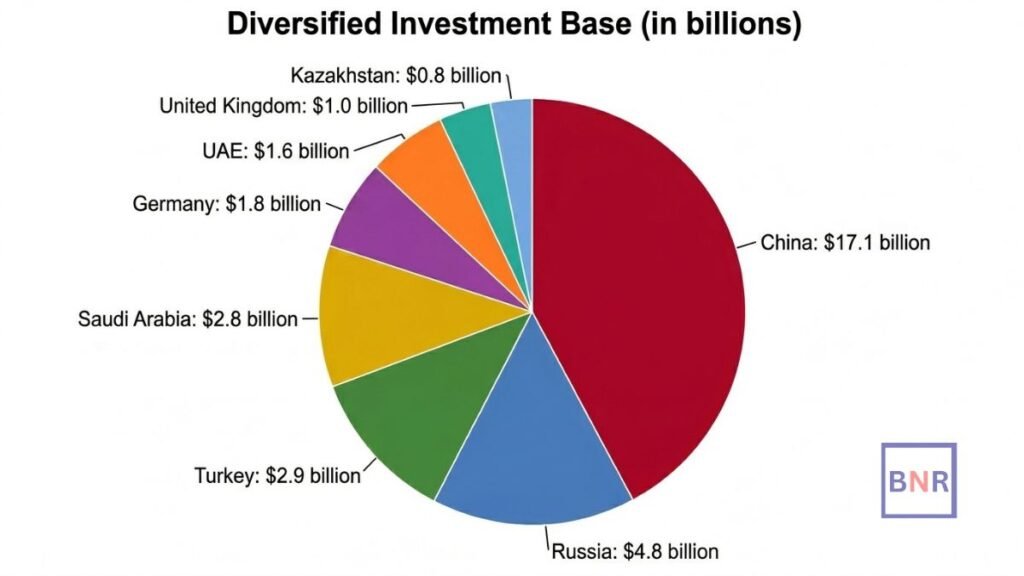
The investment data confirms the architecture’s appeal. In 2025, Uzbekistan pulled in a record $43.1 billion in FDI and loans, up sharply from $31.9 billion in 2024 and $19.5 billion in 2023.
The investment base has diversified meaningfully: China remains dominant at $17.1 billion, but Russia ($4.8 billion), Turkey ($2.9 billion), Saudi Arabia ($2.8 billion), Germany ($1.8 billion), the UAE ($1.6 billion), the United Kingdom ($1.0 billion), and Kazakhstan ($0.8 billion) all registered meaningful commitments.
Singapore companies are exploring Uzbekistan’s digital economy. Volkswagen has entered the market via Chinese operations. Qatar’s MBK Holding is in discussions for a tech partnership.
From January to June 2026, the Tashkent International Investment Forum (TIIF-2026) recorded unprecedented engagement from American firms on critical minerals, infrastructure, energy, and AI.
The Geography That Doesn’t Negotiate
None of this changes the fundamental constraint: Uzbekistan is double landlocked. Every viable corridor route to the West runs through Kazakhstan. Every viable alternative to the north runs through Russia. More critically, the one southern alternative through Afghanistan is commercially dead, choked off precisely by the US-Iran sanctions and regional instability highlighted in the double-bypass thesis.
The China-Kyrgyzstan-Uzbekistan (CKU) railway, expected to be completed by 2026, provides a more direct link to Chinese markets. It is a genuine breakthrough for Uzbek connectivity because the southern routes are politically toxic.
However, it passes through Kyrgyzstan before connecting to Chinese rail, which means Uzbekistan depends on two sovereign third parties to access its primary growth market. This is the geographic paradox that Uzbekistan’s diplomatic agility cannot fully resolve.
In the corridor race, route control is leverage. The party that controls the physical infrastructure collects the transit fees, sets the tariff structure, manages the bottlenecks, and captures the compounding institutional relationships that come with being the indispensable node.
Kazakhstan controls the overland backbone. Azerbaijan controls the Caspian crossing and the BTK connection to Europe. Uzbekistan, despite its superior strategic architecture, must pay both of them, in transit fees, in political accommodation, or in infrastructure dependency, to reach its own markets.
The Geographic Trap
Uzbekistan’s record-breaking $43.1 billion in FDI during 2025 proves its constitutional neutrality is a massive asset, not a liability. By remaining non-aligned, Tashkent lowers the geopolitical risk for competing global powers, allowing Chinese, Russian, European, and Gulf capital to co-exist in its domestic market.
The actual ceiling on Uzbekistan’s corridor ambition is strictly geographic. You cannot become an indispensable transit node when you do not control the physical route. Because it is doubly landlocked, Uzbekistan must rely on Kazakhstan to access the West and on Kyrgyzstan and China to access the East.
In the corridor race, route control is leverage. The party that controls the physical infrastructure collects transit fees and accrues compounding institutional power.
Uzbekistan is building immense market attractiveness, but without sovereign control over transit bottlenecks, it is forced to pay political and financial tolls to its neighbors just to reach its own buyers.
The Structural Irony: The Finish Line Is in Brussels, Not Central Asia
Here is the analytical point that most coverage of this corridor misses entirely.
All three countries are running a race whose winner is determined not by who builds the most infrastructure, signs the most deals, or attracts the most FDI.
The winner is determined by which country the European Union institutionally endorses as its primary corridor partner. And Brussels makes that determination based on criteria that none of the three fully meets.
The EU’s engagement with the Middle Corridor is substantial and accelerating. The €10 billion Global Gateway commitment, the World Bank guarantees, the TEN-T network inclusion of Georgia and Azerbaijan, the Samarkand Summit endorsements, and the ongoing EU-Kazakhstan corridor negotiations are not symbolic gestures. The EU is building a genuine institutional stake in this corridor’s success. What it is not doing is committing to a single anchor state.
The reason is structural. Brussels requires three things from a primary corridor partner that Kazakhstan, Azerbaijan, and Uzbekistan all struggle to deliver simultaneously.
The first is governance standards. All three states are authoritarian or semi-authoritarian by any independent assessment. Azerbaijan’s democratic deficit is the most documented; three of its state-owned tankers were sanctioned by the UK in 2025 for sanctions circumvention.
Kazakhstan’s political system remains closed despite economic openness. Uzbekistan’s reform trajectory is real but incomplete, with significant informality and regulatory opacity persisting.
The EU can finance corridor infrastructure in these countries. It cannot anchor its strategic trade architecture on states it cannot publicly defend to its own citizens and parliaments.
The second is sanctions cleanliness. All three have active economic ties to Russia that pose legal and reputational risks to EU institutional partners.
Kazakhstan’s rail partnership with RZD, Azerbaijan’s STAR refinery exposure, Uzbekistan’s continued Chinese and Russian FDI dominance; none of these are disqualifying on their own. Together, they prevent any of the three from occupying the unambiguous Western-partner status that would justify the deepest level of EU institutional commitment.
The third is scalability. The corridor currently moves 4.5 million tons annually. The EU wants it to handle 100 million tons by 2035. That is a 22-fold increase. None of the three countries, individually or collectively, has demonstrated the institutional capacity to manage EU-grade infrastructure partnership requirements at that scale.
The Anaklia deep-sea port in Georgia, identified by the World Bank and EU as a central corridor priority, has seen its 2026 budget slashed from $56 million to around $18 million, and its final contractor remains unconfirmed as of mid-2026.
This bottleneck highlights another geopolitical risk: international observers increasingly view Georgia’s ruling party as being in Putin’s pocket. To counter this, the US and EU are actively exploring redundancies, such as engaging more with Armenia (e.g., through TRIPP), to ensure Georgia does not hold a monopoly on the corridor if political tides shift entirely toward Moscow.
The corridor’s most critical western bottleneck is stalled. That is not a problem for Kazakhstan, Azerbaijan, or Uzbekistan, but it illustrates the gap between the strategic vision and the operational reality.
The race they are running is real. The prize, they think they are competing for being named the EU’s preferred corridor anchor, may not be available to any of them in the form they expect.
What Brussels is more likely to build is a distributed architecture: financing multiple nodes, playing states against each other to extract governance concessions, and avoiding single-point dependency regardless of which state’s infrastructure is most capable. In that scenario, all three countries win something. None wins the race.
What Investors and Researchers Should Watch
The following indicators will signal, more reliably than official announcements, which country is actually pulling ahead, and which is approaching its ceiling.
Kazakhstan’s inflection point is cargo volume against capex. KTZ carried 110.3 million tons in January-April 2026, down 1.1% year-on-year, with cargo turnover down 10.3%. This is a warning signal, not a verdict; construction disruptions during the Mointy-Kyzylzhar build partially explain the dip.
But if cargo volume plateaus or continues to decline through 2026 while infrastructure spending continues at its current rate, the overextension thesis is confirmed. Watch the quarterly KTZ freight data against the $15 billion 2030 capex commitment.
Azerbaijan’s inflection point is the STAR refinery’s feedstock sourcing. As of March 2026, 39% of STAR’s feedstock still came from Russia. The EU’s 18th sanctions package covers this. The question is enforcement speed. If European importers of STAR-refined products face active enforcement action in 2026-2027, Azerbaijan’s dual-track energy strategy becomes untenable, and Baku will be forced to choose between its Russian energy entanglement and its Western corridor positioning.
That choice, forced rather than voluntary, will arrive faster than Baku’s public positioning suggests. Watch the Center for Research on Energy and Clean Air’s monthly sanctions enforcement reports.
Uzbekistan’s inflection point is whether it secures a corridor infrastructure deal that bypasses Kazakhstan. The CKU railway changes Uzbekistan’s eastern connectivity. What would change its western strategic position is a Caspian transit agreement that gives Uzbekistan direct access to the Azerbaijani port network without routing through Kazakh territory.
No such agreement currently exists. If one emerges, it signals Tashkent has found a partial solution to its geographic ceiling. The corridor’s systemic inflection point is the Anaklia port decision in Georgia.
Until a contractor is confirmed and construction begins on the deep-sea port that the EU and World Bank have identified as the corridor’s critical western gateway, the entire infrastructure investment thesis for all three countries faces a bottleneck that none of them controls. Monitor Georgia’s transport ministry budget allocations and contractor selection process quarterly.
The EU’s institutional signal is which country receives the first major EU infrastructure co-financing agreement that includes governance conditionality clauses; not grant funding, but structured co-investment with strings attached. That instrument, when it appears, will tell analysts which country Brussels has decided it can work with at depth. It has not yet appeared for any of the three.
Three Strategies, One Corridor, Three Ways to Lose
The Middle Corridor is not a geopolitical abstraction. It is a functioning trade route that moved 4.5 million tons of cargo in 2024, is on track to move significantly more in 2026, and has attracted over $10 billion in committed multilateral financing. The race to anchor this corridor is real, consequential, and under-analyzed.
Kazakhstan has the infrastructure scale and the sovereign capital to win. Its liability is a Russian border that is simultaneously its biggest asset and its biggest constraint for Western partners, combined with a diplomatic overextension that is dispersing institutional bandwidth across relationships that cannot all deliver proportional economic return.
Azerbaijan has the execution momentum and the most coherent pivot strategy of the three. Its liability is a depleting hydrocarbon base that funds the pivot, a governance deficit that caps Western institutional trust, and sanctions exposure through its refinery operations, which is narrowing its room for maneuver precisely when it most needs it.
Uzbekistan has the strongest strategic architecture and the most favorable trajectory for external investment. Its liability is geographic; it cannot control the corridor routes it needs to dominate, and its constitutional neutrality, while commercially valuable, prevents the aggressive bilateral commitments that convert preferred-partner status into indispensable-node status.
The structural irony is this: the EU, which controls the institutional validation all three are racing to capture, is unlikely to award it exclusively to any of them. Brussels will distribute financing across all three, extract governance concessions from each, and avoid single-point dependency regardless of which state’s infrastructure case is strongest. The architecture of the EU’s corridor engagement is distributive by design.
In a race where the finish line moves, the winner is the country that manages its liabilities most intelligently; not the one that announces the most ambitious targets. By that measure, the race is still open.
Based on the evidence available in mid-2026, none of the three has yet demonstrated the combination of infrastructure execution, governance improvements, and sanctions-clean positioning that would lead Brussels to choose depth over distribution.
The window is real. The ceiling for each competitor is closer than the official projections suggest.
Structural Ceilings: Country Comparison
| Country | Strategic Advantage (Asset) | Structural Liability (Ceiling) | Key Inflection Point to Watch |
| Kazakhstan | Overland infrastructure backbone & massive sovereign capital. | Deep integration with Russian rail & severe diplomatic overextension. | Cargo volume plateauing despite the $15 billion capex commitment. |
| Azerbaijan | Execution momentum & Caspian transit control (BTK railway). | Depleting oil reserves & sanctions exposure via the STAR refinery. | Speed of EU sanctions enforcement on Russian crude imports. |
| Uzbekistan | Constitutional neutrality & unprecedented diversified FDI ($43.1B). | Double-landlocked geography; entirely dependent on neighbors for transit. | Securing a direct Caspian transit deal that bypasses Kazakhstan. |
Read more analysis in our Great Power Economics section.