SpaceX Cursor Deal: AI’s $10B Stress Test

⏱️ 10 Mins Read
When even walking away costs $10 billion in the SpaceX Cursor deal, an AI arms race has entered a territory that nobody has even mapped.
SpaceX-Cursor Deal
On April 22, 2026, SpaceX announced a partnership with Cursor, an AI coding startup built by Michael Truell and his team in 2023.
The terms, as described by SpaceX in its tweet, were straightforward. SpaceX gains the right to acquire Cursor for $60 billion later in the year. If it walks away, it pays Cursor $10 billion for the work done during the partnership.
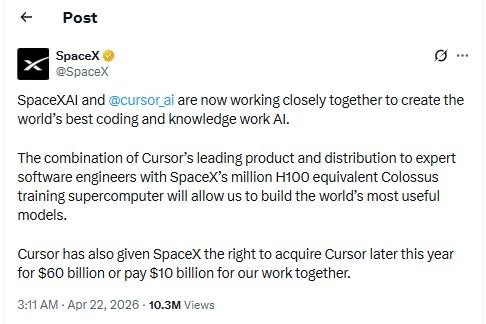
The SpaceX-Cursor deal is a staged option acquisition: a structure that gives the buyer the right but not the obligation to purchase a company after running a real-world experiment together.
It is part partnership, part due diligence, and part insurance policy, but it answers a question that standard Mergers and Acquisitions (M&A) can’t: how do you value an AI startup from outside without auditing its most important assets?
Why both companies needed this deal, why the structure was chosen over a conventional acquisition, and what it means for every AI startup and investor watching it from the sidelines.
The Infrastructure Giant with a Distribution Problem
SpaceX is clearly distinct from other technology companies due to its diversity.
When SpaceX acquired xAI, it completed a vertical integration, owning the world’s most powerful AI supercomputer, Colossus, the AI model (Grok), and the social distribution layer (X). But what it does not own is the AI developer.
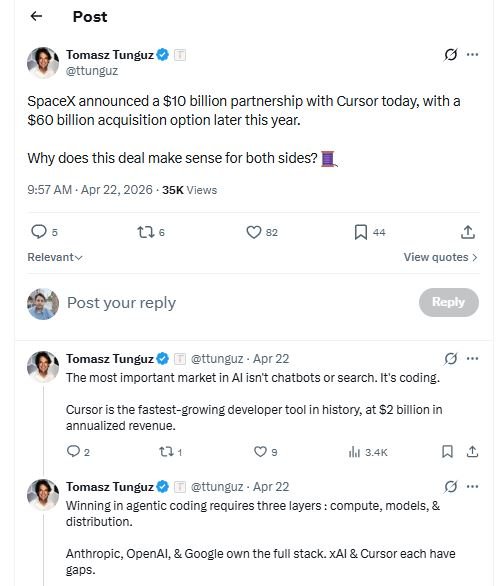
“Winning in Agentic coding requires three layers: compute, models, and distribution. Anthropic, OpenAI, and Google own the full stack. xAI and Cursor each have gaps,” said Tomasz Tunguz, VC at Theory Ventures.
SpaceX needed distribution and trust of developers faster than it could organically build it, especially when it has confidentially filed for an IPO and is expecting a record offering
Cursor, on the other hand, is the fastest-growing developer tool that is genuinely excellent, but on top of ChatGPT & Claude, which are now its competitors.
Michael Truell and his small team, including a Pakistani co-founder, Sualeh Asif, didn’t do anything wrong; they used the best available models rather than spending years and hundreds of millions of dollars training their own.
The result was a product that developers loved, grew virally, and became the category leader in AI-assisted coding, but when these models became competitors, options shrank rapidly.
Anthropic is building its own coding environment. OpenAI launched its own IDE integrations. Google is doing the same. Every model provider that Cursor relies on for its core product is simultaneously working to make Cursor redundant. That is not speculation. That is the disclosed product roadmap of each of Cursor’s three primary suppliers.
This is what Max Kolysh, cofounder of Dover, said on X: Cursor’s long-term viability was contingent on maintaining access to ant/oai models. Both are actively building Cursor competitors, which is an existential platform risk to survive; they need their own foundation models. Training frontier models requires deep pockets. And they found the guy with the deepest pockets in the world.
Cursor had the users. It had the brand. It had the developer’s trust. What it did not have was the model, and without a model, all of that is rented, not owned.
Rohit Mittal, cofounder and CEO of Helium Ventures, tweeted: “It will be very interesting if Cursor migrates its token consumption from Claude to xAI.”
Why Not Just Acquire Cursor Outright?
If SpaceX has the resources and its strategic rationale is clear, then why introduce the complexity of an option structure instead of simply acquiring Cursor?
The answer reveals something important about how frontier AI companies are thinking about value, uncertainty, and due diligence in an era where competitive advantages can disappear in a model release cycle.
A traditional acquisition requires a buyer to commit to a price before they fully understand what they’re buying.
In mature industries, where uncertainty is manageable, you audit the revenue, the contracts, the team, and the IP.
But Cursor’s value is not primarily in its revenue. It is in a specific thesis: that its training data, its user behavior data, and its developer distribution are genuinely differentiating inputs to building a better coding model.
That thesis has not been tested because nobody thought to test it, but testing requires running Cursor’s data through a frontier training run on a supercomputer, which is not something you do during a due diligence process. It is something you do after you’ve committed resources and time.
“The option structure reflects that uncertainty. If the training work ports over, SpaceX buys Cursor and owns the pipeline. If it doesn’t, they pay $10B for the experiment and walk. Either outcome, Grok ends up stronger than it would have been, and xAI gets an answer to a question it couldn’t answer internally,” Anand Kannappan, Co-founder, PatronusAI said on X
The Call Option as Corporate Instrument
What SpaceX and Cursor have constructed is, in the language of financial derivatives, a call option on a strategic asset. SpaceX pays a premium ($10 billion) to secure the right but not the obligation to purchase the underlying asset (Cursor) at a predetermined strike price ($60 billion) within a defined window.
The analogy to financial options is imperfect but instructive. In options markets, you buy a call when you believe the underlying asset will increase in value and you want to benefit from that upside without committing full capital upfront. You accept the premium as a sunk cost in exchange for flexibility.
In this deal, SpaceX is buying flexibility. The $10 billion is not a break-up fee in the traditional M&A sense; it is payment for the right to experiment at scale. SpaceX gets to run its thesis that Cursor’s data plus Colossus compute equals a frontier coding model on real infrastructure with real stakes, before committing $60 billion to a bet it cannot fully evaluate from the outside.
For Cursor, the structure provides something equally valuable: a guaranteed floor. The company gets access to the world’s most powerful AI training infrastructure, the implicit validation of a SpaceX partnership for recruiting and enterprise sales, and a minimum $10 billion payment regardless of the outcome.
In exchange, it accepts a ceiling on its near-term optionality; other acquirers are unlikely to bid during the option window.
The Hidden Asymmetry
During the partnership period, both companies will generate data that is enormously valuable for future decision-making. SpaceX will learn whether Cursor’s training data genuinely differentiates or whether the value was always in the product layer, not the data.
Cursor will learn whether Colossus infrastructure can produce a model competitive with Claude and GPT, or whether frontier model training requires capabilities that xAI simply doesn’t have.
The shared-information structure creates aligned incentives for the experiment to be conducted and evaluated rigorously.
Historical Precedents: The Genre Is Not New
The explicit structure and the headline-grabbing numbers are new, but these acquisition instruments have precedents. Microsoft’s relationship with OpenAI evolved through multiple staged commitments rather than a single acquisition.
Similarly, Amazon’s $4 billion investment in Anthropic includes tiered commitments and cloud infrastructure reciprocity. Anthropic runs its models on AWS, Amazon gains preferred access and strategic insight, and the relationship deepens only if the data supports it. What SpaceX has done with the Cursor deal is make this structure explicit, binary, and public.
Why Cursor Accepted This Deal
The Cursor was built with a product-first philosophy in the AI gold rush of 2023 and 2024. While competitors raced to market with half-finished features, Cursor shipped slowly and deliberately, building user trust through reliability, and that strategy worked.
But product excellence does not solve a structural problem. When Anthropic and OpenAI began disclosing their own IDE integrations and coding environments, the product advantage Cursor had carefully built began to look less permanent.
The question was no longer whether Cursor was the best coding tool. It was whether Cursor could remain the best coding tool once its model providers stopped supplying it with their best models, framing the deal not as an opportunistic payday, but as a survival strategy.
What The Rivals Are Thinking
Anthropic faces perhaps the most complex calculation. The company is simultaneously Cursor’s largest model supplier and its most direct competitive threat.
It has spent two years carefully cultivating Cursor as a reference customer, the kind of high-profile, developer-beloved application that demonstrates Claude’s capabilities to enterprise buyers.
If Cursor migrates its token consumption from Claude to Grok, as Helium Ventures CEO Rohit Mittal speculated, the impact on Anthropic is not merely financial. It is reputational. Cursor is the kind of partner whose absence from the Claude ecosystem sends a signal to other developers and enterprises evaluating which model provider to build on.
Anthropic’s response options are limited and uncomfortable. It can accelerate its own coding product to reduce its dependence on Cursor as a distribution channel. It can offer Cursor preferential pricing or API access to retain the relationship. Or it can do nothing and absorb the loss.
What it cannot do is acquire Cursor: the SpaceX option agreement presumably includes exclusivity provisions that foreclose that path during the option window. The deal has, in effect, taken Cursor off the market for the period that matters most.
OpenAI’s Competitive Posture
OpenAI’s position is simpler and more aggressive. The company has been building its own coding environment and agentic development tools, and the SpaceX-Cursor deal accelerates its timeline for needing those products to be competitive.
If Cursor successfully trains a proprietary model on Colossus infrastructure, the resulting product would represent a credible competitor to both ChatGPT and Claude in the developer segment.
OpenAI cannot prevent that development. But it can accelerate its own coding tools to ensure that by the time a Cursor-xAI model launches, it is entering a market where OpenAI already has established developer relationships.
The strategic arms race this deal initiates is not about any single product. It is about which company controls the developer’s daily workflow because the developer who uses your coding tool is also likely to use your API, deploy on your cloud, and recommend your model to their engineering team.
Google and Microsoft: The Infrastructure Giants Watch
Both Google and Microsoft occupy interesting positions in the post-deal landscape. Both have massive compute infrastructure, their own AI models, and developer relationships through GitHub (Microsoft) and Google Cloud (Google). Neither is directly threatened by the SpaceX-Cursor partnership in the short term.
But both are watching the deal structure itself with considerable interest. If the staged option acquisition proves to be an effective mechanism for rapidly acquiring AI distribution without the commitment of a full acquisition, Google and Microsoft may develop similar instruments for their next round of AI startup relationships.
Is $60 Billion Real?
Before accepting the deal’s logic too readily, a healthy skepticism is warranted about the numbers themselves. $60 billion is an extraordinary valuation.
There are two ways to read this. The first is that SpaceX genuinely believes Cursor’s developer distribution and training data are worth that much in the context of the AI race and that the winner of the coding tools market will be worth hundreds of billions.
The second is that the $60 billion is theatrical: a number designed to make Cursor’s employees feel secure, and its enterprise customers feel confident, while SpaceX runs its experiment, expecting the $10 billion walk-away is the more likely outcome.
At $10 billion, even the exit costs a fortune, which tells you exactly how seriously SpaceX is taking this category.
Hadley Harris of Eniac Ventures offered the sharpest version of the skeptical case: “I’m just a lowly seed investor, but I don’t get Cursor at $50B. Every frontier dev I know has moved off Cursor and off IDEs entirely. Only laggards are still on it. And dev tools always move from thought leaders to laggards, never the reverse,” he said on X.
The Experiment Might Fail
Cursor’s training data proves less differentiating than hoped, and SpaceX pays $10 billion and walks. Under that scenario, Cursor is left in a weakened position, having signaled to the market that it exists with $10 billion but without a model, without independence, and without a clear next move. The option protects SpaceX’s downside. It does not protect Cursor.
Why This Deal Structure Will Spread
Regardless of how the SpaceX-Cursor experiment concludes, the deal structure it represents is almost certain to proliferate. This is because the fundamental challenge of AI M&A in 2026 is that the assets being acquired are inherently uncertain in ways that traditional due diligence cannot resolve.
The value of an AI startup lies in its data, its model quality, its developer relationships, and its ability to compound all three over time. None of these is accurately assessed by reading financial statements or auditing code repositories. They are assessed by running experiments at scale.
Staged option acquisitions solve this problem elegantly. They allow the acquirer to conduct their due diligence in production with real compute, real data, and real timelines before committing full capital.
The premium paid for the option covers the startup’s operational costs during the experiment period. The strike price, if exercised, reflects the value that has been verified rather than the value that has been assumed.
For founders, the structure offers something that traditional acquisitions don’t: the opportunity to prove your value before accepting a price.
For investors and employees, the structure introduces a new kind of uncertainty that compensation structures have yet to adapt to.
Not a Deal but a Mirror
The most important thing about the SpaceX-Cursor deal is not the $60 billion number. It is not the Elon Musk angle, the xAI competitive dynamics, or even the question of whether Cursor survives.
It is what the deal reveals about the state of the AI industry in 2026: an industry moving so fast that traditional mechanisms of capital allocation, corporate acquisition, and competitive strategy have become inadequate.
Now, the line between partner and competitor, supplier and acquirer, collaborator and executioner, is so blurred that new legal and financial instruments are being invented in real time to navigate it.
The staged option acquisition is not a clever deal structure. It is a symptom of a deeper condition: the AI industry has not yet developed the institutional vocabulary in law, in finance, in employment, in strategy, to handle the uncertainty it has created. What SpaceX and Cursor have built is not just a partnership, but has provided a test case for everyone in the AI industry; whether they admit it or not, they are waiting for the outcome.