
⏱️ 8.5Mins Read
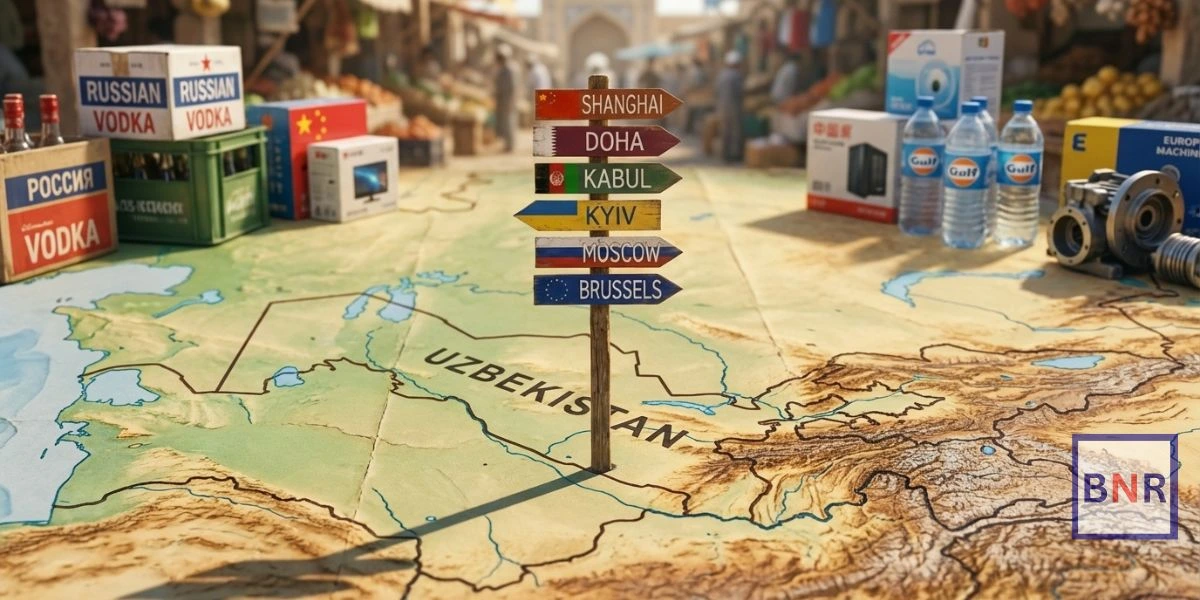
Somewhere between the sanctions lists of Washington, the infrastructure ledgers of Beijing, and the war dispatches from Kyiv, a landlocked Central Asian country has quietly made itself indispensable to all of them simultaneously without formally siding with any. That is not an accident. It is a strategy. And it may be the most consequential economic story in the world.
📌 Executive Brief
- The Strategy Uzbekistan has quietly made itself useful to every major power — Russia, China, the West, and the Gulf — without formally siding with any, turning constitutional neutrality into an economic superpower play.
- The Opportunity While the world’s attention is consumed by wars and trade disputes, Uzbekistan is capturing steel markets, Afghan trade routes, Chinese manufacturing overflow, and tech capital — all simultaneously, all compliantly.
- The Risk Every neutral that made itself indispensable — Switzerland, Singapore, Dubai — eventually faced the moment when one powerful ally called it complicity. Uzbekistan is not there yet, but the commerce it is enabling is quietly shortening that distance.
The Model That Made Empires
History’s most durable economic powers were rarely the strongest, but they were the most useful. Switzerland did not build an empire through military force – it built one through banking neutrality, becoming the vault of choice for capital that needed to move without a flag attached.
Singapore did not dominate global trade by virtue of size – it dominated by becoming the port that no supply chain could afford to bypass. Dubai did not inherit an airline empire – it engineered one by positioning itself as the layover between every hemisphere.
The strategic logic behind each of these transformations is identical: in a fragmented, rivalrous world, the most valuable geopolitical position is not strength but acceptability. The nation that every side can use and none can afford to alienate holds leverage that no aircraft carrier can project.
Uzbekistan has read this history carefully. And for the past decade, it has been executing this playbook precisely, with a discipline and patience that its geographic obscurity has allowed it to pursue unobserved.
Seven Roles, One Country
Uzbekistan, neutral by constitutional design, young by demographic reality, and meticulously pragmatic by governing philosophy, has, in the span of nearly a decade, transformed from a double-landlocked country into a land-linked one, threading itself into the logistical fabric of Europe, Asia, and South Asia simultaneously.
That repositioning has allowed Tashkent to occupy, at the same moment, seven distinct roles that would seem mutually contradictory if attempted by almost any other state: “A geopolitical transit corridor threading goods between sanctioned and unsanctioned economies. An industrial output machine whose steel carries none of the compliance flags attached to Russian or Chinese production. A tax shelter for technology capital, seeking a clean jurisdiction with zero corporate liability until 2040.
A target for Gulf venture capital looking for frontier-market returns. A shadow gateway into Afghanistan, one of the most commercially isolated consumer markets on earth. A carbon-compliance puzzle for Brussels, whose tariff instruments were not designed with Uzbek steel in mind. And now, a quiet but measurable lifeline threading goods and commercial relationships into a war-battered Ukraine.
No other country currently occupies all seven of these positions. Most could not sustain two of them without triggering a diplomatic rupture. Uzbekistan sustains all seven because its constitutional neutrality, combined with the deliberate absence of military alliances, provides each partner with the assurance that engagement carries no political contagion.
The Infrastructure Indispensability of Uzbekistan
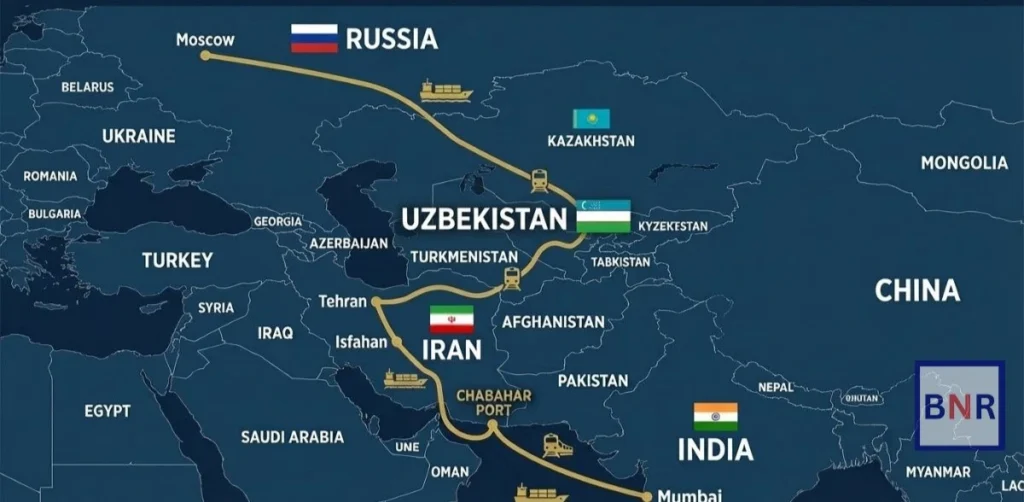
The physical architecture of this strategy is a multi-vector transport network being constructed, simultaneously, in every cardinal direction. This is not a metaphor – it is engineering.
Five corridors are at various stages of development, each providing a distinct routing option for international trade:
China–Kyrgyzstan–Uzbekistan–Turkmenistan–Iran–Turkey Corridor
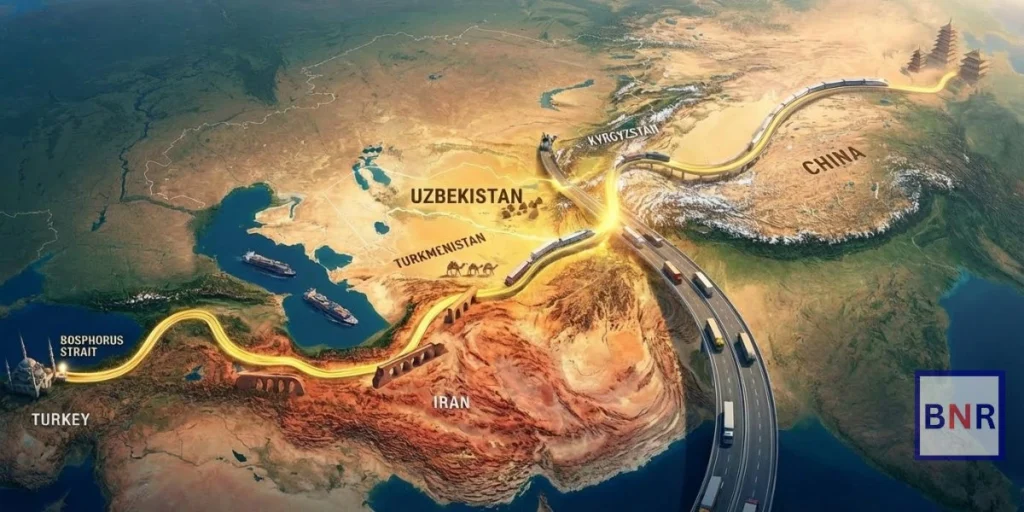
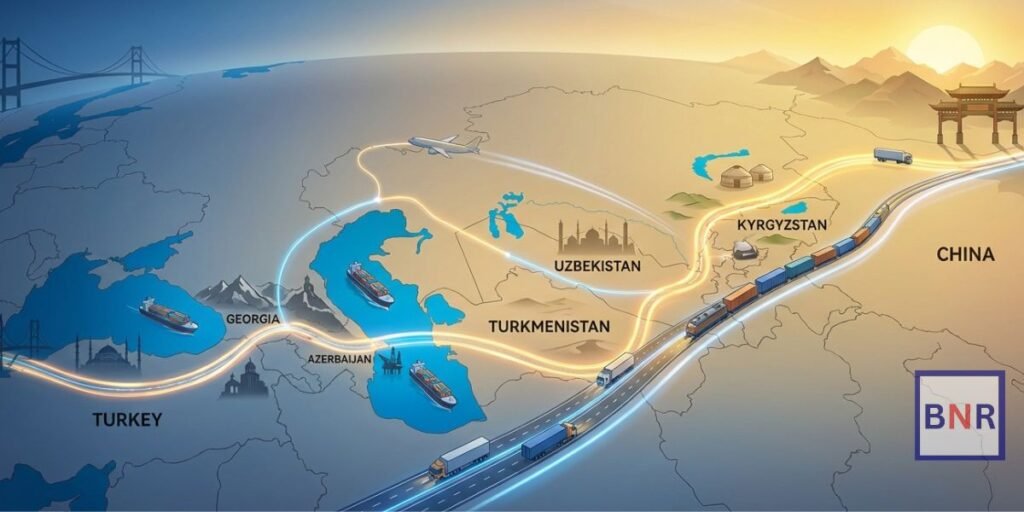
The CASCA+ Multimodal Corridor
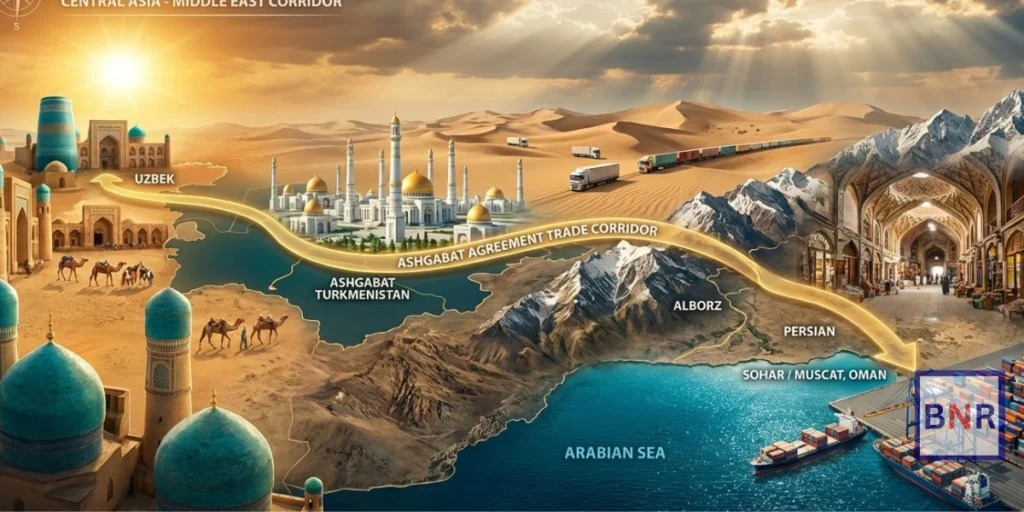
The Ashgabat Agreement Route (Uzbekistan–Turkmenistan–Iran–Oman)
Integration with Iranian Routes and the INSTC
The Belarus–Russia–Kazakhstan–Uzbekistan–Afghanistan–Pakistan Route
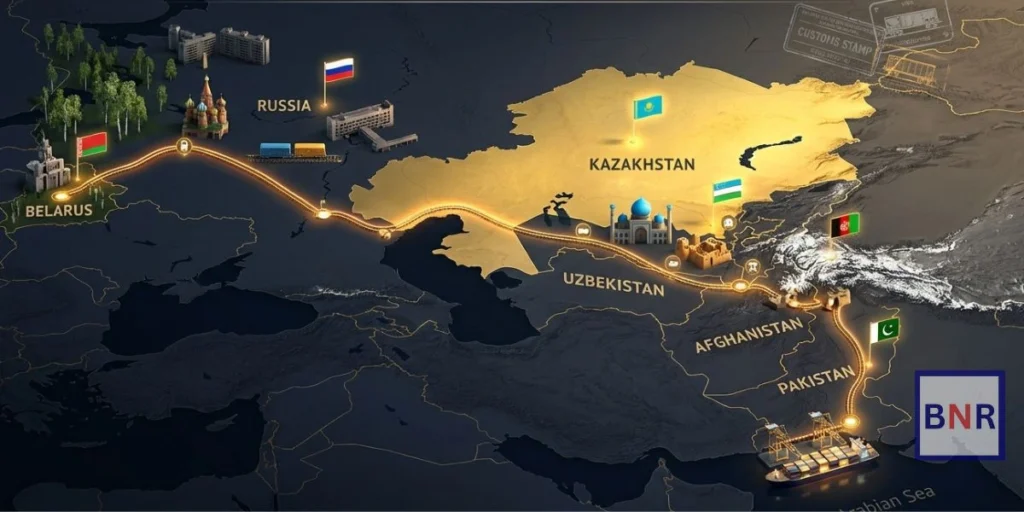
No single corridor needs to be fully operational for the strategy to work. Redundancy is the point. If one route is severed by conflict, sanctions, or political rupture — as the Strait of Hormuz threatens periodically to be, international freight can pivot immediately to another. The country that controls the pivot point controls the terms of the rerouting.
Tashkent has a name for this architecture’s end state: the Neutral Transit Corridor. It does not yet appear in the formal vocabulary of international logistics. It likely will.
Steel with No Compliance Flag
Uzbekistan’s industrial case is best understood through its metallurgical sector, which in January 2026 recorded 2.1-fold year-on-year growth, reaching 29.2 trillion soums in output — from a sector that had itself doubled in the preceding five years.
The commercial logic for a European buyer is counterintuitive but compelling. Uzbek steel is competitively priced and originates from a country with no functioning domestic carbon market. Importing it does trigger a carbon adjustment tariff under the EU’s Carbon Border Adjustment Mechanism. But that tariff, at current EU carbon prices, remains considerably smaller than the combined sanctions risk, logistics premium, and reputational exposure of sourcing from Russia — or the anti-dumping and geopolitical tariff risk of sourcing from China.
Uzbek steel, in other words, is not the cheapest option but the least expensive compliant one. In a procurement environment shaped by sanctions, ESG mandates, and reputational audits, that distinction has become worth a significant premium.
No anti-dumping duty. No sanctions exposure. No compliance flag. For a European procurement officer trying to explain a supply chain decision to a board, those three absences are worth more than the tonnage discount.
Afghanistan: The Captive Market
On March 28, 2026, the governor of Uzbekistan‘s Namangan Region landed in Kabul with a business delegation to formalize trade relations with Afghanistan. The timing was deliberate.
Uzbek dried fruits, confectionery, vegetable oils, and construction materials are positioned to reach one of the most commercially isolated consumer markets in the world, facing virtually no international competition, particularly following the conflict with Pakistan and the disruption of Middle Eastern supply routes. Where other exporters see sanctions exposure and reputational risk, Uzbekistan sees a captive market with no functioning alternative supplier and a shared border.
The move also serves a second purpose. Securing the Afghanistan route provides Uzbekistan with a southern transit option. Every formalised trade relationship with Kabul is simultaneously an insurance policy on the southern logistics network.
The Air Link, the Label, and the Limits
On March 30, 2026, China Eastern Airlines flight MU6037 touched down at Tashkent International Airport with 265 passengers. Official statements described it as a connectivity milestone, a Belt and Road achievement, a tourism opening.
The cargo arithmetic tells a different story. An Airbus A330-200 operating the Shanghai–Tashkent route has a belly cargo capacity of approximately 38 cubic meters and, after passenger and baggage loads, a payload allowance of between 8 and 12 tons per flight, depending on fuel load and passenger weight. At four flights per week, that translates conservatively to 1,600 to 2,500 tons of air freight capacity per month between China’s largest commercial city and Central Asia’s most rapidly industrializing economy.
The commercial context: China’s fast-fashion manufacturing sector accounts for roughly 65 percent of global garment production by volume. Now it is under simultaneous pressure from three directions: US and EU tariff escalations, ESG-driven brand decisions to exit China for reputational reasons, and domestic labor cost inflation, which has narrowed the factory-floor advantage that made Chinese production dominant for over two decades.
The response from some Chinese manufacturers is relocation of the final production stage, moving assembly to a jurisdiction whose export label carries none of the political or commercial toxicity of “Made in China” in Western retail markets.
Fabric rolls, zippers, synthetic components, and design samples from a Chinese supplier to an Uzbek assembly floor. The finished garment ships as “Made in Uzbekistan.”
The limit of this strategy is real and should not be understated. EU and US customs agencies maintain mechanisms specifically designed to detect origin-laundering – the routing of goods through a third country to misrepresent their manufacturing source.
These mechanisms have been refined considerably since the 2000s, and several major apparel sourcing investigations have originated precisely in Central Asian re-export patterns.
Whether Uzbekistan can scale textile assembly to a degree that satisfies rules-of-origin requirements rather than merely routing Chinese goods through Uzbek warehouses is the operational question the new air link makes urgent.
The Zero-Tax Jurisdiction
Uzbekistan’s IT Park, which provides full exemption from corporate tax, income tax, VAT, property tax, land tax, and customs duties till 2040, has expanded rapidly. By the end of 2025, more than 3,400 companies were operating within it, including over 970 enterprises with foreign capital participation. The country ranked second globally among startup ecosystems by growth rate, recording 132 percent expansion.
These numbers invite a structural observation that official releases phrase carefully around. A foreign-capital company registered in a zero-tax jurisdiction, with no mandatory public beneficial ownership disclosure and full exemption from every standard revenue-authority instrument, incorporated in a country with borders and supply-chain proximity to both Russia and China, offering a clean legal domicile and a compliant export label: this is, structurally, an offshore vehicle.
If it becomes a haven for untraceable capital from sanctioned neighbors, FATF gray-listing is the exact mechanism by which Western powers would issue the “ultimatum”.
The Ukraine Thread
The numbers, as always, are carefully phrased in every official release. Uzbekistan–Ukraine trade reached $35.4 million in January 2026 — up 14.2 percent year-on-year, and nearly double the $18.1 million recorded in January 2024. Ukraine remains among Uzbekistan’s top 20 trading partners.
These figures are small in absolute terms and significant in directional terms. They represent Uzbekistan, maintaining and expanding a commercial relationship with a country at war with one of its largest trading partners. That Tashkent has managed to increase trade with Kyiv without triggering retaliation from Moscow is perhaps the clearest single illustration of how precisely calibrated Uzbekistan’s neutrality has become. It is a balance that requires constant management, and its persistence across two years of escalating Russian economic pressure suggests that the management has been deliberate, not accidental.
Structural or Situational?
The critical question that no analyst has yet answered with the specificity it deserves is whether Uzbekistan’s leverage is structural or situational.
The situational case argues that Uzbekistan’s current position depends on a unique coincidence of external crises: a Russia under sanctions, a China under tariff pressure, an Afghanistan isolated from traditional suppliers, a Ukraine in need of alternative trade routes, Iran also in war, and a Middle East crisis. Resolve any one of these crises -Uzbekistan’s indispensability evaporates with it.
The structural case is more convincing. Uzbekistan’s geography does not change when the conflicts end. Uzbek constitutional neutrality is not a foreign policy posture that a new government can reverse without institutional cost – it is embedded in the legal architecture of the state. Its multi-vector transport corridors will still exist when the Russia–Ukraine war concludes, when US–China tensions stabilize, and when Gulf energy markets normalize. The infrastructure being built now is not contingent on the crises that accelerated its construction.
Tashkent’s total foreign trade turnover reached $5.8 billion in January 2026 alone, a 29.2 percent year-on-year growth generated across an economy that sits at the intersection of sanctions-hit Russia, globally isolated Afghanistan, war-battered Ukraine, and conflict-engulfed Iran, while itself remaining untouched by any of these crises.
The Navoi Free Economic Zone, where nationals from South Korea, Great Britain, Italy, China, the UAE, Singapore, and Russia conduct business simultaneously with no taxes and duties, is not a crisis product. It is an institutional design choice that predates and will outlast the current configuration of global tensions.
The leverage, in short, is structural. The crises have merely made it visible.
America Defends Old World — China Designs New
The Switzerland Moment
Uzbekistan’s economic trajectory is, by nearly every indicator, genuinely impressive and likely durable. But the risk it faces is the same risk that every Switzerland, every Singapore, every Dubai has eventually confronted.
There comes a moment for every indispensable neutral when being useful to everyone becomes, in the eyes of at least one powerful party, indistinguishable from being complicit with their enemy. Switzerland faced it during two world wars. Singapore faced it during periods of US–China decoupling pressure. Dubai faces it now.
Uzbekistan has not reached that moment yet. Its trade volumes are still small enough, and its diplomatic profile still low enough, that no major power has found it worth the political cost to issue an ultimatum.
In addition, domestic bottlenecks such as its historical vulnerability to winter energy shortages, water scarcity, or bureaucratic friction could also threaten its growth plans. Whether Uzbekistan manages to avoid that moment entirely or whether the weight of the commerce it is enabling quietly tips it across a line it did not intend to cross is the central tension at the heart of the most consequential business story in Central Asia that nobody has yet written.
