
⏱️ 4.5Mins Read
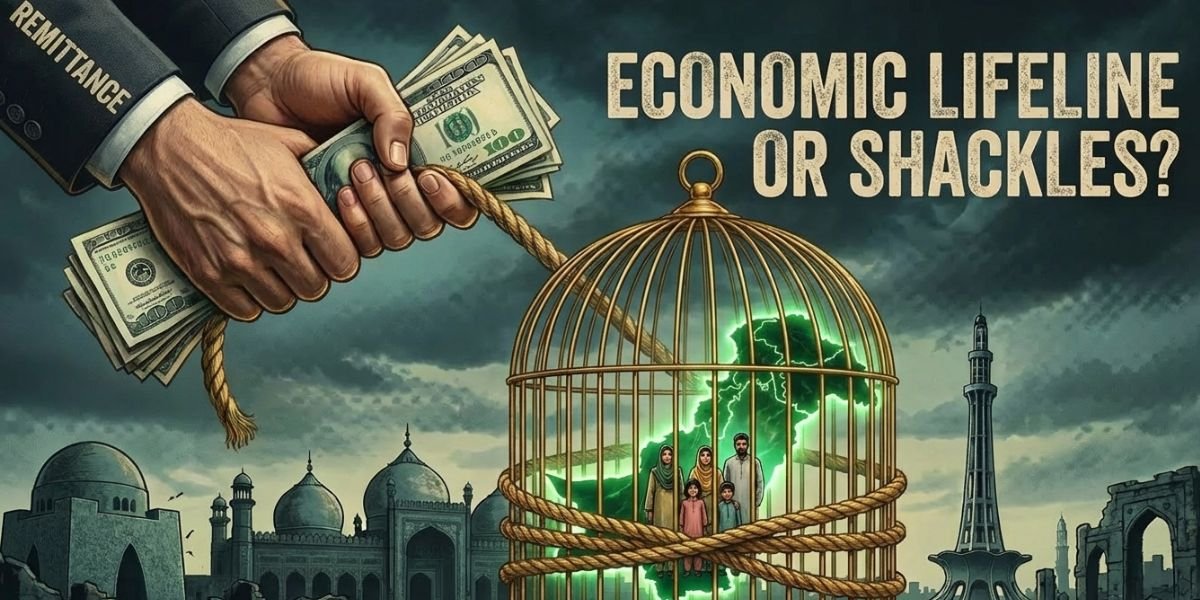
Remittances in Pakistan have become a life-support mechanism, financing the trade deficit and balance of payments, and fuelling a speculative real estate bubble.
In BeyondNewsReport, we explore how the Pakistani economy has been stuck in a remittances trap and explore the solution needed to break this economic cage.
📌 Executive Brief
- The Dependency Problem Pakistan’s remittances have ballooned to $38 billion — nearly 9% of GDP, making the country one of the world’s most remittance-dependent economies.
- The Historical Trap A policy choice made in the 1970s to export cheap labour to Gulf states instead of building industrial capacity set Pakistan on a path of structural dependency that persists five decades later.
- The Missed Opportunity: If just 15% of annual remittances were channelled, the economic multiplier effect could be transformative. Instead, Pakistan risks watching this lifeline slowly dry up as the emotional connection of second and third-generation diaspora to their homeland continues to fade.
The Dependency Trap
In Pakistan, remittances have consistently hovered between 8.5% and 9.4% of GDP for over a decade, reaching their peak at $38 billion in FY2024–25.
However, despite being the world’s largest recipient of remittances in absolute terms, India’s inflows contribute roughly 3.5% of its GDP, while Bangladesh’s stand at around 6% to 7%.
Remittances in Pakistan are considered one of the vital lifelines used to finance imports and to manage the trade deficit and balance of payments shortfalls, rather than utilizing them for productive capital formation.
How the Trap Was Set: The 1970s Origins
This economic cage was laid in the late 1970s during the Middle East oil boom under the Zulfiqar Ali Bhutto era, when the export of blue-collar labour to the Gulf region was recognised as an easy safety valve for high domestic unemployment — a choice that de-prioritized industrialization and export diversification in favour of remittance dependency, a pattern that largely persists to date.
The State Bank of Pakistan (SBP) internally views remittances as the primary shock absorber for the external account. If remittance flows dropped by just 20% in a single fiscal year — a loss of roughly $5.5 to $6 billion — Pakistan’s current account deficit would widen sharply, decreasing foreign reserves, forcing severe import compression, halting manufacturing supply chains, and potentially triggering an immediate currency devaluation and balance of payments crisis.
Several government policy choices have entrenched this dependency:
- Maintaining an overvalued Rupee for decades, which subsidized imported consumption funded by remittances, while killing export competitiveness.
- Successive tax amnesty schemes, which legally protect undocumented capital.
- A government scheme that heavily subsidizes telegraphic transfer (TT) costs to keep money in formal channels, costing the exchequer over Rs. 200 billion in recent years.
Dead Money: How Remittance Built a Real Estate Economy
The Pakistan Institute of Development Economics (PIDE) documented how remittances fuel real estate consumption, creating “dead capital” instead of industrial capacity, highlighting that “Over-regulation of the real estate sector discourages overseas investors and may cause a reduction of remittances in Pakistan.”
It suggests that over 40% of remittance savings are directly invested in the real estate and construction sector, while the rest is largely consumed to maintain daily lifestyles.
The Roshan Digital Account: Promise and Limits
The RDA successfully attracted over $8 billion by offering Naya Pakistan Certificates (NPCs) with sovereign-backed, tax-free yields of up to 7–8% in USD.
However, this represents expensive debt for the government. Moreover, inflows slowed when domestic political instability and default fears peaked, revealing that overseas Pakistanis’ trust is highly sensitive to macroeconomic stability.
A vast proportion of plots in housing schemes such as DHA, Bahria Town, and various so-called Smart Cities are bought by overseas Pakistanis.
According to Hasan Bakhshi, Chairman, Association of Builders and Developers (ABAD), Pakistan suffers a housing shortage of 12 million units. Yet plots worth millions sit empty for years and are being traded like commodities, but not built as homes.
Although Pakistani fintechs have successfully built payment infrastructure, the Roshan Digital Account is currently the only instrument that allows overseas Pakistanis to manage wealth in Pakistan and explore investment opportunities in the equity market and other asset classes.
Despite a severe crackdown by the FIA on Hawala/Hundi operators, these informal networks are still transacting in the billions annually due to the exchange rate premium and to avoid the scrutiny of the Federal Board of Revenue (FBR).
THE ROAD NOT TAKEN
If even 15% of annual remittances – approximately $5.7 billion were routed into sovereign-backed technology funds such as a Pakistan Emerging Technology and AI Fund or Pakistan Venture Funds, industrial zones, or renewable energy bonds, the multiplier effect would be transformative, generating employment, creating an exportable surplus, and reducing the trade deficit considerably.
Pakistan, being one of the top five largest recipients of remittances globally, is missing the opportunity to achieve sustainable economic growth by deploying these inflows toward non-productive ends.
Hundreds of highly successful tech founders of Pakistani origin are building companies in the US, UK, or UAE — driven in part by the SBP‘s historically restrictive foreign exchange repatriation rules and a lack of predictable contract enforcement.
Pakistan’s IT exports currently hover between $3 billion and $4 billion annually. The government has planned to exceed IT exports to $15 billion by 2030, but it could only be achieved if the capital of overseas Pakistanis and their talent had been systematically integrated into the local IT sector, similar to India’s Hyderabad or Bangalore models.
To achieve the $15 billion milestone, Pakistan needs to address its structural disadvantages: frequent internet disruptions, the widely criticized national firewall implementations of 2024–25, severe marine cable vulnerabilities, and the absence of Tier-4 data centers.
Structural Failures: Who Is Actually Responsible?
The Special Technology Zones (STZs) underperform because, instead of being developed as duty-free havens for server farms and R&D labs, they are often marketed as commercial real estate.
Responsibility is fatally fragmented among the Ministry of Overseas Pakistanis, the SBP, and the Board of Investment. No single entity is held strictly accountable to measurable KPIs for converting remittances into industrial or tech capital.
Behind closed doors, SBP and Ministry of Finance officials acknowledge: “We know real estate is a dead-end, but we need those monthly dollars just to pay for oil and debt payments. We don’t have the macroeconomic breathing room to lock that capital into 10-year venture funds.”
OpenAI’s IPO Dream at Risk as School Shooting Lawsuit Exposes AI’s Legal Blind Spot
The Clock Is Ticking
Pakistan has to break this debt-trap cycle with structural reforms, aggressive taxation on non-productive real estate to force capital into equities and tech, alongside judicial reform to secure the investors. Otherwise, the remittance life-support machine will inevitably begin to unplug itself as the emotional ties of the second and third generations of overseas Pakistanis are gradually fading.
