
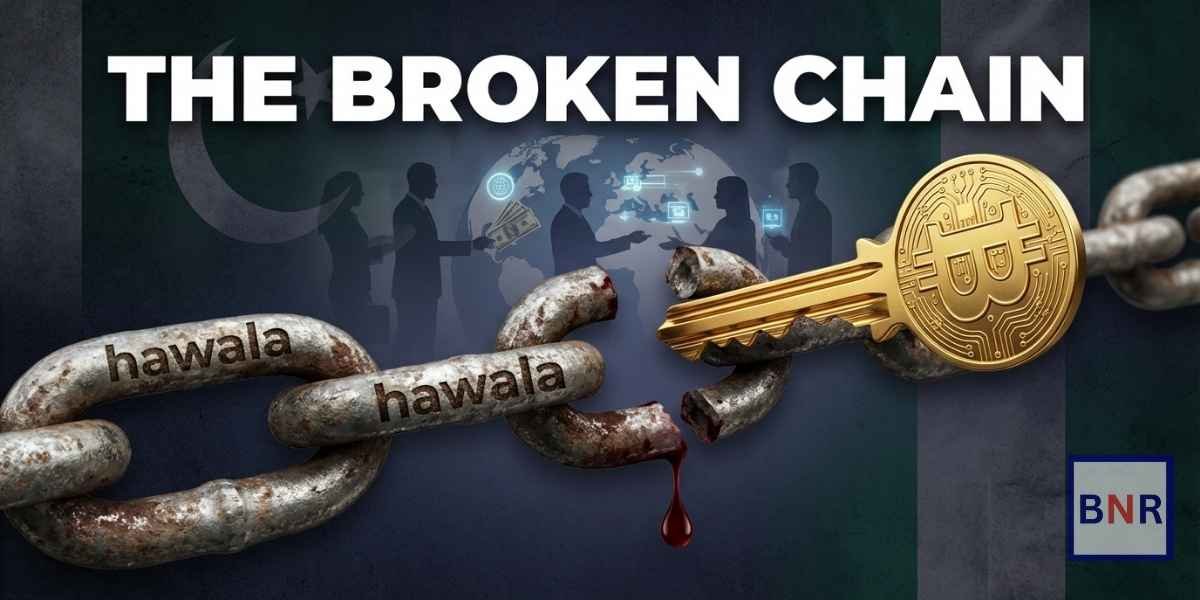
Nigeria didn’t kill hawala with police raids. It killed it with a better product. Pakistan has the users, the remittances, and the political will. All Islamabad has to do is read the Nigerian Crypto blueprint.
⏱️ 15 Mins Read
📌 Executive Brief
- The Multi-Billion Dollar Leak: Despite record formal remittances, Pakistan loses an estimated $7 billion annually to informal hawala networks.
- The Nigerian Blueprint: Facing a similar crisis, Nigeria successfully neutralized its underground remittance networks not through police raids, but by fully regulating stablecoins like USDT.
- The P2P Fraud Epidemic: Pakistan’s current regulatory vacuum has given rise to a devastating “bank chain dispute scam” on Peer-to-Peer (P2P) crypto platforms. Fraudulent buyers exploit banking loopholes to freeze the accounts of legitimate crypto sellers, leaving victims financially stripped and legally defenseless.
- The Terror Financing Threat: The traditional hawala system is rapidly evolving into an untraceable “digital hawala” powered by P2P crypto trading, providing a seamless corridor for capital flight, tax evasion, and the financing of outlawed networks without detection.
- The Solution for Islamabad: Pakistan already possesses the infrastructure and user base to adopt Nigeria’s model. By enacting clear legislation, enforcing KYC compliance, and empowering local fintechs like JazzCash and Easypaisa as regulated stablecoin off-ramps, the government could protect citizens and pull $7-10 billion back into the formal economy.
In one of the busiest shopping centres in Karachi’s Saddar area, a man receives a WhatsApp message having details of a factory worker in Dubai, along with contact details of his family member. Within two hours, the worker’s family living in North Nazimabad has collected cash – no bank account, no wire transfer, no government record. The transaction is complete, and the Hawala operator has done his job.
This is the story of almost every family that occasionally or regularly collects money sent by their family members working abroad.
Although the Roshaan Digital Account (RDA) is also an option, it is primarily used for investment purposes, not for monthly remittances. Hawala is an old and efficient way to send money from abroad, but it has serious economic and security consequences. Pakistani agencies have established many links where hawala money was used in terror financing.
Now, 6,000 km away in Lagos, Nigeria, equally incapacitated by illegal, untaxed, and ungoverned economic systems, a different model is taking shape.
Equipped with the world’s most aggressive stablecoin regulatory framework, Nigeria has done what Pakistani policymakers have so far been unable to accomplish through years of raids, seizures, and FATF compliance exercises.
This Nigerian stablecoin regulatory framework has made the formal financial system cheaper, faster, and more trustworthy than the informal one. As a result, Nigeria now leads the world in stablecoin ownership.
Why the Nigerian Diaspora abandoned Hawala
For years, a Nigerian working in Western countries faced two major hurdles when sending money home:
- Exorbitant Fees: Traditional remittance networks like Western Union or standard wire transfers often charge anywhere from 6% to 10% in fees for Sub-Saharan Africa.
- Exchange Rate Gap: Historically, Nigeria had a heavily managed currency. The official Central Bank of Nigeria (CBN) exchange rate for the Naira was artificially low compared to the parallel or black market rate.
If any Nigerian sent money through a bank, they lost money to fees and got a terrible exchange rate. As a result, the Nigerian diaspora relied on informal, Hawala-equivalent networks.
As a result, the central bank of Nigeria, which is among the top 10 remittance-receiving countries, lost billions of dollars in foreign exchange.
The Tech Shift: Stablecoins as Digital Hawala
As cryptocurrency matured, stablecoins like Tether (USDT) and USD Coin (USDC) perfectly solved the remittance problem for Nigeria. Now, a Nigerian, living abroad, can send USDT to their relative’s crypto wallet in seconds without a fee, if the transaction is made on the same blockchain.
The relative in Nigeria then goes to a licensed Virtual Asset Service Provider (VASP) to sell the USDT for Naira at the true, open-market exchange rate, and receives the funds in cash or their bank account. This became the new normal in Nigeria. According to the Women’s World Banking Organization, stablecoin transactions tied to Nigeria were over $22 billion.
The Policy Pivot: Regulating the Inevitable
Between 2021 and late 2023, the Central Bank of Nigeria (CBN) had an active ban prohibiting local banks from facilitating cryptocurrency transactions. This kept the massive stablecoin economy completely underground. However, in a major pragmatic shift in December 2023, the CBN officially lifted this ban. They recognized that outright prohibition was simply driving capital into the shadows.
The CBN issued new guidelines allowing banks to open accounts for Virtual Asset Service Providers (VASPs). Simultaneously, the Nigerian Security Exchange Commission began actively enforcing a regulatory framework to license these crypto exchanges.
The Result: Capturing the Invisible Remittances
This is where the “invisible” becomes “visible.” By providing a legal path for crypto exchanges to operate and connect to the banking system, Nigeria incentivized citizens to use regulated platforms rather than underground WhatsApp or Telegram brokers.
When a licensed exchange facilitates a stablecoin-to-Naira transaction, that data is logged. It is subject to Anti-Money Laundering (AML) and Know Your Customer (KYC) compliance. More importantly, the Central Bank can now see, quantify, and tax these massive inflows. By embracing stablecoins as a legitimate remittance rail, the Nigerian government essentially built a bridge between the blockchain and the traditional banking system, pulling billions of dollars of grassroots foreign exchange out of the black market and onto the country’s official books.
The Bleeding Wound
Pakistan is not Nigeria. But by and large, the economics are identical. The pain is identical, and the solution is sitting in Lagos, fully tested, waiting to be copied.
Nigeria didn’t kill hawala with police raids. It killed it with a better product. Pakistan has the users, the remittances, and the political will. All Islamabad has to do is read the blueprint.
Pakistan’s Remittance Economy — The Number Behind the Number
Pakistan’s official remittance story is, by any measure, a success. According to the SBP, the country received an unprecedented $38.3 billion in formal remittances during the fiscal year 2025 — a 26.6% surge over the previous year, placing Pakistan among the top five remittance-receiving countries.
These inflows have become, as economists frequently note, the true lifeline of Pakistan’s external accounts, dwarfing what the country painfully negotiates to borrow from the IMF or World Bank.
But embedded inside this headline is a hemorrhage that official statistics cannot capture.
Senator Salim Mandviwala informed that up to $8 billion per year is reportedly coming to Pakistan from the Hundi market.
This huge gap between what Pakistan formally receives and what it should receive represents serious economic and security issues. Every dollar that flows through a hawala is a dollar that authorities in Pakistan cannot monitor.
Why Hawala Despite Pakistan Remittance Initiative (PRI)
The government of Pakistan, to discourage its citizens from using hawala/hundi to transfer funds back to the homeland, introduced PRI. Under this initiative, Rs. 89.9 billion have been allocated for FY2025-26.
How it works: If money ($200 or more) is sent using a formal banking channel or any international money transfer operator, the transfer fee is paid by the government on behalf of the sender.
If the government is making formal transfers completely free under PRI, then hawala should theoretically be eradicated.
But, in reality, the hawala system is flourishing and processing billions of dollars annually.
1. The Exchange Rate Premium (The “Real” Fee)
In Pakistan, there is a gap between the interbank exchange rate and the open market rate, leaving room for hawala operators.
Despite a zero transfer fee under PRI, banks have a practice to convert foreign currency at the interbank exchange rate; however, hawala operators offer the open market rate.
For example, if the interbank rate is Rs 279 per dollar, but the open market rate is Rs 281, an overseas Pakistani sending $1000 makes an extra Rs 2000 just by using hawala. For a remittance-receiving Pakistani, that difference pays for two days of groceries.
2. The Undocumented Diaspora
Millions of Pakistani expatriates, particularly laborers in the Gulf countries or migrants in Europe, are undocumented, working in the gray economy, or have expired visas. They cannot pass strict Anti-Money Laundering (AML) and Know Your Customer (KYC) checks, along with income proof required to use a PRI-backed channel. However, there is no paperwork; send money to Pakistan through hawala.
3. Financial Exclusion & Doorstep Delivery
The rural areas of Pakistan have inadequate banking networks that force the family to travel to a city to receive money if it is sent through PRI-backed channels. However, hawala operators have deep, localized networks. They often physically deliver the cash directly to the recipient’s door within a few hours of the transaction being initiated abroad.
4. The Shadow Economy’s Thirst for Dollars
The hawala system isn’t just sustained by poor workers sending money home; it is heavily funded by wealthy Pakistanis and corrupt officials moving money out of the country. Hawala works on a matching system (trade without money movement).
- The Demand: A businessman in Karachi wants to buy property in Dubai or under-invoice imported goods to avoid customs duties. He hands the hawala dealer millions of Rupees in Karachi.
- The Supply: A laborer in Dubai wants to send money home. He hands the hawala dealer Dirhams in Dubai.
- The Settlement: The dealer uses the laborer’s Dirhams to fund the businessman’s Dubai property, and uses the businessman’s rupees to pay the laborer’s family in rural Pakistan. This whole money circle is widely known as the ‘Chamaak’ business in Pakistan, and local law enforcement agencies have found several established links of terror financing through this Chamaak business.
The capital flight, tax evasion, and smuggling create an endless demand for illegal transfer of foreign currency abroad, allowing hawala operators to flourish in their illicit money trade.
5. The Crypto Evolution (“Digital Hawala”)
While the government of Pakistan, despite taking several initiatives hanging in the balance to adopt crypto evolution aggressively, hawala operators have rapidly evolved into Peer-to-Peer (P2P) crypto trading.
A worker in any Western country can buy USDT (Tether) and instantly transfer it to a local dealer in Pakistan via a local WhatsApp group, and then the amount is physically sent in cash or through bank transfers as local currency. This digital evolution bypasses traditional law enforcement raids and offers instant, untraceable liquidity that formal banking channels simply cannot match.
The Terror Financing Corridor — Where Remittances Become Weapons
The hawala process that allows an overseas Pakistani to send money home also provides an opportunity for outlawed networks to move funds without detection. Intelligence agencies have documented extensively how hawala networks in the troubled regions are used to finance attacks on military and civilian targets.
Hawala operators are not aliens – they have societal acceptance due to their legitimate businesses. Sometimes you can find a goldsmith, a mobile phone shop owner, a gym owner, a forex trader, or importers or exporters as hawala operators because these legitimate businesses cover illicit money flows.
The P2P Scam That Has No Name
There is a financial crime taking place across Pakistan’s cities daily that has received almost no mainstream media coverage. It is methodical, technically sophisticated, and leaves its victims with no legal recourse. It is a direct product of the regulatory vacuum surrounding cryptocurrency, and it is destroying the savings of ordinary middle-class Pakistanis who have done nothing wrong.
It works like this. A Pakistani crypto holder — a teacher, a small business owner, a freelancer — posts an offer on crypto exchanges’ peer-to-peer trading platform to sell USDT. A buyer accepts the offer and transfers Pakistani rupees to the seller’s bank account. The seller, seeing the deposit confirmed, releases the USDT from escrow. The transaction appears complete. Then the buyer calls their bank.
They claim the transfer was made in error. They claim their account was compromised. They claim fraud. The bank, following standard operating procedure and with no way to verify the underlying crypto transaction, freezes the seller’s account and begins a reversal process. The USDT is gone. The rupees are gone.
The seller has lost on both sides of the transaction simultaneously. No USDT. No rupees. No legal recourse. And no regulator to call
What makes this crime particularly cruel is the position it places the victim in. Pakistan’s banks have no framework for recognising a crypto seller as a legitimate financial actor. The seller cannot walk into a branch and produce documentation proving they conducted a lawful crypto trade because, until recently, there was no legal definition of a lawful crypto trade. They cannot file a police report because the crime sits in a jurisdictional grey zone between cybercrime, banking fraud, and crypto regulation. They are financially and legally defenseless.
Why This Crime Only Exists Because of Regulatory Failure
The bank chain dispute scam is not a product of sophisticated criminality. It is a product of regulatory absence. In a properly structured crypto ecosystem — like the one Nigeria now operates — this crime is structurally impossible.
Under Nigeria’s framework, a retail user does not sell USDT directly to a stranger through a peer-to-peer platform and expose their personal bank account to a counterparty they have never met.
They sell USDT to a licensed Virtual Asset Service Provider (VASP) — a regulated exchange that has completed full KYC verification, holds government-issued operating licenses, and is legally recognized as a financial institution by the banking system. The exchange converts USDT to naira and deposits the proceeds. The user’s bank account receives a transfer from a licensed financial entity, not from an anonymous individual.
There is no fraudulent complaint mechanism available. The licensed exchange is not going to call the bank and claim the transaction was an error. The entire attack surface for the bank chain dispute scam disappears the moment regulated exchanges replace P2P as the primary conversion mechanism.
Every day that Pakistan delays building this framework, more citizens lose their savings to a crime that its own regulators could eliminate with a single legislative stroke.
The Nigerian Blueprint
It would be easy to assume that Nigeria arrived at its current position of global stablecoin leadership through a coherent, far-sighted policy program. The reality is more instructive. Nigeria got there by making the same mistakes Pakistan is making now and then, learning from them.
In February 2021, Nigeria’s Central Bank issued a directive banning all financial institutions from facilitating cryptocurrency transactions. The result was predictable and immediate.
Crypto trading did not stop. It went underground. A massive peer-to-peer trading economy emerged, operating outside any regulatory framework, with all the fraud, manipulation, and money laundering risks that entail. The CBN’s ban had achieved the opposite of its intended effect.
The correction began in December 2023, when the CBN reversed its ban and permitted banks to service licensed crypto entities. It was completed in March 2025, when President Bola Ahmed Tinubu signed the Investments and Securities Act (ISA) 2025 into law, the landmark legislation that permanently recognized digital assets as securities under the authority of Nigeria’s Securities and Exchange Commission.
The ISA 2025 did not simply legalize cryptocurrency. It built an entire regulatory architecture around it. Every entity wishing to operate as a Virtual Asset Service Provider (exchanges, custodians, brokerages, token issuers) must obtain an official SEC license.
Mandatory Know Your Customer and Anti-Money Laundering compliance became a legal requirement. Platforms were required to report suspicious transactions to Nigeria’s Financial Intelligence Unit. Ponzi schemes using digital assets were explicitly criminalized.
On January 1, 2026, Nigeria went further. The Nigeria Tax Administration Act 2025 came into full force, linking every cryptocurrency transaction to a Tax Identification Number and National Identification Number.
Every exchange must file monthly transaction reports with the Nigerian Revenue Service and retain records for seven years. Non-compliance triggers escalating financial penalties and, ultimately, license revocation.
The Numbers That Prove the Model Works
The results of Nigeria’s regulatory transformation are not theoretical. They are documented in transaction volumes that have made global financial analysts take notice.
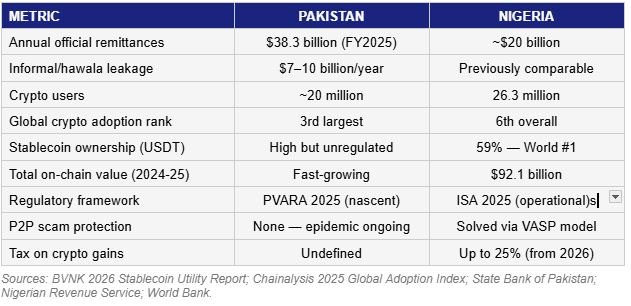
Between July 2024 and June 2025, Nigeria received over $92.1 billion in total on-chain cryptocurrency value, nearly triple South Africa’s volume. This is not speculative trading capital. Only 14% of Nigerian digital asset holders describe themselves as traders. The overwhelming majority use stablecoins for what Nigerian regulators describe as practical financial utility, savings preservation, remittances, everyday payments, and hedging against currency devaluation.
The stablecoin transfer fee comparison is perhaps the most commercially compelling argument. Traditional remittance channels charge 5% to 12% on transfers to sub-Saharan Africa, while the stablecoin transfers over regulated rails cost below 1% to 3% and settle in minutes.
This is the product that is destroying hawala in Nigeria. Not legislation. Not enforcement but pure economics.
The Pakistan Model — Three Wins In One Policy Move
Pakistan’s policy environment in 2026 is, for the first time, structurally capable of replicating Nigeria’s model. The Pakistan Virtual Assets Regulatory Authority, established under the Virtual Assets Ordinance 2025 and the Pakistan Crypto Council, has a mandate.
In January 2026, Pakistan signed a memorandum of understanding with World Liberty Financial to integrate a dollar-backed stablecoin into its cross-border payment infrastructure.
The infrastructure is being built, but what is missing is the legislative clarity and licensing framework that transforms these pieces into an operational ecosystem. Nigeria’s experience demonstrates that this gap can be closed in under 24 months once political will is committed.
This legislative clarity and licensing framework will help Pakistan to win simultaneously on three distinct fronts.
1. Capture the $7–10 Billion Hawala Leak
If overseas Pakistanis can send USDT or USDC directly to a licensed family wallet in Islamabad, Lahore, or Karachi, and that wallet converts instantly to PKR via JazzCash or Easypaisa at a nominal fee, the economic case for using a hawala system neutralizes completely.
The hawala operators charge comparable fees with no transparency or legal protection. However, a licensed stablecoin corridor at the same cost but with legal cover and no banking complexity is an objectively superior product.
The worker in Dubai does not choose hawala out of loyalty to informality. They choose it because nothing better exists. Build something better, and they will switch.
Nigeria proved this. Every billion recovered from the informal system represents foreign exchange reserves, tax base, and monetary policy visibility that Pakistan currently lacks.
2. Eradicate the P2P Fraud Trap and Protect Ordinary Traders
Under a Nigerian-style licensing model, the bank chain dispute scam structurally cannot exist. Individual traders would no longer sell USDT directly to anonymous counterparties and expose their personal bank accounts to fraudulent reversal claims.
Licensed exchanges recognized by the SBP as legitimate financial entities would serve as the sole conversion mechanism between stablecoins and PKR.
Banks would be legally required to recognize exchange-originated transfers as valid transactions. The entire attack surface for P2P fraud disappears overnight. Thousands of Pakistanis who have lost savings to this epidemic would be protected.
3. Cut Terrorist Financing Networks
The hawala system’s defining characteristic is the absence of a paper trail. Stablecoins’ defining characteristic when transacted through regulated, KYC-compliant, government-licensed exchanges is the permanent, immutable blockchain record.
A Pakistan modeled on Nigeria’s ISA 2025 framework, with mandatory TIN/CNIC linkage to every transaction, monthly reporting to the Financial Intelligence Unit (FIU), and real-time suspicious transaction alerts, would make it technically impossible to channel terrorist financing through the remittance system without creating a traceable record.
The troubled border hawala networks that currently move outlawed organizations’ operational funds, documented by both Pakistani intelligence and the United Nations Office on Drugs and Crime, depend entirely on the absence of documentation. Regulated stablecoin remittance corridors remove that advantage permanently.
The $40 Billion Business Opportunity That Pakistan’s Fintech Giants Are Missing
In the architecture of a regulated stablecoin remittance ecosystem, one category of business stands to benefit more than any other: the domestic payment gateway. JazzCash and Easypaisa are today used by millions of Pakistanis for domestic transfers, utility bills, and mobile top-ups.
With no licensed role, no regulatory protection, and no strategic position in the wider crypto ecosystem, they are already integrated into Binance’s P2P marketplace as payment methods. They operate passively in this capacity, facilitating the settlement of rupee transactions and have no role in monitoring reciprocating crypto transactions.
Under a Nigerian-style regulatory model, this changes categorically. Licensed payment gateways would become the nationally designated stablecoin off-ramp, the last mile of a $40 billion annual remittance corridor.
Every overseas Pakistani sending USDT home would funnel their conversion through a licensed domestic gateway. JazzCash and Easypaisa would not be passive facilitators of anonymous P2P trades. They would be regulated, fee-earning, government-recognized financial infrastructure processing billions of dollars in annual stablecoin-to-PKR conversion.
The business model transformation is from mobile wallet to national crypto bank. And the growth trajectory is not incremental but categorical.
Nigeria’s Yellow Card, which operates the equivalent function across twenty African countries, has seen stablecoins grow to represent 99% of its transaction volume. When the legal framework exists, volume follows. Pakistan’s payment gateways have the existing user base, the mobile infrastructure, the brand trust, and the government relationships to dominate this space the moment PVARA issues the first licensed VASP designation for domestic off-ramps.
The company that moves first — that builds a seamless, low-cost, legally-protected USDT-to-PKR conversion product before the regulatory framework is even finalized will own the market for a generation.
What Pakistan’s Government Must Do Now
Nigeria’s transformation from regulatory chaos to global stablecoin leader took approximately four years. Pakistan does not have four years, due to economic challenges, low foreign reserves, and an ever-changing geopolitical situation.
The Human Stakes
Behind the policy frameworks, the transaction volumes, and the regulatory framework are people.
The factory worker in Jeddah who sends 40,000 rupees home every month and pays 3,000 of them to a hawala operator due to the absence of a faster or cheaper licensed alternative.
Similarly, the freelance developer in Lahore who sold USDT on Binance P2P to pay his rent had his bank account frozen by a scammer’s fraudulent complaint, and spent three months unable to access his own salary while navigating a legal system that had no category for his situation.
The mother in Peshawar who receives remittances in cash from a shop operated by a hawala operator with no receipt, no record, and no evidence to initiate legal action in case of the hawala operator’s refusal to pay.
These are the people for whom Nigeria built its framework. These are the people for whom Pakistan has not yet built one.
The Blueprint Is In Lagos
In 2021, Nigeria’s Central Bank banned cryptocurrency and created chaos. By 2026, Nigeria will lead the world in stablecoin adoption, have captured billions in previously invisible remittances, have given its crypto traders legal protection, and have built a regulated digital asset economy that is the envy of the continent.
In 2025, Pakistan established PVARA, signed MOUs with Binance and World Liberty Financial, allocated electricity to Bitcoin mining, and ranked third globally in crypto adoption. It has the users. It has the remittances. It has political engagement. What it does not yet have is the courage to follow the blueprint through to completion.
The hawaladar in Saddar bazaar is not an enemy of Pakistan. He is a symptom of a system that has failed to offer anything better. Replace the system. Build the licensed exchanges. Empower local fintechs as regulated platform off-ramps. Link every transaction to a CNIC. Give the P2P fraud victim a legal category and a court to walk into. And watch the $10 billion that is currently invisible to Pakistan’s economy reappear on the State Bank’s balance sheet. Nigeria did it in four years. Pakistan, with better infrastructure, larger remittance volumes, and a regulatory body already in place, could do it in lesser timeframe.
