
⏱️ 3Mins Read
When the government of Pakistan slashed the fuel prices 2026 by Rs. 80 to Rs. 378.41 per litre on April 3 and termed it as an exceptional relief, however, the math remains uncalculated for the working class, who are still paying 43% more for fuel than they were just five weeks ago. The question is simple: Is there a way to bring sustainable relief to them?
📌 Executive Brief
- The Reality: The Rs. 80 petrol price cut is an illusion; the working class is still paying 43% more for fuel than five weeks ago.
- The Impact: Gig workers and lower-middle-income families are caught in a survival trap of rising costs and falling earnings.
- The Solution: A proposed targeted levy on vehicles over 1500cc could generate enough revenue to reduce overall petrol prices by up to Rs. 50 per litre, entirely within IMF parameters.
On April 2, 2026, the federal government surged petrol to Rs. 458.41 per litre and diesel to Rs. 520.35, following a global price surge. But under public pressure, the government on April 3, 2026, slashed the Petroleum Development Levy (PDL) by Rs. 80 and brought petrol down to Rs. 378.41.
However, the price remains 43% higher than it was five weeks ago, due to the ‘largest supply disruption’ in the history of the global fuel market, as declared by the International Energy Agency report.
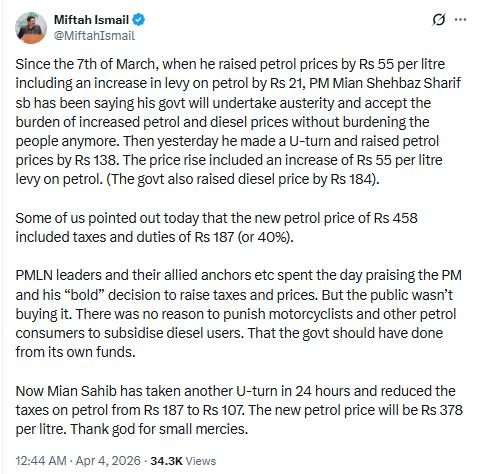
Miftah Ismail, former Finance Minister and Awaam Pakistan Party leader, criticized PM Shehbaz’s policy flip-flops, saying a Rs. 138 petrol hike to Rs. 458/litre on April 2 followed by a 24-hour U-turn that cut the PDL and reduced the price to Rs. 378, thanking God for small mercies.
Who Is The Actual Sufferer of Fuel Prices 2026
The World Bank publication stated that roughly 25% of the population in Pakistan lives below the poverty line. But the more relevant benchmark for understanding middle-class distress is the World Bank’s lower-middle-income threshold: $4.20 per person per day, or approximately Rs. 1,170. A household earning Rs. 3,000 to Rs. 5,000 daily, considered solidly middle income, is already in survival mode when transportation expenses, utility charges, and groceries alone consume the majority of that income.
The impact of the fuel price hike on gig economy workers is direct. Bykea, Pakistan’s largest domestic bike-hailing and delivery platform, has over 500,000 registered driver partners across its operational cities. Factor in InDrive and Yango, both of which are running bike-hailing, delivery, and four-wheeler services. The population of ride-hailing workers is conservatively in the hundreds of thousands.
A rickshaw driver or a motorcycle rider is now paying 43% more in fuel costs to maintain a household, while the higher prices are already suppressing ride and delivery demand. The equation is simple: pay more – earn less.
Even at the revised Rs. 378.41, the monthly fuel bill, assuming earnings of Rs. 2,000 per day and a daily consumption of two litres, sits at approximately Rs. 22,700, leaving approximately Rs. 37000 for other expenses, including rent, food, school fees, etc.
For the daily-wage factory worker commuting across Karachi on three diesel-driven bus routes, a fare increase is not an inconvenience. It is a choice between eating and showing up.
The Alternatives: What the Government Could Still Do
The government is operating under an IMF program that limits fiscal maneuver. But Adnan Mufti, Partner, Moore Shekha Mufti, argues that one option remains both viable and largely unexplored: a Special Levy on Luxury Vehicle Fuel.
The precedent was set on March 22, when Prime Minister Shehbaz Sharif announced to impose a Rs. 200 levy on high-octane fuel. The principle, Mufti said, was correct, but the execution was far too narrow.
“High-octane consumers are small in number,” Mufti said. “The far larger opportunity lies in vehicles above 1,500cc engine capacity, including SUVs, sedans, double-cabin pickups that run on regular petrol. These vehicle owners can easily absorb a special levy of Rs. 30 to Rs. 50 per litre. The revenue potential is significant,” Mufti said, estimating this broader levy would generate more than Rs. 9 billion, projected revenue from the high-octane revenue measure.
A Proposed Framework to Impose The Levy
Targeted Assessment: The levy applies exclusively to vehicles with an engine capacity over 1,500cc (including SUVs, sedans, and double-cabin pickups).
Fixed Monthly Quota: The tax is calculated as a fixed monthly levy based on a standard 50 litres of petrol consumption.
Automated Billing: Provincial excise authorities, working with traffic police, issue an automated e-ticket to the vehicle owner every month.
Strict Enforcement: The system operates under the same conditions as e-challans, ensuring compliance until the economic crisis stabilizes.
The result would allow the government to reduce overall petrol prices by up to Rs. 50 per litre with no net revenue loss and no requirement for a general subsidy, a measure fully within IMF program parameters, Mufti said.
Pakistan’s $38 Billion Remittance Trap: Economic Lifeline or Cage?
He also urged the provincial governments to introduce free public transport services on the same model as Islamabad to ease the financial burden on the working class. The options exist. The question is whether the government has the will to use them.
